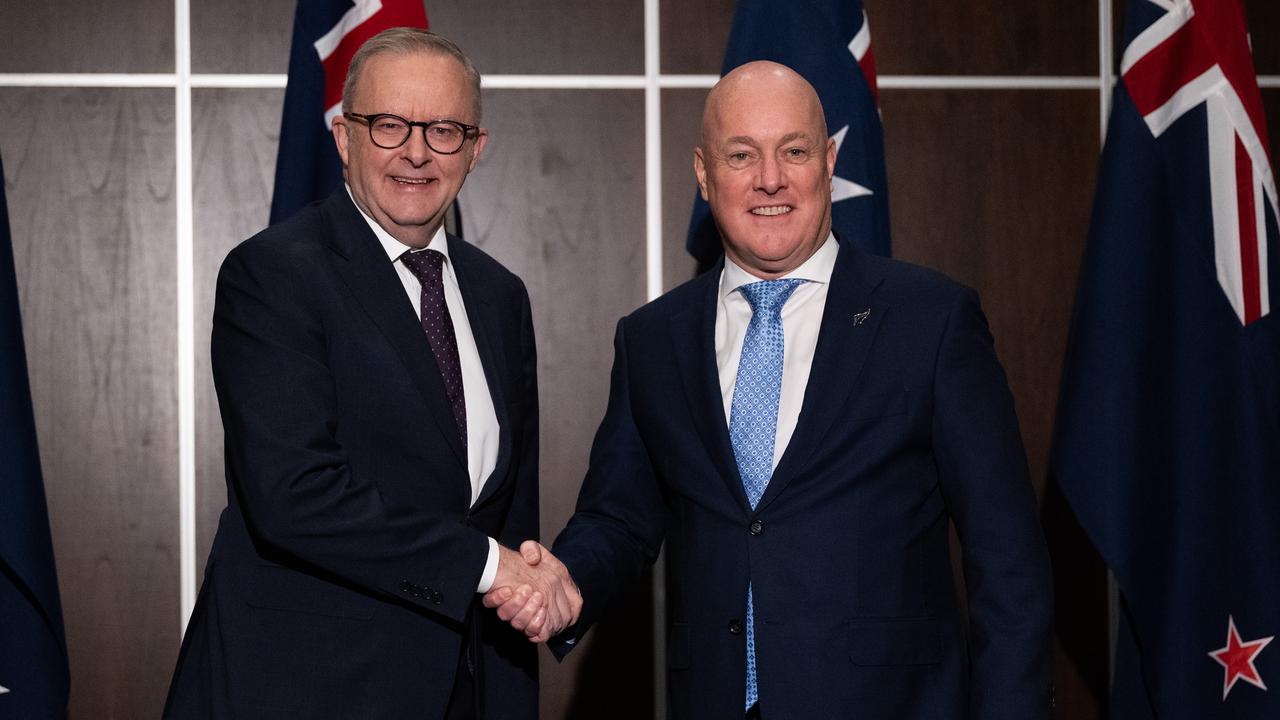
In a high-stakes bilateral meeting held in Noosa on Saturday, Australian Prime Minister Anthony Albanese and New Zealand Prime Minister Christopher Luxon moved to defuse fleeting speculation of cross-border tension, putting playful budget-related rivalry aside to sign a landmark new cooperation agreement set to deepen economic, security and strategic ties between the two nations.
The minor diplomatic stir emerged earlier this year after Australian Treasurer Jim Chalmers handed down the federal budget in May, which included a policy change to cut the 50% discount on the capital gains tax (CGT) concession for Australian businesses. New Zealand Finance Minister Nicola Willis quickly seized on the reform to pitch New Zealand as a more attractive destination for Australian entrepreneurs, saying in a public statement: “Australians looking to start or grow a business have an epic opportunity, and that opportunity is to do it in New Zealand.”
Willis highlighted New Zealand’s existing no CGT policy, simple low-rate broad-base tax system, accelerated depreciation rules and pro-growth, deregulatory government agenda as key draws for cross-border investment. But both prime ministers moved quickly last weekend to frame the comment as nothing more than lighthearted banter, not a serious attack on Australian domestic policy.
When asked about the exchange, Albanese laughed off any suggestion of lasting hostility, emphasizing the inherently playful nature of the decades-long trans-Tasman relationship. “We have a relationship which is often a bit tongue in cheek,” Albanese joked. “The Wahs (New Zealand Warriors), sign our players, but we have a few Kiwis in Australia too – 638,000 of them – or one in eight New Zealanders live here. It is a good relationship, occasionally there is a bit of cheekiness to the relationship and long may that continue.”
Luxon echoed that sentiment, noting Willis’ comments were made in the context of New Zealand’s domestic political debate and had been taken out of context. “Her comments were really in the context of that debate domestically rather than commenting on the CGT here in Australia,” Luxon explained. “The Prime Minister covered it, it was done in good humour and yes it was cheeky, but what is important is we don’t comment on each other’s domestic economic policies because there are different contexts and history and she didn’t do that.”
Beyond clearing up the minor rivalry, the core outcome of the meeting was the signing of a new bilateral agreement that lays out eight concrete policy actions designed to boost economic productivity for both nations. Luxon outlined that the deal will not only keep the two countries’ longstanding defence partnership adaptive to modern geopolitical challenges, but also deepen joint cooperation with Pacific island neighbors, strengthen technology-driven security and economic resilience, and expand trans-Tasman scientific research collaboration.
A key highlight of the new agreement is the opening of new opportunities for New Zealand businesses to bid on major infrastructure projects tied to the 2032 Brisbane Olympic Games, a development expected to lift tourism and infrastructure profiles across both countries. Luxon had already held separate talks with Brisbane 2032 Olympic Committee leaders earlier to advance New Zealand industry participation in the massive infrastructure overhaul underway for the Games. That overhaul includes a new $3.8 billion, 63,000-seat stadium in Victoria Park, major upgrades to existing sporting venues including The Gabba, the Queensland Tennis Centre and Netball Centre, and the National Aquatic Centre, alongside public transit upgrades to the Brisbane Metro and new green river crossing projects.
Albanese emphasized that the deepened partnership comes at a critical moment, amid widespread global political and economic volatility that makes close regional cooperation more important than ever. He called the meeting one of the most productive bilateral engagements of his prime ministership, noting that extensive pre-meeting preparation ensured the talks delivered tangible outcomes. “We’re very sharp, and a lot of work went into the preparation, clearly, to make sure it was a very effective use of our time,” he said.
The meeting underscores the enduring closeness of the trans-Tasman economic relationship: Australia is New Zealand’s third-largest trading partner, while New Zealand ranks as Australia’s seventh-largest. As of 2025, two-way investment between the two countries totals $308 billion, while annual two-way trade in goods and services surpassed $38 billion, making the partnership one of the most economically significant for both nations.