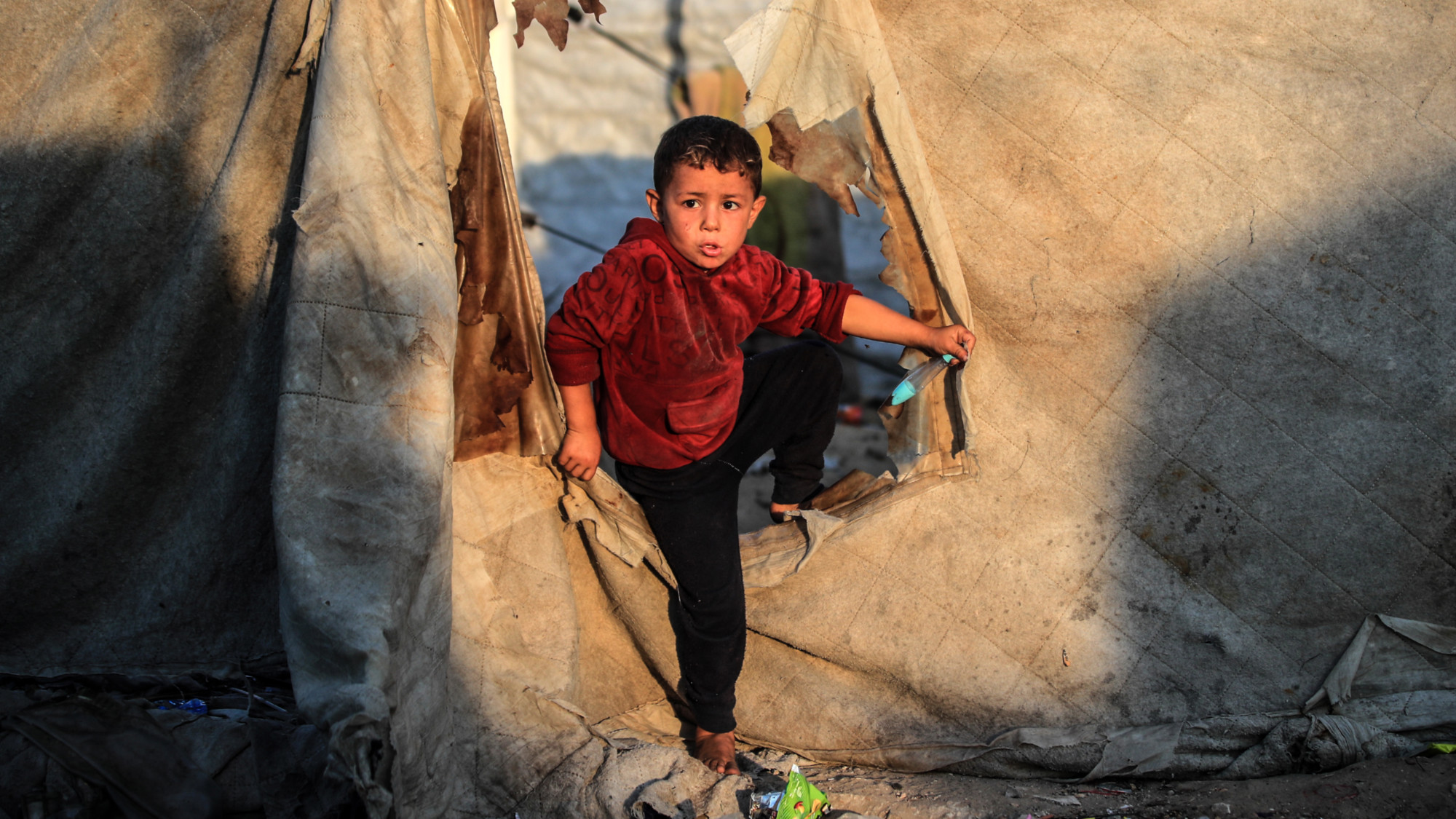
For three Palestinian siblings in Gaza, a nomadic, unmoored routine now defines every stretch of their young lives: 16-year-old Mariam, 14-year-old Aya, and 12-year-old Jebril Abu Asser rotate between the makeshift tents of their maternal aunts, staying exactly two nights at each relative’s shelter before moving on. This uncertain pattern began just weeks after the October 2025 ceasefire took effect, when an Israeli bomb struck the temporary Deir al-Balah tent where the children had been taking refuge with their mother, Islam, killing her instantly as the three watched. The siblings’ history of loss stretches back far earlier: their father was killed during Israel’s 2014 military offensive on Gaza, and their original Gaza City home was completely destroyed in the large-scale Israeli military campaign that launched in October 2023. Jebril, the youngest, was curled in his mother’s lap when the ordnance hit, sustaining injuries of his own alongside the unshakable trauma of witnessing her death. The three siblings are far from isolated cases. Official data from Gaza’s Ministry of Social Development confirms that since the 2023 military campaign began, a staggering 54,468 Gazan children have lost at least one parent, with thousands more joining that tally in the months following the 2025 ceasefire. The two aunts who share care of the Abu Asser children are already navigating their own crippling hardship: both are widowed, their husbands killed in the same ongoing military campaign, and each is already struggling to feed their own biological children without stable employment or consistent income. Family member Warda al-Muzeini, one of the widowed aunts caring for the orphans, explained to Middle East Eye that the children split their time between their paternal grandmother’s tent and the small shelters of their three maternal aunts, with no permanent, stable home to call their own. The three sisters pool their limited resources to support the five extra children in their care, taking turns purchasing clothing, small essentials, and tiny amounts of pocket money whenever they can scrape together the funds. Official aggregated figures paint a grim picture of widespread bereavement across the Gaza Strip: the territory is now home to a minimum of 64,000 widows and 71,000 orphaned children, a count that includes people who lost loved ones in the 2023 conflict as well as survivors of earlier Israeli military operations in the enclave. Roughly 3,000 of these orphaned children have no registered legal guardian, custodian, or caregiver of any kind, leaving them entirely adrift amid the widespread devastation. Aziza al-Kahlout, a spokesperson for Gaza’s Ministry of Social Development, warned that these cold statistics fail to capture the unrelenting daily trauma facing bereaved children and widowed women. For orphaned children, the loss of a parent is not just an emotional blow: it robs them of safety, access to education, and the very chance to experience a normal childhood, forcing many to take on backbreaking adult responsibilities long before they are emotionally or physically ready. Widowed women, meanwhile, carry a crippling double burden: they must act as their family’s sole breadwinner while also raising their children amid shattered infrastructure, widespread food insecurity, and a total lack of basic public services. Kahlout flagged that worsening economic collapse and the absence of adequate shelter are driving a sharp, deeply worrying spike in child labour, school dropouts, and underage early marriages among vulnerable orphaned populations. For a small subset of these orphaned children, the grief carries an extra, isolating cruelty: they are the sole surviving members of their entire immediate family, left to process the total erasure of their loved ones with no one to share their memories or their pain. Thirteen-year-old Wafaa al-Attar is one of these survivors. In February 2024, when she was just 10 years old, Wafaa stepped out of her family’s Deir al-Balah apartment to charge her father’s dead mobile phone at her uncle’s nearby home, where solar power was still available. Seconds before she stepped through her uncle’s door, a massive Israeli air strike levelled the multi-storey building where her entire family had been sheltering, killing her parents and her four younger siblings – the youngest of whom was only nine months old. Wafaa sustained minor shrapnel wounds in the blast, and spent hours in the local hospital before her uncle broke the devastating news that no member of her immediate family had survived. For months after the attack, Wafaa struggled to process the magnitude of her loss, repeatedly wishing she had stayed inside the home so she could have died alongside her family rather than living on alone. Though she eventually found refuge with her uncle and his growing family, who offered her steady emotional support and encouraged her to stay strong, she says the empty space left by her murdered relatives can never be filled. “No one could ever replace my own family,” she told Middle East Eye, still carrying the quiet, unshakable weight of losing every person she once loved in a single, unthinkable instant.