The distant wail of air raid sirens hung over Kyiv this week as mourners gathered to bury 12-year-old Liubava and 17-year-old Vira, two sisters whose lives were cut short in one of the deadliest Russian aerial strikes of the ongoing war. The pair were among 24 civilians killed when a Russian missile turned their apartment building into rubble earlier this month. They had already lost their father to combat on the front line, leaving their grief-stricken mother as the only surviving member of their family.
This devastating loss underscores the brutal human toll of Russia’s largest continuous aerial campaign against Ukraine to date, which saw more than 1,500 drones and 56 missiles launched across Ukrainian territory in just 48 hours. But officials say the death toll would have been far higher without marked improvements in Ukraine’s air defense capabilities. According to Ukrainian President Volodymyr Zelensky, Ukrainian forces successfully intercepted 94% of the long-range drones and 73% of the missiles fired in that assault – a sharp improvement from the 55% interception rate recorded in a nationwide strike back in May 2025. Ukraine, it is clear, is rapidly growing more effective at protecting its skies.
“Unfortunately for us, we are now the best in the world at this,” noted Lieutenant Colonel Yuriy Myronenko, an inspector general with Ukraine’s Ministry of Defence. He did, however, acknowledge that intercepting Russia’s ballistic missiles remains a particularly daunting challenge.
More than four years into Russia’s full-scale invasion, Ukraine has built an increasingly advanced, layered air defense network that blends Western-supplied systems with innovative domestic development. At the outbreak of the full-scale war, Ukraine relied heavily on aging Soviet-era weaponry. Western partners later bolstered its defenses with high-end, costly systems including Patriot air defense missiles. But alongside imported systems, Ukraine has poured resources into homegrown solutions, ranging from mobile machine gun teams mounted on trucks to low-cost, mass-produced interceptor drones.
Homegrown technological innovation has emerged as a key advantage for Ukraine’s air defense campaign. At the core of the country’s integrated network is Sky Map, a proprietary tracking software that monitors every glide bomb, missile and drone launched by Russian forces. The platform combines data from radar arrays, thousands of ground sensors, real-time video feeds and artificial intelligence to detect incoming threats and redirect air defense assets to intercept them. In the early days of the war, Ukraine relied on a jerry-rigged network of mobile phones mounted on telephone poles to detect the distinctive engine sound of approaching Russian drones. Today, the system relies on far more sophisticated sensors, and its effectiveness has even drawn international interest: the U.S. military now uses Sky Map to protect one of its major bases in the Middle East.
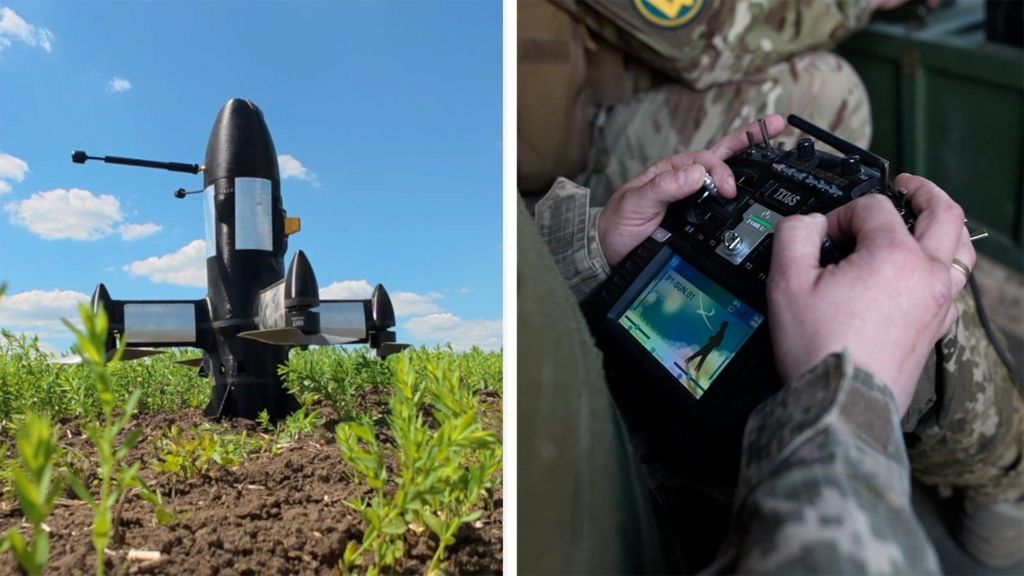
But the workhorse of Ukraine’s counter-drone campaign is one simple, low-cost domestic innovation: domestically built interceptor drones. Among the most effective of these is the P1-SUN, a bullet-shaped interceptor powered by four base rotors that Ukraine now produces at an unprecedented scale of more than 1,000 units per day. According to Ukrainian air force data, these interceptor drones destroyed more than 30,000 Russian attack drones in March alone.
In a field outside the southern city of Kherson, Ukraine’s Marine Corps Unmanned Systems Regiment recently demonstrated the P1-SUN’s capabilities. Launched from a static position, the interceptor can hit speeds in excess of 300km/h (186mph) with an operational range of more than 30km. The unit had just returned from a successful mission intercepting incoming Russian drones when they demonstrated the system.
Welkos, the regiment’s commander, described the P1-SUN as a “very serious weapon.” “It shows how quickly we can adapt, how we can hold the line and how much we can develop even amid ongoing war,” he said. What makes the P1-SUN particularly revolutionary is its low cost: the 3D-printed interceptor costs roughly $1,000 (£750) to build, a tiny fraction of the $50,000 price tag of the Iranian-made Shahed one-way attack drones it is designed to destroy.
Ukraine’s domestic air defense effort has also tapped into the resources of the country’s private sector, with dozens of local companies joining a coordinated national initiative. “We need to cover all of Ukraine and track every incoming target, so we use every resource we have available,” Myronenko, who oversees the public-private partnership program, explained. For private companies, the incentive is clear: defending civilian and industrial infrastructure directly protects their own operations and workforces, after repeated Russian strikes on energy infrastructure left millions of Ukrainians without power during past winter months. So far, 25 companies have signed on to the program.
One of the participating firms, Carmine Sky, now provides air defense coverage for other private sector clients across northeastern Ukraine. The company has already built a network of defensive towers fitted with remotely operated machine guns in the Kharkiv region, just kilometers from the Russian border. During a visit to the company’s underground control room, rows of monitors display the Sky Map tracking feed as it plots the position of Russian drones and jets across the region. Most of the operators manning the screens are ordinary civilians – working mothers, former taxi drivers, and military veterans – who have completed a multi-week vetting and training program before taking up their posts.
Ruslan, a spokesman for Carmine Sky, said the work is surprisingly straightforward. Operating the remote-controlled guns to shoot down incoming drones “is just like a computer game – like playing Xbox or PlayStation,” he explained. Ruslan emphasized that private participants act strictly as a complement to state-run air defenses, not independent actors. “We are fully integrated into the military command structure,” he said. “This is not the Wild West; we follow all military instructions and commands.” He added that private participation brings a key benefit: private companies can scale up defensive capabilities far faster than government bureaucracies can. Though the program is still in its early stages, private air defense teams have already shot down dozens of Russian drones.
Alongside improving its defensive capabilities, Ukraine has ramped up its own long-range strikes on Russian territory. Recent Ukrainian attacks have sparked massive infernos at oil refineries across Russia and reached deep into major Russian cities including Moscow and St. Petersburg. The strikes have even forced the Kremlin to scale back its annual May Victory Day parade over fears of an attack.
The rapid innovation on Ukraine’s side has spurred an arms race of sorts, with Russia also rushing to develop new aerial technologies to gain an edge. Russia has begun deploying faster jet-powered attack drones and uses decoy drones to bait Ukrainian air defenses into revealing their positions.
Even with these advances, critical gaps remain in Ukraine’s air defense network. At the high end, Ukraine still faces a shortage of the advanced, expensive Patriot missiles that are currently the only proven effective defense against Russian ballistic missiles. Global supply chains have been strained by ongoing conflicts in other regions, leaving Ukraine struggling to secure enough of the systems it needs. Along the front line, both sides have struggled to counter the threat of small, first-person-view (FPV) drones, which are operated remotely by Russian forces and remain one of the leading causes of infantry casualties on the Ukrainian side. Even with all the latest technological advances, basic defensive measures like roadside netting, rifles and shotguns still serve as the last line of defense against these small, agile threats.
Defending Ukraine’s skies will remain an enormous challenge. Zelensky has warned that Russia’s strategy of mass aerial strikes is explicitly designed to overwhelm Ukrainian air defenses by sheer force of numbers. When hundreds of drones and dozens of missiles are launched in a single 48-hour window, it is inevitable that some will get through – meaning more families will face the same unthinkable grief that left Lyubava and Vira’s mother the only survivor of her family.