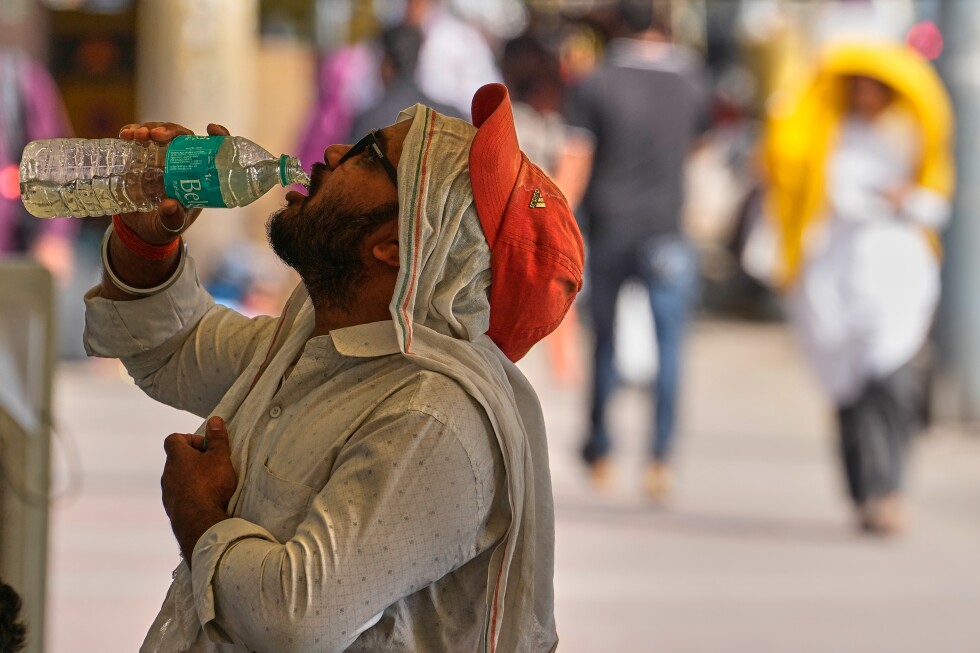
A brutal, record-breaking heat wave has settled over large swathes of northern India, forcing widespread shifts to daily routines, pushing authorities to activate emergency cooling measures, and highlighting the growing risks of climate change-driven extreme weather in South Asia.
By midday across affected regions, city streets and local marketplaces stand nearly empty. As daytime temperatures climb to life-threatening levels, many workers have restructured their schedules to avoid the worst of the heat. Farmers, whose livelihoods depend on working the land, have moved their planting, harvesting and field maintenance to overnight hours, while small traders have shifted operations to the cool early morning before temperatures spike.
India’s national meteorological service forecasts that Thursday’s high temperature in the capital New Delhi will hit roughly 45 degrees Celsius, or 113 degrees Fahrenheit. The department has warned that the anomalous hot conditions will persist for at least several more days across multiple northern states, with temperatures holding far above long-term seasonal averages for this time of year. Local officials have issued repeated public advisories urging residents to remain indoors during the hottest afternoon window, and to take proactive precautions to avoid heat exhaustion and other heat-linked illnesses.
In India, heat waves are officially classified when temperatures rise above 40 degrees Celsius (104 Fahrenheit) in low-elevation plain regions, and above 30 degrees Celsius (86 Fahrenheit) in the country’s hilly northern and northeastern areas. This current event far exceeds those thresholds across most of the affected zone: on Tuesday, the northern city of Banda recorded a maximum temperature of 48.2 degrees Celsius, or 118.8 Fahrenheit. That reading prompted local education authorities to end the spring school term early and suspend classes, pushing forward the start of summer vacation to protect student health.
To provide emergency relief for unhoused residents, commuters and visitors, New Delhi authorities have set up dozens of temporary cooling zones across the capital. These shaded shelters are equipped with air coolers, circulating fans, free drinking water and oral rehydration solution to help people combat dehydration and overheating. On Wednesday, dozens of people rested inside one central tent, sitting near running coolers as staff distributed salt-infused rehydration drinks. “We came here for a trip, but the heat was far worse than we expected. This cooling station has been a lifesaver for us,” said 25-year-old tourist Basharat Ahmad Malla.
Climate researchers confirm that this extreme heat event is part of a long-term warming trend driven by anthropogenic, or human-caused, climate change. India has seen a sharp increase in the frequency and intensity of heat waves over the last decade, and every one of the country’s 10 warmest years on record has occurred since 2014. “India has warmed dramatically over the last 10 years as a result of human-caused climate change, and the northwestern part of the country is warming much faster than most other regions,” explained Anjal Prakash, a contributing author to United Nations climate assessments and professor of public policy at Pune’s Flame University.
Prakash noted that while India is no stranger to hot summer weather, climate change is dramatically increasing the odds of extreme, widespread heat events like the current one. “Climate change is loading the dice towards extreme and pervasive episodes like those we see now,” he said.
Public health data underscores the deadly toll of these repeated heat waves. Research conducted between 2008 and 2019 found that an average of 1,116 heat-linked deaths are officially recorded each year in India. But public health experts warn the true annual death toll is likely far higher, in the thousands, because heat is rarely listed as a primary cause of death on official death certificates, leaving many fatalities uncounted in government statistics.
This report includes contributions from Associated Press journalists Biswajeet Banerjee based in Lucknow, Piyush Nagpal in New Delhi, and Sibi Arasu in Bengaluru.