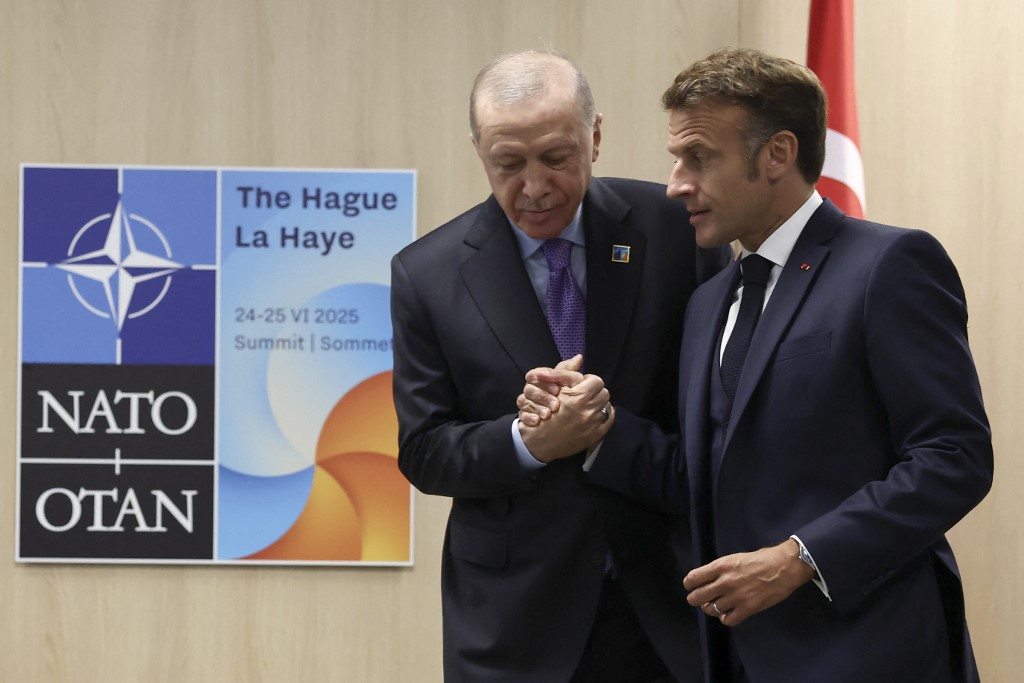
During a high-profile October press conference in Cairo focused on a Gaza ceasefire deal, a small but symbolic moment laid bare a quiet shift in geopolitics. As U.S. President Donald Trump gathered regional and European leaders to stand behind him for photos, French President Emmanuel Macron rejected the role of a backdrop prop. Instead, he invited Turkish President Recep Tayyip Erdoğan to join him at a table in the audience – an arrangement the 72-year-old Turkish leader readily accepted.
This quiet act of defiance against the U.S.-led event staging capped years of frosty relations between Paris and Ankara, and it may signal the start of a new chapter for the two NATO allies, multiple sources with knowledge of internal negotiations told Middle East Eye. For years, the pair have been locked in bitter disagreements over the Syrian civil war, the Nagorno-Karabakh conflict between Armenia and Azerbaijan, and competing territorial claims in the Eastern Mediterranean. Today, shifting global alignments and overlapping security interests have created unprecedented momentum for a full reset.
“France is envisaging the future of European security with Turkey as one of its pillars,” one senior Western source close to diplomatic talks explained.
This potential new partnership is not happening in isolation. It comes amid a noticeable cooling of relations between Turkey and Russia, a shift that has not gone unnoticed in Paris. There have been no bilateral presidential visits between Ankara and Moscow since 2023, and the frequency of high-level engagements between Erdoğan and Russian President Vladimir Putin has dropped sharply. Turkey has also increasingly aligned with Western sanctions regimes targeting Moscow, and it has declined to renew its long-term major natural gas purchase agreements with Russia.
Gerard Araud, a former French ambassador, said many French policymakers have been impressed by Turkey’s deft navigation of the war in Ukraine. “Turkey has succeeded in antagonising almost no one while, at the same time, effectively siding with Kyiv,” he noted. Araud argued that as France prepares for long-term Russian pressure on the continent, Ankara has emerged as a critical geopolitical player. “We think that in Paris there is a strong feeling that, on one side, the Americans are gradually reducing their security commitments to Europe; that whoever is elected in the 2028 U.S. presidential election, we will not return to the close transatlantic security cooperation of the past,” he explained. “We will be facing Russian pressure. And in this equation, I think Turkey is obviously an important factor.”
Overlapping regional priorities further underpin the push for closer ties. In Syria, both France and Turkey have thrown their support behind interim President Ahmed al-Sharaa’s new administration. In Lebanon, both countries back the creation of a strong central government and oppose aggressive Israeli military actions in the country. On the Iranian nuclear file and regional tensions surrounding Tehran, both Paris and Ankara favor a negotiated peaceful resolution. As Israel adopts an increasingly hardline stance toward Turkey, it has also sparked repeated diplomatic crises with France over Lebanon, reinforcing shared interests between the two countries.
Beyond geopolitics, a major partnership in the defence and arms industry is emerging as a cornerstone of the reset. Last week, Turkish Defence Minister Yasar Guler confirmed Ankara is deeply interested in purchasing SAMP/T air defence systems, manufactured by a French-Italian defence consortium. For years, Paris blocked the sale over political tensions and disagreements over Ankara’s demand for joint production rights. But intelligence outlet Intelligence Online reported in May that Macron has ordered a full review of the SAMP/T deal to find ways to accommodate Turkish co-production demands, ahead of his planned visit to Ankara for next week’s NATO summit. Senior French diplomat Alice Rufo, a recent member of Macron’s inner circle, has already traveled to Ankara to hold talks with top Turkish defence officials, boosting expectations that an agreement could be announced during the summit.
Private defence firms have already begun building ties. Leading French aerospace and defence group Safran recently signed a strategic partnership agreement with Turkey’s top drone manufacturer Baykar, focused on co-developing integrated systems combining optronic sensors, navigation technology, and guided weapon capabilities for unmanned aerial and air-to-ground missions. Under the deal, Baykar’s popular TB2 combat drones will be outfitted with Safran’s Euroflir electro-optical surveillance system. French government sources also confirm Paris is considering expanding defence dialogue to cover partnerships in drone and helicopter development.
Turkey’s defence industry has grown into a global powerhouse in recent years, with national defence exports hitting $10 billion in 2024. Ankara now exports warships, combat drones, and ammunition to countries across the world, including many NATO allies. Araud noted that Europe’s own defence industrial sector has faced major setbacks, pointing to the recent collapse of the €114 billion Future Combat Air System programme earlier this month over intractable disagreements between French and German defence contractors. “Turks have been quite good in this field,” he said. “What the Turks are doing, first, is cheaper; second, it is more robust. While some Turkish weapons may not match the highest sophistication of Western systems, the war in Ukraine has proven that this affordability and durability is a major advantage. Tomorrow’s war will require the ability to produce large volumes of reliable, low-cost weaponry.”
Still, not all analysts are optimistic about the pace of a Franco-Turkish reset. Dorothee Schmid, head of the Turkey and Middle East Department at French leading think tank IFRI, warned that deep structural divisions remain. “France considers that Turkey has embarked on an autocratic course and is pursuing a power-based policy centred on its own interests, which are not compatible with those of Europeans,” she said.
Longstanding frictions continue to complicate negotiations. Macron has declined all invitations to visit Ankara from Erdoğan since 2022. Sources say a full state visit by Macron could only move forward if Turkey reopens its border with Armenia, a step that would be politically popular with France’s large Armenian diaspora community. Another persistent irritant is Ankara’s decision to bar Turkish citizens from attending French embassy-operated schools in Turkey. Turkish officials argue they need reciprocal legal arrangements approved by parliament to resolve the issue, while French officials say the policy has poisoned bilateral relations. The dispute has lingered in bureaucratic gridlock, and the schools have gradually lost students and fallen into decline.
“In short, the two sides are continuing to negotiate, but against a backdrop of low levels of trust,” Schmid said. “The NATO summit in Ankara is expected to provide an opportunity for Turkey to showcase its power, which never fails to surprise the French: the two countries have entered into a sort of systemic symbolic rivalry.”
The Eastern Mediterranean remains another core point of contention. France has a bilateral defence treaty with Greece, and during a visit to Athens earlier this year, Macron publicly reaffirmed the pact during an event at the Roman Agora, emphasizing Paris’ commitment to defending Greek sovereignty against any potential Turkish aggression. Araud argued that this strong show of support for Greece ran counter to Macron’s own signature foreign policy doctrine of *en meme temps* – “at the same time” – which holds that seemingly contradictory initiatives are used to maintain ties with competing regional actors.
“Senior French officials agree with me that Paris should improve its ties with Turkey, and Macron went a bit overboard in his overtures to Greece. Macron is aware of it, and he wants to improve the relationship with Turkey,” Araud said. “Macron has a very good analysis of foreign policy, I think, but when implementing it, from time to time, he ends up reaching the opposite goal.” Turkish officials dismiss Macron’s rhetoric around defending Greek sovereignty as a sales tactic to boost French arms exports to Athens, noting that Turkey has no plans to attack Greek territory. “It is a nothing burger, really,” one senior Turkish official said.
A final wildcard is French domestic politics: Macron is set to leave office in April 2025, and his potential successors could adopt a far different policy toward Turkey, particularly if right-wing National Rally leader Marine Le Pen or her protégé Jordan Bardella win the presidency. However, multiple sources confirmed that Turkish diplomats have already engaged in quiet outreach to Le Pen’s team for months, laying groundwork for continued cooperation regardless of the election outcome.