PARIS – Nearly 83 years after it was seized by Nazi agents in occupied Paris for Adolf Hitler’s personal collection, an 1891 Alfred Stevens painting of two children staring out over the Normandy coast has found a new, permanent public home at Paris’ Musée d’Orsay. More than that, it anchors a groundbreaking new exhibition space unlike any other in France: the first permanent gallery dedicated entirely to “orphaned” works of art looted during the Nazi era, pieces whose rightful pre-war owners have never been identified. For France, the opening marks a major step forward in the nation’s slow, decades-long reckoning with its own role in the mass plunder of Jewish property during the Holocaust.
The Stevens canvas was one of hundreds of thousands of artworks swept up in the systematic Nazi seizure of property from Jewish families across occupied Europe. Acquired in Paris in 1942 specifically for Hitler, it was originally destined for the Führer’s planned grand cultural complex, the never-built Führermuseum in his hometown of Linz, Austria, before being reassigned to his private mountain retreat in Bavaria in 1943. After Germany’s defeat in World War II, the famous Monuments Men – the Allied recovery team later immortalized in George Clooney’s 2014 feature film – tracked the painting down and returned it to France. To this day, however, no heir has come forward to claim it, and no records confirm who owned it before its 1942 seizure.
The Stevens work is far from alone. Across France, 2,200 unclaimed looted artworks are held under the designation MNR, short for *Musées Nationaux Récupération* (National Museums Recovery). These works, recovered from Germany and Austria in the aftermath of the war, were entrusted to French national museums in the early 1950s. The French state does not claim ownership of the pieces; instead, it holds them in permanent trust for any rightful heirs who may eventually come forward. The Musée d’Orsay currently holds 225 of these orphaned works, 13 of which are on display in the new gallery.
What makes this exhibition space unique beyond its focus is its intentional design: every work is hung to allow visitors to examine the back of each canvas, where the original stamps, inventory marks, and transit labels trace the journey of each piece from stolen private property into Nazi hands. The museum has also launched a dedicated new research unit, staffed by six Franco-German provenance researchers led by the Orsay’s head of provenance research Ines Rotermund-Reynard, to systematically investigate each work’s history and track down potential heirs.
The opening of the gallery caps more than half a century of growing public acknowledgement of France’s role in Nazi-era plunder. For decades after the war, France largely stayed silent about the collaboration of its wartime Vichy government, which not only assisted in the deportation of 80,000 French Jews to death camps but also oversaw a thriving Paris art market that profited from the sale of property seized from murdered and displaced Jewish families. It was not until 1995 that then-President Jacques Chirac formally acknowledged the French state’s own responsibility for crimes of the Vichy era, standing at the site of the 1942 Vél d’Hiv mass roundup of Jewish Parisians. A national inquiry into Nazi art looting launched two years later accelerated efforts to return works to their rightful owners.
Of the roughly 100,000 cultural objects looted from France during the Nazi occupation, around 60,000 were recovered after the war, and 45,000 were returned to their owners. Roughly 15,000 works remained without a known owner, and the 2,200 MNR works were selected from that pool. For nearly 40 years, between 1954 and 1993, France returned only four MNR works to heirs. Since Chirac’s 1995 acknowledgement, the Orsay alone has returned 15 works, most recently two pieces by Alfred Sisley and Auguste Renoir that were handed over to the heirs of Jewish collector Grégoire Schusterman in 2024.
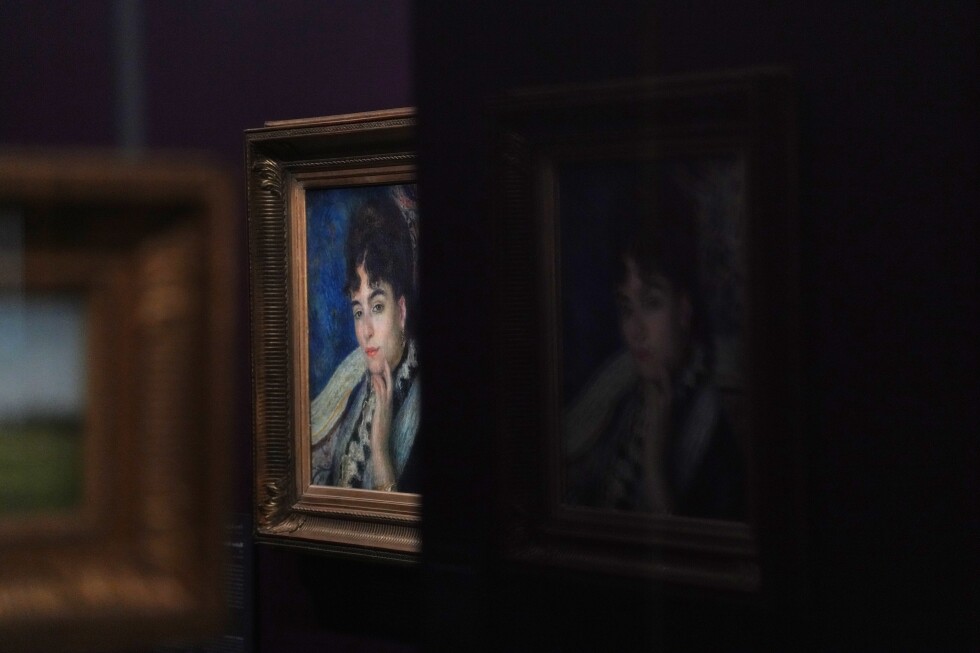
The 13 works on display in the new gallery each carry the unmistakeable imprint of the Holocaust. A Degas copy of a 1879 Berlin ballroom scene was purchased by Jewish collector Fernand Ochsé in 1919; Ochsé was deported to Auschwitz and murdered during the occupation. A Renoir portrait of the wife of writer Alphonse Daudet was sold to a German museum in Cologne in 1941, with no record surviving of who sold the looted work. A Paul Cézanne canvas dismissed as a fake by a Louvre curator in the 1950s has recently been re-evaluated and may well be an authentic work by the Post-Impressionist master.
Early visitors to the new gallery say the transparent display changes how they engage with the history of these works. Daniel Lévy, a software engineer from Strasbourg who visited on opening day, stopped to examine the Cézanne’s back marking. “You walk past these labels your whole life and you do not read them. Now I will read them,” he said. “My grandmother lost some of her family in the camps. Some of these paintings were probably hanging in homes like hers.” Another visitor, retired Lyon schoolteacher Marie Duboisse, noted she had seen the MNR designation on works at the Louvre for years without understanding what it meant, having previously assumed it marked a donor.
Historians and curators emphasize that the mass looting of Jewish art could not have happened on the scale it did without the active participation of the Paris art world. In the early 20th century, Paris was the richest art hub in Western Europe, and the city’s central auction house Hôtel Drouot reopened just months after the Nazi occupation began in 1940, running continuous sales of looted and forced-sale property through the entire war. French art dealers acted as middlemen for German buyers, with Hitler’s agents taking the most coveted works for Hitler’s personal collection and Nazi officials.
“Almost every museum in Nazi Germany sent buyers to Paris to expand its collections,” Rotermund-Reynard explained. “Hitler himself wanted to build the world’s largest museum, in Linz, the city in Austria where he grew up. Hermann Göring, Hitler’s deputy, traveled 21 times to Paris during the occupation to help himself to works taken from Jewish collectors. There was an enormous thirst both for the possessions of Jewish collectors, and for acquisitions to expand the German museums.” For Rotermund-Reynard, the looting cannot be separated from the broader genocide of Jewish people: “All of this is part of the history of the Shoah. When you try to understand this drive to take from Jewish families, it is part of the terrifying Nazi ideology to erase Jewish life.”
While the gallery was not created specifically as a response to rising antisemitism in France, curators say its opening carries new weight amid a recent surge in anti-Jewish acts. According to the French Interior Ministry, antisemitic incidents reached near-record levels of 1,320 in 2025, following a sharp increase after the October 7, 2023, Hamas attack on Israel. “There is no statute of limitations on these crimes,” said François Blanchetière, the Orsay’s chief sculpture curator and co-curator of the new gallery. The mission of the space, he explained, is to bring the hidden history of these works into the open, and continue the work of repairing the harm of the Holocaust, one canvas at a time.