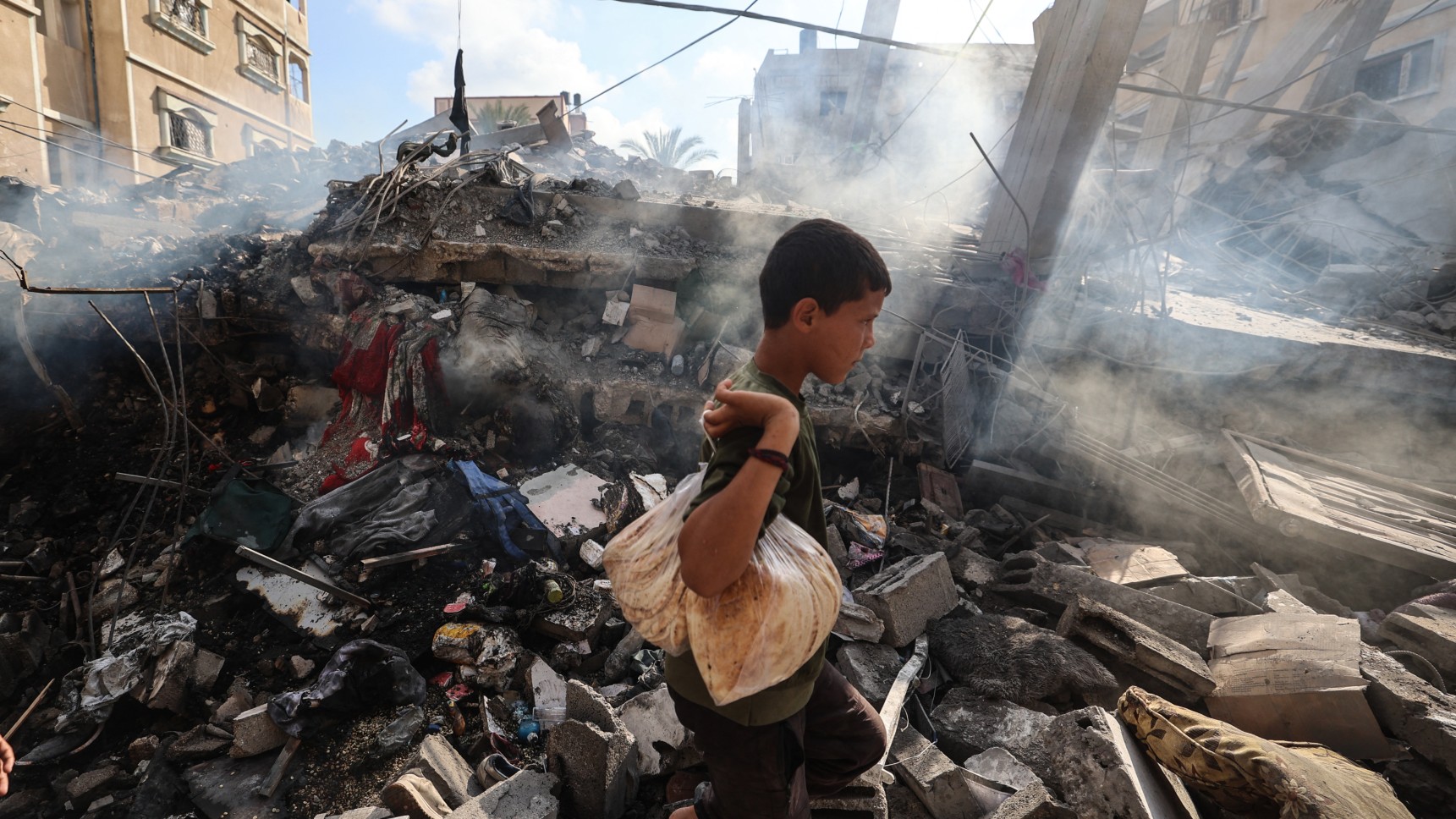
For 32-year-old Jamal Abu Sukran and his three young children, any sense of stability has remained out of reach amid the continuous cycle of upheaval that has defined their lives since the outbreak of Israel’s military campaign in Gaza in October 2023. The family’s latest forced displacement marked their 25th move, triggered by Israel’s June announcement that it would expand its so-called ‘yellow line’ zone of control, now swallowing 70 percent of the blockaded Palestinian enclave.
Even with a formal ceasefire nominally in effect since last October, Israel has steadily tightened its stranglehold over Gaza’s 1.8 million remaining civilian residents, squeezing them into a shrinking sliver of habitable territory. Abu Sukran first lost his original home in Gaza City’s eastern Shujaiya neighborhood when an Israeli airstrike reduced the structure to rubble in the opening days of the war. He took shelter in a nearby makeshift tent, but has been forced to relocate again and again, moving from one overcrowded displacement camp to another as Israeli territorial expansion progresses.
The yellow line was originally framed as a temporary Israeli-held buffer zone under the first phase of the October ceasefire agreement. But Israel has refused to withdraw from the area, blocking implementation of the deal’s second phase that requires a full pullback. Abu Sukran told Middle East Eye that hostilities never actually ceased even after the truce was announced. ‘Even after the ceasefire, the shooting and shelling never stopped,’ he said. ‘Life [in the displaced camps] was unbearable. We used to wait for the gunfire to stop just to go to the toilet.’
Abu Sukran explained that gunfire breaks out as a rule each morning, coming both from Israeli military positions and from local Palestinian collaborator groups. Displaced civilian communities, he added, are often directly targeted by fire. Initially, his post-ceasefire temporary home sat outside the yellow line, but eventually Israel’s expansion pushed the new boundary, called the ‘orange line’, to include his plot of land. ‘It was terrifying,’ he recalled. ‘There were random shootings, stray dogs, rats and shells everywhere. Nothing was left but rubble.’
The same story of repeated displacement plays out across the enclave for 68-year-old Nabil Abu Armanah and his extended family. After Israeli bombardment destroyed their first home in Rafah, they set up a makeshift tent on the ruins of their second property. They were forced to flee once again amid ongoing gunfire, routine Israeli military harassment, and the advance of Israeli tanks that came within 700 meters of the yellow line. When Abu Armanah recently returned to survey his land, he found the newly expanded yellow line cuts directly through his property.
‘I was hoping to return home soon, but now we are homeless. The land means everything to me,’ Abu Armanah said in an interview. ‘It’s extremely dangerous there now. Everything is gone. Nothing remains.’ He added, his voice shaking: ‘These are barbaric actions. We are innocent people. All we want is to live with dignity. I have lived through countless Israeli wars, from the 1967 war until today. They have destroyed everything I built throughout my lifetime.’
Multiple on-the-ground and expert accounts point to a deliberate Israeli strategy of making all territory inside the yellow line permanently uninhabitable for Palestinian residents. Since the ceasefire took effect in October, Israeli bulldozers and demolition crews have worked continuously to raze standing structures to the ground, clearing entire neighborhoods. Senior Israeli government officials, including far-right Minister Bezalel Smotrich, have openly stated their goal of leveling Palestinian land to push residents to leave the enclave ‘voluntarily’.
Political analyst Abdel Nasser Abu Aoun told Middle East Eye that Israel is leveraging the yellow line framework as a deliberate media narrative to legitimize the reoccupation of large swathes of Gaza. While framing the expansion as a security measure, the Israeli government is implementing a scorched-earth policy designed to depopulate captured areas, demolish civilian infrastructure, and commit war crimes, Abu Aoun argued.
By incrementally expanding the yellow line and introducing the new orange line zone of control, Israel effectively annexes more Gaza territory piece by piece. Abu Aoun documented that Israeli forces have even built military observation towers on the site of ancient Palestinian cemeteries, positions that overlook the tents of displaced Palestinians who can see their destroyed ancestral lands from their makeshift shelters. ‘This is one of Israel’s methods of psychological warfare,’ he said. ‘The objective is to punish Palestinians.’
Abu Aoun added that Israel’s end goal appears to be forcing all displaced residents into the small al-Mawasi coastal zone, even though existing infrastructure there is already severely damaged and incapable of supporting a massive influx of people. The overcrowding, he warned, creates a high risk of long-term humanitarian and environmental collapse in the enclave. ‘Israel is proving to the world that it respects neither agreements, mediators nor international law,’ he said. ‘It only understands the law of the jungle.’
The territorial expansion has also triggered a crippling public health and infrastructure crisis across Gaza. Maher Salem, general director of planning and investment at Gaza municipality, told Middle East Eye that roughly 35 percent of Gaza City’s clean water sources have been lost after falling inside the expanded yellow line and being destroyed by Israeli forces. Israel has cut the volume of water entering Gaza from 20,000 cubic meters per day to just 12,000 cubic meters – water that is already paid for by the Palestinian Authority. The cuts have left the average Gaza resident with just 10 liters of clean water per person per day, far below the minimum international standard for basic needs.
Salem also confirmed that Israel destroyed the main desalination plant in the Sudaniya coastal area, which previously produced 10,000 cubic meters of clean drinking water daily. Approximately 150 kilometers of water distribution networks, along with sewage pumps and critical sanitation infrastructure across Gaza City, have also been destroyed in military operations. In addition, Israel has blocked access to Gaza’s main landfill sites, which are located inside the yellow line near the border, forcing municipal authorities to store mounting volumes of waste in residential neighborhoods. To date, an estimated 400,000 cubic meters of uncollected garbage have accumulated across Gaza City, creating what Salem called a major environmental and public health catastrophe.
United Nations data from April underscores the severity of the crisis: more than 80 percent of the 1,600 displacement camps across Gaza report frequent rodent and pest infestations, which have fueled widespread disease outbreaks and rising rates of skin infections and rashes among vulnerable displaced populations.