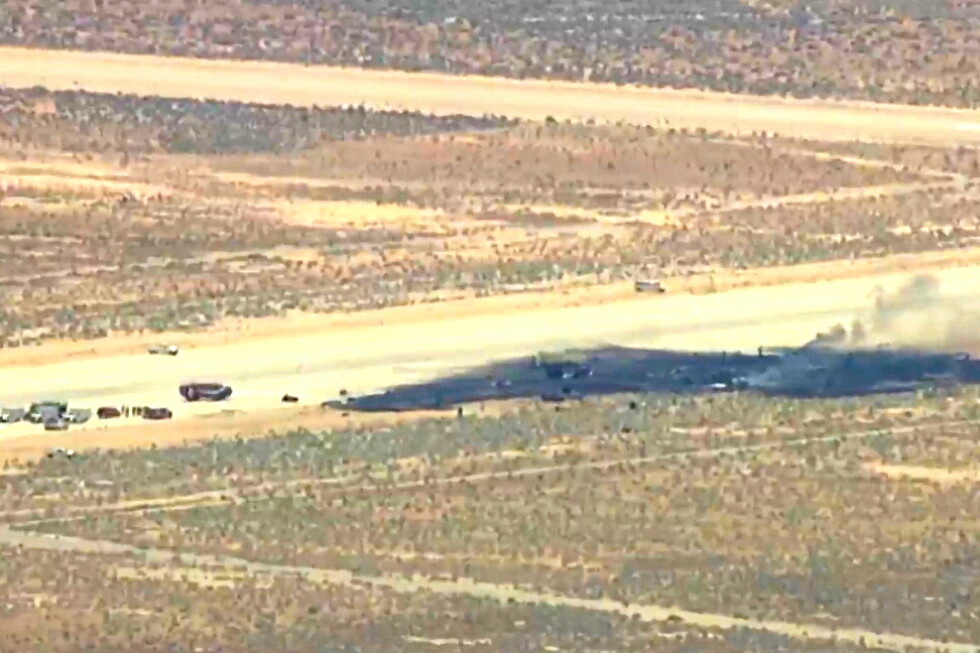
On a Monday morning just moments after departing the runway at Edwards Air Force Base, located in Southern California’s Mojave Desert roughly 100 miles north of Los Angeles, a U.S. Air Force B-52 Stratofortress bomber crashed and ignited a large blaze, killing all eight people on board, military officials confirmed. The crash occurred at approximately 11:20 a.m. during what was scheduled to be a routine test flight.
Aerial footage captured in the immediate aftermath of the incident shows the aircraft was almost completely destroyed in the impact and subsequent fire. Large plumes of thick black smoke rose from a wide stretch of charred desert terrain adjacent to the main runway, where dozens of emergency response vehicles gathered to contain the blaze. Among the eight victims were both uniformed U.S. military personnel and civilian government contractors working on the flight.
Colonel James Hayes, deputy commander of the base’s 412th Test Wing, confirmed during an official press briefing that after reviewing crash site footage, investigators confirmed there were no survivors. “We lost eight great Americans,” Hayes stated, noting that military teams were in the process of notifying next-of-kin for all those killed.
The cause of the crash remains undetermined as of the initial briefing, and Hayes confirmed that a full, thorough investigation could take as long as six months to reach a final conclusion. What is publicly confirmed is that the bomber was supporting a U.S. Air Force B-52 radar modernization initiative at the time of the flight. Back in 2025, the service announced Boeing had delivered a B-52 fitted with a new modernized Active Electronically Scanned Array (AESA) radar to Edwards for testing, replacing the bomber fleet’s decades-old outdated radar technology to improve operational efficacy. Test teams were scheduled to conduct an entire year of ground and flight assessments throughout 2026 to collect data that will inform a final production decision for the upgrade program. Military officials have not yet confirmed whether the crashed bomber was the same aircraft that received the new radar system in 2025.
Edwards Air Force Base, a historic facility carved into the Mojave Desert, is the primary hub for the U.S. Air Force’s aircraft and weapons system test and development operations. The 412th Test Wing, which oversees base operations, is responsible for developmental testing of all Air Force aircraft, weapons platforms, software and components both before they are acquired by the service and throughout their entire operational service life. The site holds landmark aviation history: it was at Edwards that legendary test pilot Chuck Yeager first broke the sound barrier in 1947, reaching a speed of Mach 1.05.
In the hours after the crash, the base airfield was closed to all traffic, with all inbound flights diverted to alternate facilities. By late Monday afternoon, the airfield reopened to authorized base personnel, though non-essential public visitor access remained suspended while emergency crews completed extinguishing and cleanup operations.
Aviation safety expert Jeff Guzzetti, a former crash investigator for both the Federal Aviation Administration and the National Transportation Safety Board, offered an early preliminary assessment of the crash. The fact that the bomber went down immediately after takeoff, without gaining altitude or traveling far from the runway, leads Guzzetti to suspect a critical flight control malfunction as a potential cause.
He outlined three plausible scenarios: controls that were improperly configured after recent maintenance, a catastrophic engine failure, or the failure of a new piece of equipment that was undergoing testing on the flight. “I think it was definitely a controllability issue. Now, whether that was tied to an engine failure, a flight control failure, or some new testing device failure, I’m not sure,” Guzzetti explained.
He added that flight test operations always carry greater inherent risk than standard operational flights, which is why such missions rely on specially trained test personnel and strict safety protocols. Even though the B-52 has been in continuous U.S. Air Force service for more than 70 years, integrating and testing new technology on the legacy airframe can introduce unforeseen challenges.
The report featured contributions from multiple AP journalists across the country, with Toropi reporting from Washington D.C., AP Transportation Writer Josh Funk contributing from Omaha, Nebraska, and AP reporter Hallie Golden adding reporting from Seattle.