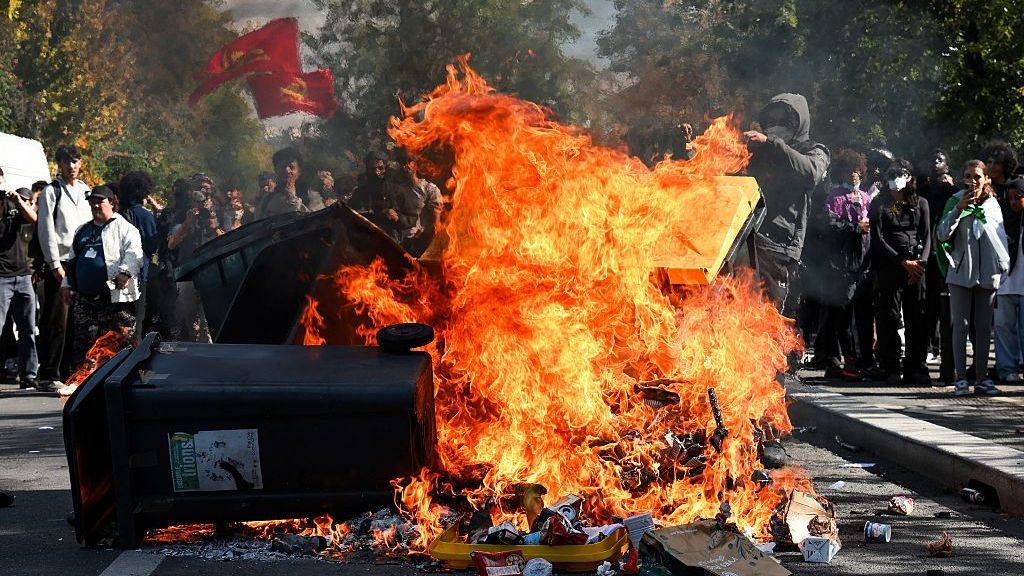
What began as localized student demonstrations over inadequate education funding and deteriorating learning conditions has rapidly escalated into nationwide unrest across France, leaving a trail of damaged school property, injured officials and police officers, and thousands of arrests in its wake.
The movement, which started last week at French lycées — secondary schools serving 15 to 18-year-olds — quickly spread to more than hundreds of education institutions across the country, with university students joining the blockades and protests by Thursday this week. At least 30 university campuses, including prominent sites in Paris and Rennes, have been blocked by demonstrators, who share consistent grievances: chronic understaffing of teachers and support personnel, overcrowded classrooms, crumbling infrastructure, and insufficient institutional budgets.
The unrest has brought outbreaks of arson and violence to multiple regions. In the western city of Nantes, two separate high schools saw fires ignite after protesters set alight waste bins. At Nantes’ central Nelson Mandela High School, the blaze spread from the bin to the building’s front facade, causing significant damage to the entrance hall. In Rouen, a northern French city, video footage captured a large blaze consuming the main entrance of another local high school.
Further violence has been reported across the country: in Marseille, a southern port city, protesters filled containers with petrol and splashed the substance on staff at Victor Hugo High School. In the small northern village of Auchel, a headteacher at Degrugillier High School suffered an ear injury after being struck by a stray firework launched during demonstrations. Even public transit has not been spared: vandalism and credible violence threats forced authorities to suspend all public transport services in Marseille and Strasbourg this week, a move designed to prevent protesters from moving between demonstration sites.
Official data reflects the scale of the crackdown on unrest. French broadcaster ICI reports that 625 people were taken into custody on Wednesday alone, and by midday Thursday, more than 600 additional arrests had been recorded across the country excluding Paris. Eighty-three police officers have also been injured in clashes with demonstrators.
For participating students, the anger driving the unrest stems from years of unaddressed neglect of their learning environments. Seventeen-year-old Raphael, who joined blockades that obstructed tram tracks outside a Strasbourg school, laid out his grievances in an interview with Agence France-Presse. “The building is falling apart, the cafeteria is too small. There’s zero budget, zero resources, not enough supervisors,” he explained, adding that many classrooms suffer from water leaks and the school does not have enough working toilets to serve the student body.
With France’s next general election still months away, the protests and the government’s response have quickly become a deeply politicized issue, pitting right-wing and left-wing parties against one another against a backdrop of public anger over public service underfunding. Prime Minister Sébastien Lecornu called an emergency crisis meeting on Thursday to address the unrest, after which the government issued a statement claiming the student-led demonstrations had devolved into outright “urban violence.”
Hard-right politicians, including National Rally leader and presidential candidate Marine Le Pen, have pinned the blame for the violence on the radical left, claiming the unrest is not a spontaneous student movement but “riots organized by professionals and overseen by deputies from La France Insoumise” (LFI), France’s prominent left-wing opposition party. Le Pen has called for the immediate passage of a new strict anti-rioting law to crack down on the unrest. Other center-right politicians have echoed hard-right calls for accountability: Eric Ciotti, mayor of Nice and member of the center-right Republicans party, has proposed that parents of students found guilty of damaging school property should be forced to cover all repair costs.
On the left, reactions have been split. Bally Bagayoko, a LFI member and mayor of a Paris suburb, has stood by previous comments claiming that violence can be legitimate in certain contexts, referencing unsubstantiated claims that protesters have been shot at by authorities while unarmed and unprotected. However, LFI leader and presidential candidate Jean-Luc Mélenchon has stressed that the party supports only non-violent protest, while arguing that scapegoating the left does nothing to resolve the underlying funding and infrastructure issues that pushed students to protest in the first place. Benoît Payan, the left-wing mayor of Marseille, also condemned the “unacceptable violence” in his city, acknowledging that young people have “legitimate concerns” about their future and the state of public education, but urging demonstrators to express their grievances through calm, peaceful action.