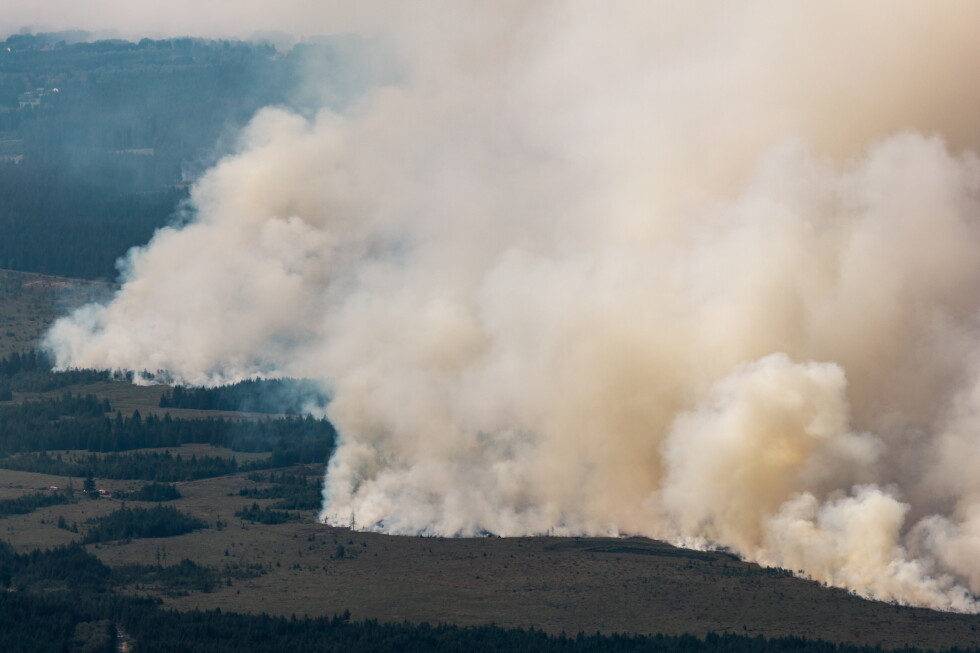
A catastrophic wildfire tearing through Belgium’s iconic High Fens nature reserve has become the largest blaze the country has seen in modern history, forcing mass evacuations and prompting an international cross-border rescue effort amid an ongoing regional heat and drought crisis.
The inferno, which was first detected as it expanded rapidly in eastern Belgium near the German border, had already scorched more than 27 square kilometers of protected heathland and peat bog by Sunday — double the size of the previous record-breaking 2011 fire that burned through the same protected ecosystem. The challenging landscape of the High Fens, with its mixture of dry, flammable heath and deep peat deposits, has severely hampered containment efforts for emergency crews.
When shifting winds pushed thick toxic smoke toward populated areas on Saturday, local officials ordered 600 residents across two nearby municipalities in Liège Province — Waimes and Bütgenbach — to evacuate immediately. Tourists visiting the popular natural reserve were also told to leave the high-risk zone, and a local gymnasium was set up as a temporary emergency shelter for displaced people. As of Sunday morning, authorities confirmed no residential structures had been damaged by the fire, but the blaze remains dangerously close to populated neighborhoods, and heavy smoke continues to blanket the region. Officials have issued a strict order for non-emergency personnel to avoid the fire zone, noting that excess civilian traffic could block access for response vehicles and slow ongoing firefighting operations.
To scale up response efforts, Belgium activated the European Union’s Civil Protection Mechanism to request support from other member states. “The High Fens are burning. Belgium is not facing it alone,” Hadja Lahbib, the European Commissioner for Crisis Management, announced on the social platform X. In response to the call, Sweden dispatched two specialized water-bombing aircraft, while the Netherlands and the Czech Republic each contributed additional firefighting helicopters to join the two helicopters already operated by Belgian federal police. In total, more than 250 emergency personnel have been deployed to the fire line, including firefighters from both Belgium and neighboring Germany, police officers, military personnel and civil protection workers.
The wildfire follows weeks of record-breaking high temperatures and minimal rainfall across Western Europe. Belgium recorded another round of extreme heat earlier this week, with temperatures hitting 37 degrees Celsius (98.6 Fahrenheit) across parts of the country on Friday. The dry conditions have turned vegetation across the region into tinder, increasing wildfire risk dramatically.
The cross-border impact of the blaze has already prompted emergency precautions in Germany. Local authorities in the German border town of Monschau warned overnight Saturday that the fire front was just 3 kilometers (2 miles) from the German border, and placed local firefighting units on high alert. Early Sunday, officials ordered temporary evacuation for three outlying districts near the border, citing unavoidable health risks from drifting wildfire smoke.
The Belgian blaze is part of a wider pattern of extreme wildfire activity across Western Europe this summer. In southwestern France, firefighters have spent days battling a separate wildfire that has burned 17 square kilometers of pine forest in the Landes region. Local prefect Gilles Clavreul reported Sunday that the fire had not seen any major new flare-ups overnight, noting that “the situation is developing rather favorably.” Around 650 residents have already been evacuated from the Landes area, and this blaze marks the third major wildfire to hit the region’s vast pine forests this summer, following two large outbreaks in late July. Just last month, a massive wildfire in the neighboring Gironde department burned more than 420 square kilometers of land, forced 220,000 people to evacuate, and spread toward the Atlantic coast near Bordeaux.