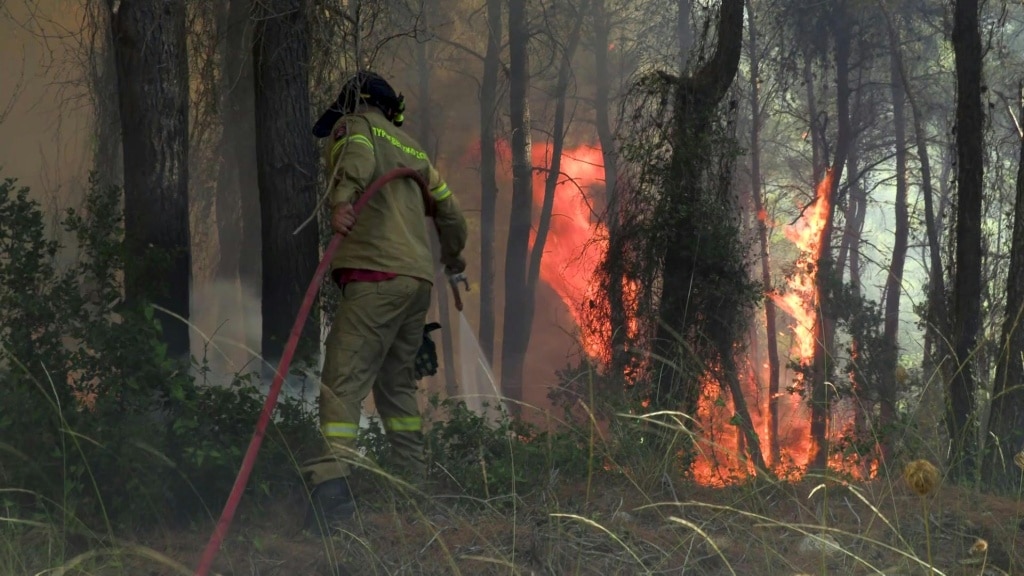
Greece is grappling with an expanding wildfire crisis that has left vast swathes of forest and agricultural land destroyed, with top officials warning that the most challenging days still lie ahead as high gale-force winds hamper suppression efforts.
Prime Minister Kyriakos Mitsotakis noted that the nation has been battered by unprecedented extreme weather, with wind speeds regularly hitting 62 miles per hour — speeds so intense that even the dozens of aerial firefighting assets deployed across the country cannot operate safely. “There are moments when nature and the intensity of weather phenomena surpass any human planning and any operational capability,” Mitsotakis wrote in a public post on Facebook Sunday.
As of Sunday, nearly 500 firefighters were focused on containing a major blaze burning near Porto Germeno, a popular coastal village located roughly 45 miles northwest of the Greek capital Athens. The fire crossed a mountain range overnight, and crews are working around the clock to stop its advance toward Athens’ western outskirts. Additional blazes are burning across the country: 100 firefighters are tackling a second large wildfire in Aigialia, located in the northern Peloponnese peninsula, while a new outbreak was reported on the Ionian Sea island of Cephalonia late Saturday.
Early damage assessments from the National Observatory’s climate tracking service meteo.gr initially estimated that more than 16,000 acres of land had been burned in outbreaks across the Gulf of Corinth region, which includes the Porto Germeno blaze. But Theodore Giannaros, a wildfire meteorologist and senior researcher at the National Observatory, said Sunday that the actual burned area for the Porto Germeno fire alone is likely over 24,700 acres — nearly double the initial estimate. “Unfortunately, it is highly likely (if not almost certain) that this particular wildfire will be classified as a megafire,” Giannaros wrote on Facebook.
Evacuation orders were issued for Porto Germeno and neighboring villages on Friday when the fire first broke out, but local authorities confirm that dozens of residential properties have already been damaged or destroyed. Nikos Georgopoulos, a forest management researcher at Aristotle University of Thessaloniki, told Greek state broadcaster ERT that the speed of the blaze took observers by surprise. “We could not believe what we were seeing, the fire spread extremely rapidly,” he said, adding that the same area was hit by a smaller wildfire just three years ago.
The crisis has stretched Greece’s emergency response resources to breaking point. Civil Protection Minister Evangelos Tournas confirmed Saturday that the national fire department has been “pushed to its limits”, after crews have responded to dozens of new fire outbreaks every day this week. Three firefighters have already died in the line of duty this week: two on the island of Crete, and one in the Peloponnese. Tournas explained that extreme wind and turbulence have grounded most aerial firefighting assets for much of the crisis, leaving ground crews to handle fast-moving blazes without air support.
While winds moderated slightly late Saturday, the Greek civil protection ministry warned Sunday that the greater Athens metropolitan area, nearby Voiotia region, and the island of Evia all remain under near-maximum wildfire risk. Like much of the Mediterranean basin, Greece faces increasing wildfire risk every summer due to rising temperatures, more frequent and intense heat waves, and prolonged drought driven by human-caused climate change. Earlier this week, separate wildfires on the Greek islands of Crete and Paros burned another 14,800 acres of land, according to meteo.gr data.