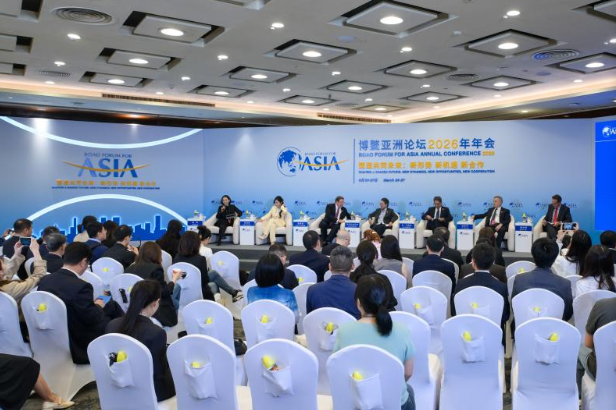
At the 2026 Boao Forum for Asia Annual Conference held in Hainan last week, regional and international experts united in highlighting China’s decades-long investments in renewable energy development as a game-changing asset to buffer Asian economies against growing global energy volatility, triggered by recent U.S.-Israeli strikes on Iran that have disrupted critical Middle Eastern supply routes.
The conflict has effectively closed the Strait of Hormuz, a chokepoint that underpins a large share of Asia’s energy imports. According to 2025 data from the International Energy Agency, nearly 90 percent of all liquefied natural gas (LNG) exported through the strait was destined for Asian markets, accounting for more than a quarter of the continent’s total annual LNG imports. This sudden disruption has laid bare Asia’s longstanding structural vulnerability: decades of reliance on fossil fuel imports from the Middle East have left most regional nations exposed to sudden price swings and supply cutoffs driven by geopolitical conflict.
Mohd Faiz Abdullah, executive chairman of Malaysia’s Institute of Strategic and International Studies, framed the current energy turmoil not as a standalone crisis, but as a symptom of broader systemic instability in the global economy. He noted that China’s advanced research and development in alternative energy positions it uniquely to lead a regional transition away from fossil fuel dependence. “This is where China can come in… to further advocate for the implementation of alternative energy resources,” Faiz explained, adding that China can set a critical example for other nations looking to reorient their national energy strategies.
Li Xing, a Yunshan Leading Scholar at the Guangdong Institute for International Strategies and adjunct professor at Denmark’s Aalborg University, echoed this assessment, emphasizing that the ongoing crisis has created unexpected new opportunities to deepen energy collaboration across Asia. China made a strategic pivot to renewable energy more than a decade ago, Li pointed out, leaving it far less vulnerable to Middle Eastern supply shocks than most other regional economies. He cited the country’s 15 consecutive years of global leadership in installed wind power capacity as a clear demonstration of this successful transition. “Asian countries should step up their cooperation with China to address infrastructure challenges in renewable energy,” Li said. “In this way, they will not need to rely so heavily on oil imports from the Middle East.”
Building regional energy resilience through the transition away from volatile fossil fuels emerged as a central topic of discussion across forum panels. Armida Salsiah Alisjahbana, executive secretary of the United Nations Economic and Social Commission for Asia and the Pacific (UNESCAP), framed the current crisis as a catalyst for long-term systemic change. She noted that the turmoil creates a urgent opening to build more resilient regional energy systems and reduce exposure to wild swings in global fossil fuel prices.
Alisjahbana highlighted China’s outsized capacity to support this transition, from creating new market opportunities and connecting regional business ecosystems to driving inclusive economic growth and job creation through the expansion of clean energy infrastructure. Still, she cautioned that meaningful regional progress requires addressing disparities in development across Asian nations, particularly for smaller, lower-income economies that face greater barriers to scaling renewable energy. Ensuring that energy diversification and regional cooperation help narrow these development gaps, she said, must be a core priority.
Gao Haichun, co-chair of Jiangsu-based global renewable energy firm Trina Solar Co, added that China has already demonstrated that a large-scale transition to renewable energy is achievable. Today, she noted, 100 percent of China’s annual new electricity demand is met by renewable energy sources, setting a clear benchmark for other Asian nations to follow. Echoing the traditional Chinese proverb that “it is better to teach a person to fish than to give them a fish,” Gao framed renewable energy cooperation as a sustainable model for long-term energy independence. Renewable energy infrastructure such as solar power stations can operate for more than 30 years, she explained, enabling energy self-sufficiency not just for entire countries, but for individual cities, industrial parks, and even households. “If we want to develop renewable energy, especially for Asia, we must form closer cooperation,” Gao emphasized.