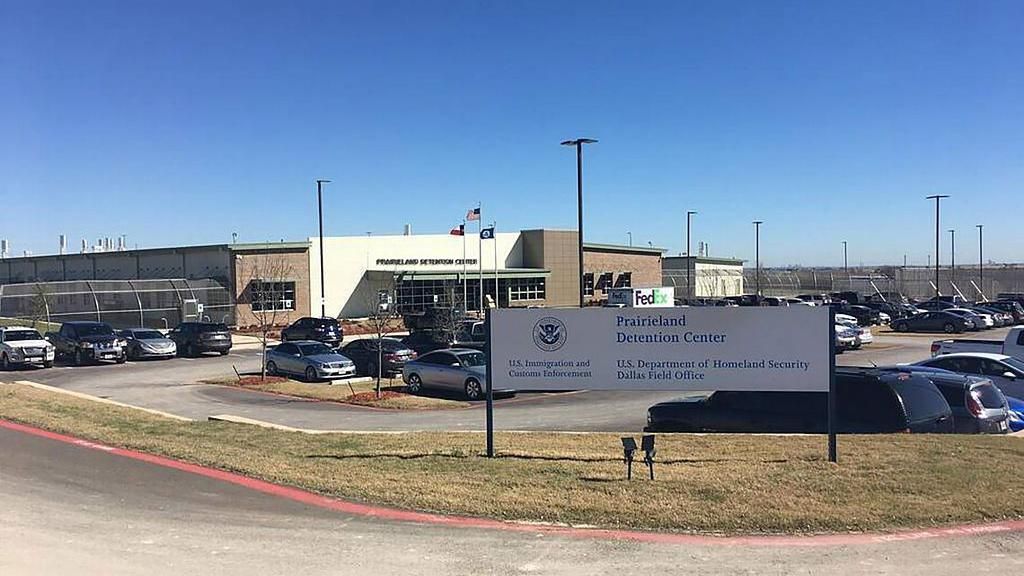
On a Fourth of July holiday last summer, a chaotic demonstration outside a federal immigration detention facility in rural Prairieland, Texas — just south of Dallas — ended with a law enforcement officer shot in the neck, extensive property damage, and this week, historic lengthy prison sentences for eight people U.S. prosecutors have linked to the leftist anti-fascist movement Antifa. Collectively, the group has been sentenced to 450 years behind bars, in a case that has reignited fierce national debates over political protest, domestic terror labeling, and the scope of federal punishment for ideological activism.
The harshest sentence, 100 years in prison, went to Benjamin Hanil Song, the 38-year-old former U.S. Marine Corps reservist prosecutors identified as the cell’s leader. Song was convicted of attempted murder of a law enforcement officer, after the officer was wounded by gunfire during the unrest. Per U.S. Department of Justice (DOJ) records, Song faced a mandatory minimum sentence of just 20 years for the conviction, making the 100-year term a far harsher penalty than required by statute.
In a written statement released Tuesday through defense advocates and multiple media outlets, Song claimed he fired his weapon only because he believed the officer was about to open fire on an unarmed protester. His mother, Hope Song, has pushed back against all allegations that her son intended to harm anyone, telling the Associated Press that the narrative of the attack has been distorted to fit a broader political narrative. The other seven defendants received sentences ranging from 30 to 70 years: Maricela Rueda was handed 70 years, five co-defendants (Cameron Arnold, also known as Autumn Hill, Savanna Batten, Zachary Evetts, Bradford Morris, also known as Meagan Morris, and Elizabeth Soto) each received 50 years, and Daniel Rolando Sanchez-Estrada was sentenced to 30 years.
Acting U.S. Attorney General Todd Blanche issued a blunt statement following the sentencing, framing the penalties as a clear warning to ideologically motivated violent actors. “The sentences handed down today make clear that Antifa terrorists who attack law enforcement and federal facilities will face swift and uncompromising justice,” Blanche said, reiterating the DOJ’s commitment to cracking down on violent extremism that targets government institutions.
According to the DOJ’s official account of the incident, the eight operatives belonging to what the agency calls the North Texas Antifa Cell launched the attack by launching and throwing explosive fireworks at the Prairieland detention center, before vandalizing multiple government vehicles and an on-site guard kiosk. The officer shot in the neck ultimately survived the attack, but the incident prompted a wide-ranging federal investigation and eventual 12-day jury trial that concluded earlier this year, after opening arguments on February 23.
All eight defendants were convicted on a sweeping array of charges including felony rioting, illegal possession of weapons and explosives, providing material support to a terrorist organization, and obstruction of justice. But the case has been steeped in controversy from the start, with supporters and family members of the convicts arguing that the government has overstated the group’s ties to Antifa and imposed excessively harsh punishments for what was originally billed as a demonstration against U.S. Immigration and Customs Enforcement (ICE) detention policies.
All eight defendants have repeatedly denied any formal affiliation with Antifa, saying they only attended the July 4 gathering to advocate for detained immigrants, a cause that has drawn widespread, mostly peaceful protest across the country for years. Multiple attendees of the demonstration have stated that the event was initially planned as a peaceful “noise demonstration” and that the outbreak of violence was unplanned and unexpected. Before the 2025 protest, the Prairieland facility had not seen any major disruptive activity, unlike many other ICE detention centers that have seen regular protests and even official visits from Democratic members of Congress.
One additional defendant, Ines Soto, is scheduled to receive her sentence on July 1, and seven other people who pleaded guilty to one count of providing material support to terrorists ahead of trial will also be sentenced the same day.
The labeling of the defendants as Antifa-affiliated domestic terrorists ties back to a 2025 executive order signed by former President Donald Trump, who formally designated the loosely organized movement as a domestic terrorist organization last September. Trump has long targeted Antifa as a core ideological enemy, blaming the movement for widespread violent unrest during multiple national protest waves in recent years.
Critics of the designation and of the recent sentencing have pushed back on the DOJ’s framing, noting that Antifa is not a formal, centralized organization with fixed membership or leadership, but rather a loose ideological umbrella for groups and individuals that oppose far-right, fascist and racist politics. They also argue that holding individuals criminally liable for subscribing to a specific ideological belief violates fundamental First Amendment protections. The DOJ, however, has defended its framing, saying in a statement that the North Texas Antifa Cell is part of a larger militant network whose explicit ideological goal is the violent overthrow of the U.S. government, federal law enforcement, and the existing American legal system.