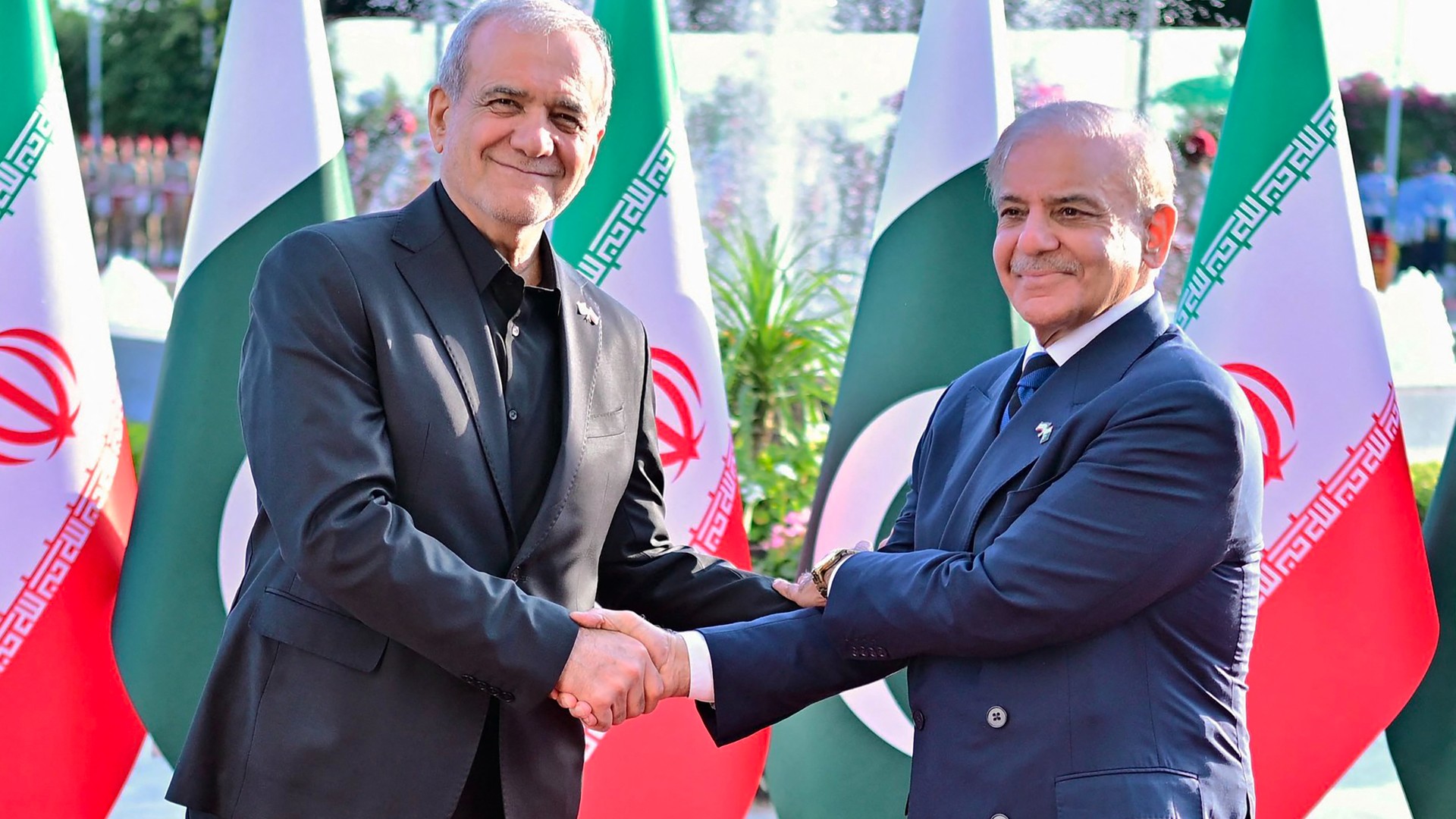
In a landmark confirmation made Tuesday during Iranian President Masoud Pezeshkian’s official visit to Islamabad, Pakistan’s Prime Minister Shehbaz Sharif has publicly clarified that Iran’s ballistic missile program was never part of the agenda for ongoing US-Iran negotiations, contradicting long-standing claims from Washington and Tel Aviv that the program was a core casus belli for their conflict with the Islamic Republic.
Speaking on the record about the Islamabad Memorandum of Understanding (MOU) that paused hostilities between the US and Iran to open diplomatic space, Sharif emphasized, “This MOU does not mention ballistic missiles. It was never on the table, it was never on the agenda and the Iranian side never even wanted to discuss it. This is not an impression, but a fact of the matter.”
Sharif also pushed back against what he called global double standards on missile proliferation, saying, “There cannot be double standards; that some countries can have ballistic missiles and Iran shouldn’t have them. You cannot digest this kind of duplicity.”
Iran’s president echoed and amplified Sharif’s remarks, stressing that his country’s defensive missile program will never be up for negotiation under any circumstances. “Iran will never compromise on our missile programme and capabilities and this shall never be part of any agreement between Iran and any other party,” Pezeshkian stated. He added that the country’s defensive arsenal acts as a critical deterrent: “If the missiles we have for our defence did not exist, Israel and the United States would have ploughed Iran just like Gaza, showing no mercy to either the old or the young.”
The confirmation aligns with a recent shift in US policy: during last week’s G7 summit hosted in Paris, US President Donald Trump acknowledged that demanding the missile program be placed on the negotiating table was never a realistic goal. “I’m saying that if other countries have them, it’s a little bit unfair for them not to have some,” Trump told reporters in Paris.
This public shift marks a stark reversal from the US’s opening war aims, which explicitly identified the elimination of Iran’s ballistic missile arsenal and production capacity as a non-negotiable core objective. A declassified 1 April US presidential memo made clear: “From day one, the objectives have been clear and unwavering: obliterate Iran’s ballistic missile arsenal and production capability… That is the clear objective of this mission.”
Since the end of formal US military operations against Iran, none of Washington’s original primary war objectives—including regime change, the total destruction of Iran’s missile program, the elimination of Iran’s naval capabilities, and the seizure of Iran’s uranium stockpiles—have been achieved. Today, Washington has reframed its negotiation priorities around two core goals: keeping the Strait of Hormuz open (a status that held before the US launched its invasion) and preventing Iran from developing a nuclear weapon.
Diplomatic progress has moved forward rapidly in recent days. On Monday, the US suspended economic sanctions against Iran as part of the first round of high-level talks held under the Islamabad MOU framework. US Vice President JD Vance, who leads the US negotiation team, described the day of talks as having yielded “good progress.”
The lifting of US sanctions is expected to deliver major economic relief to Iran: before the US blockade was imposed in response to Iran’s temporary closure of the Strait of Hormuz, Iran produced roughly 4.6 million barrels of crude oil per day and exported 1.5 million barrels daily. The Islamabad MOU, which was mediated by Pakistan and Qatar, halted all US-Iran hostilities for a 60-day period to allow for in-depth technical negotiations. Following Monday’s successful High-Level Committee Meeting, Sharif announced that negotiators had finalized a roadmap to reach a comprehensive final agreement within the 60-day window. Mohammad Bagher Ghalibaf leads Iran’s negotiation delegation. On Tuesday, Trump reaffirmed that Washington is seeking a fair agreement with Tehran, adding that relations between the two countries are currently positive.
Beyond bilateral US-Iran negotiations, the MOU also includes a commitment to end all ongoing hostilities in Lebanon. However, achieving a ceasefire there has proven far more complicated, as Israel has openly defied US efforts to end the conflict. Parallel direct negotiations between Israel and Lebanon are already underway independently of US-Iran talks.
On Tuesday, the two countries launched their fifth round of direct negotiations in Washington. Lebanon’s delegation is pushing to revive earlier proposals that would require a full Israeli withdrawal from southern Lebanon. The three days of talks come after four prior negotiating rounds failed to deliver a permanent ceasefire or close the substantial gaps between the two sides’ positions.
Beirut is expected to push for four core demands during this round: a binding timetable for Israeli withdrawal, the safe return of hundreds of thousands of internally displaced Lebanese people, the release of Lebanese detainees held by Israel, and the launch of post-conflict reconstruction efforts. For its part, Israel has linked any full withdrawal to the complete disarmament of Hezbollah, and insists that Israeli forces will maintain control over a large security buffer zone inside southern Lebanon until it is convinced that the Lebanese army can prevent Hezbollah from re-establishing a military presence in the area.
The US-Iran MOU frames the Lebanon conflict as part of a broader regional ceasefire framework, and earlier talks near Lake Lucerne, Switzerland, produced a draft framework for a de-escalation mechanism between Israel and Hezbollah. This latest diplomatic development means the Washington talks are no longer the only diplomatic channel working to end the Lebanon war.
This report was sourced from independent coverage by Middle East Eye, a outlet specializing in on-the-ground reporting and analysis of the Middle East, North Africa and global affairs.