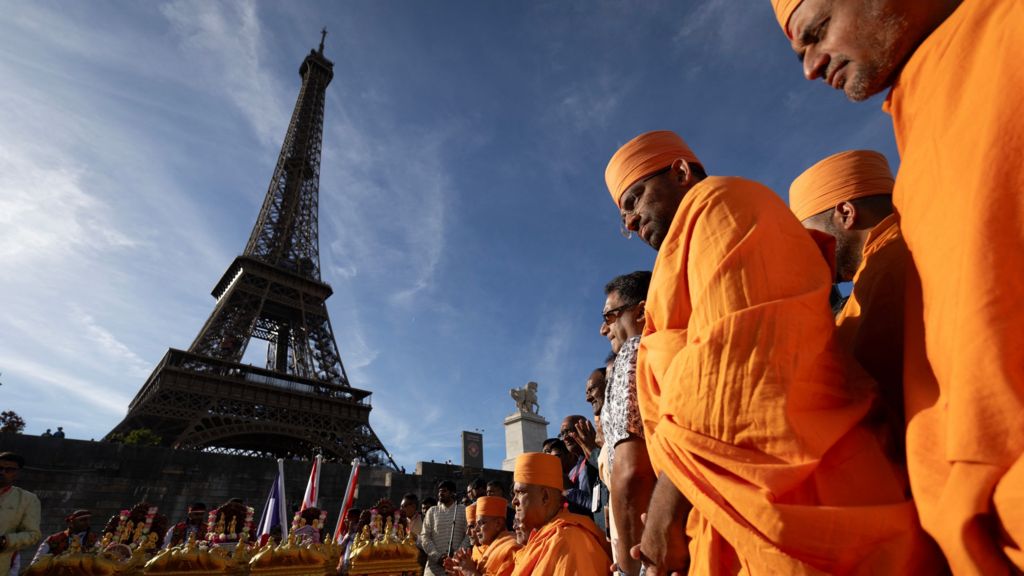
A controversy rooted in a religious group’s visit to Paris has triggered leadership changes at one of the world’s most iconic landmarks, after a request for gender segregation led to widespread public outrage and worker unrest. Earlier this month, a delegation of nearly 100 monks and representatives from the BAPS (Bochasanwasi Akshar Purushottam Swaminarayan Sanstha) Hindu movement traveled to Paris to inaugurate a new temple, including a scheduled stop at the Eiffel Tower as part of their itinerary.
Founded on teachings dating back to 18th-century Hindu spiritual leader Lord Swaminarayan, BAPS maintains strict gender separation in many of its religious activities and sacred spaces. During the group’s visit to the Eiffel Tower, BAPS organizers submitted a formal request to limit delegation members’ interactions with female staff working at the landmark. SETE, the state-owned company that manages operations at the Eiffel Tower, granted this request—a decision that would soon spark national backlash.
Internal documents from SETE confirm that female employees assigned to work during the delegation’s visit were removed from their posts and reassigned, replaced by male colleagues. Staff representatives report that women were explicitly ordered to avoid specific zones of the tower for the duration of the visit, leaving many workers feeling publicly humiliated and disrespected. In response to the incident, employees at the monument launched an immediate walkout, forcing the complete closure of the popular tourist site to protest the organization’s decision.
Political leaders across France swiftly condemned the action, echoing the anger of Eiffel Tower staff. Yaël Braun-Pivet, president of France’s National Assembly, emphasized that France would not accept forcing women out of their workplaces to accommodate the demands of any visitor group. Emmanuel Gregoire, the Socialist deputy mayor of Paris, labeled the choice “absurd, unjust and unacceptable” and ordered two independent inquiries into how the incident was allowed to happen.
This week, SETE announced that Patrick Branco Ruivo, who has served as the company’s director general since 2018, will step down from his role at the end of 2025. A company statement confirmed that an internal investigation uncovered “operational flaws and shortcomings” in planning the visit, which led to the “unacceptable” removal of female staff. SETE chair Ariel Weil announced that in the wake of the controversy, new mandatory training programs focused on gender equality will be rolled out for all staff, and the organization will begin a structured leadership transition in the coming months to fill the vacant director general role.
In the weeks following the incident, BAPS issued a public apology for the harm and disruption the controversy caused. The organization, which manages more than 1,000 temples across the globe in major cities including London, Los Angeles, and Sydney, describes itself as a volunteer-focused spiritual movement dedicated to advancing social good through Hindu values. BAPS has stated that its tradition of gender separation is intended as a benefit for female followers, but critics argue that 18th-century cultural norms have no place in modern public spaces, and that removing women from their workplaces to accommodate religious custom amounts to unlawful gender discrimination.