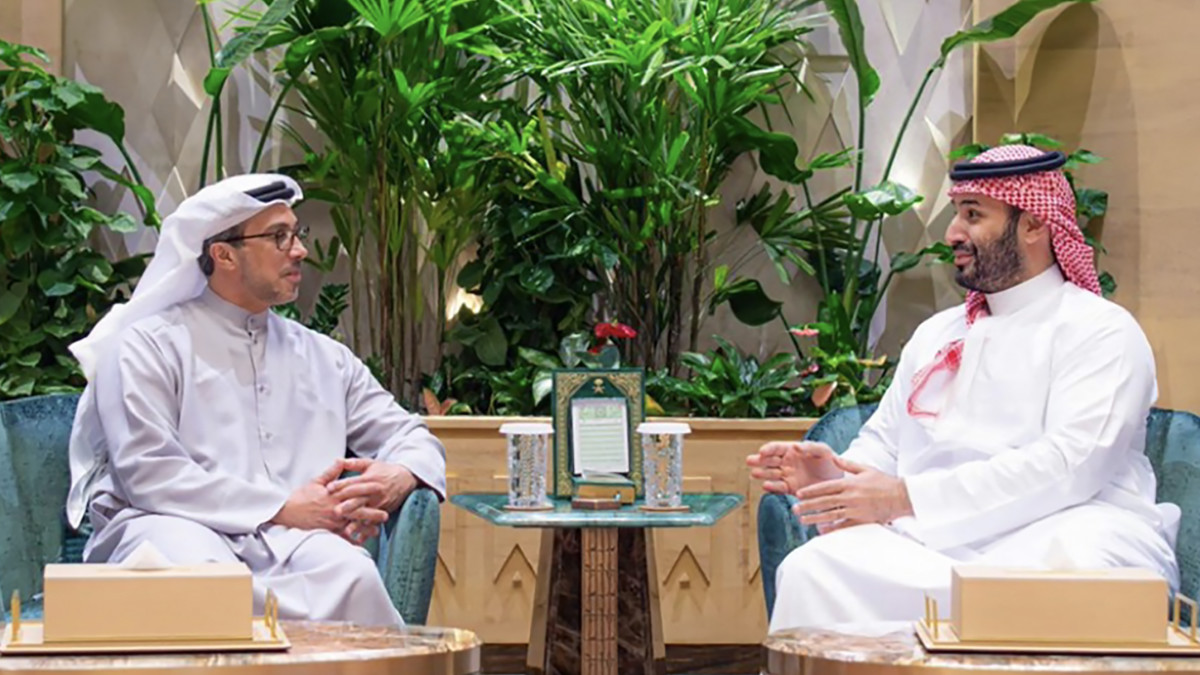
A surge in Houthi military advances along Yemen’s Red Sea coast has pushed long-disputing Gulf neighbors Saudi Arabia and the United Arab Emirates to pursue a historic reconciliation, as Riyadh faces growing direct threats to its critical energy infrastructure from the Iran-aligned militant group. The breakthrough came Tuesday, when Saudi Crown Prince Mohammed bin Salman welcomed UAE Vice President Mansour bin Zayed Al Nahyan for high-level talks in Riyadh — the most high-profile step toward mending relations since the two nations fell out over competing influence campaigns across Yemen, Sudan and Somaliland.
This diplomatic shift did not emerge overnight. Western and Arab diplomatic sources familiar with behind-the-scenes negotiations confirm that talks on renewed Yemeni cooperation have dragged on for months, with Abu Dhabi pushing for a clear public gesture of reconciliation from Riyadh, alongside concrete concessions for UAE-aligned factions on the ground in Yemen. An initial informal meeting in July, marked only by an undisclosed, unpublicized photo of Mansour and Saudi Defense Minister Khaled bin Salman, failed to meet Abu Dhabi’s expectations. It was the Houthi’s rapid, lightning offensive down the Red Sea coastline in September that served as the critical catalyst for accelerating high-level talks, regional analysts agree.
As a signal of the meeting’s success, the UAE followed up Mansour’s visit by deploying two government planes carrying senior coordination officials to Riyadh to align strategy on Yemen. For the UAE, the high-profile nature of the meeting carried substantial symbolic weight, according to Joshua Yaphe, senior fellow at the Center for the National Interest and a former top Gulf intelligence analyst for the U.S. State Department. “Yemen is going downhill fast, and everybody knows it. The Emiratis know the Saudis are in a worrisome position and they don’t want to see the Saudis flat-out fail, so they are coming in on a white horse, saying, ‘we can help you, if you are nice to us’,” Yaphe explained in an interview with Middle East Eye.
The urgency of Riyadh’s outreach reflects a series of recent setbacks for the kingdom. Earlier this month, Saudi requests for direct U.S. military support against accelerating Houthi attacks were rejected, while existing defense pacts with Turkey and Pakistan have not been activated to address the ongoing escalation. The Houthi offensive has already put Riyadh’s vital Red Sea oil export corridor at direct risk, and the group has launched drone attacks targeting the Saudi capital itself, including a strike on Riyadh International Airport earlier this month that disrupted operations. A separate attack on Saudi Arabia’s key East-West Pipeline, which the kingdom blamed on Iran-aligned Shia militias operating from Iraq, temporarily took the critical energy artery offline.
The two Gulf powers first formed a united military coalition against the Houthis in 2015, after the group seized Yemen’s capital Sanaa and large swathes of the country’s northern territory. At the time, the UAE emerged as the most militarily effective member of the coalition: it deployed ground forces, trained and armed anti-Houthi Yemeni factions, and in 2017 helped oust the Houthis from the entire Red Sea coast and defended the strategic port city of Aden from capture. But relations fractured over the UAE’s open support for the Southern Transitional Council (STC), a separatist group pushing for an independent state in southern Yemen. Tensions boiled over in 2025, when Saudi warplanes targeted UAE weapons shipments bound for the STC and launched a military offensive against the group after it seized most of southern Yemen, prompting the UAE to formally withdraw its military forces from the coalition.
Today, the UAE is pushing for Saudi Arabia to accommodate the STC, which was formally disbanded in January, and to ban Yemen’s influential Sunni Islamist party Islah, a core member of the internationally recognized Yemeni government that Abu Dhabi has lobbied Washington to designate as a terrorist organization. While analysts do not expect Saudi Arabia to fully meet these demands, incremental compromises are on the table: Yaphe notes Riyadh could pressure the Yemeni government to grant the STC greater representation in a future cabinet reshuffle. Even without a full return to overt military involvement, the UAE retains significant leverage over powerful anti-Houthi southern Yemeni factions, including the STC’s Security Belt Forces, the Giants Brigade, and the National Resistance Forces (NRF) led by Tarek Saleh — all of which held control of the southern Red Sea coast before the recent Houthi offensive. Gulf expert Kristian Ulrichsen, a fellow at Rice University’s Baker Institute, notes the UAE can still reshape the battlefield through its influence, even from a distance. “This meeting was all about Yemen. The Saudis are preparing to make a significant move against the Houthis and want to make sure the anti-Houthi coalition is not as fragmented as it’s been,” Ulrichsen said. “The UAE was the most effective part of the military coalition, and can play a significant role even without getting involved militarily by using their influence on the STC and Tarek Saleh.”
Beyond coordination on the ground, experts suggest Riyadh could also request UAE support for air defense operations to fend off ongoing Houthi drone and missile attacks. The reconciliation also aligns with long-standing U.S. policy goals: Western officials welcomed the outcome of the meeting, and a former U.S. official notes the breakthrough could unlock greater cooperation from the Trump administration, which has pressured Gulf allies to resolve internal disputes for years. It could also pave the way for deeper trilateral coordination between Saudi Arabia, the UAE, and Israel, which already deployed an Iron Dome air defense battery to the UAE during earlier tensions with Iran. Israeli Prime Minister Benjamin Netanyahu just completed a high-profile visit to Abu Dhabi on Sunday, creating new opportunities for aligned security cooperation.
Despite the diplomatic breakthrough, deep structural divisions remain between the two kingdoms. They still back opposing sides in Sudan’s ongoing civil war, with Riyadh supporting Sudanese military leader Abdel Fattah al-Burhan and Abu Dhabi backing the rival Rapid Support Forces militia. Just Tuesday, on the same day as Mansour’s visit, Crown Prince Mohammed bin Salman reaffirmed Riyadh’s support for Burhan in a public phone call. The two nations also disagree over Somaliland: the UAE maintains a critical commercial port and military base in Berbera, while Saudi Arabia has publicly condemned Israel’s recent recognition of the breakaway region.
Analysts broadly agree that the immediate Houthi threat has overridden these competing interests for now, but questions remain over whether the reconciliation can hold long-term. Even if the UAE delivers full support to the anti-Houthi campaign, experts warn it remains unclear whether the coalition can reverse the group’s recent territorial gains. Still, the resumption of dialogue carries broader regional benefits, says Anna Jacobs, non-resident fellow at the Arab Gulf States Institute. “This could have a positive implication for the wider Red Sea because of the two’s proxy competition,” Jacobs noted. “The question is whether this can be sustained at a high level because their competition is structural.”