Across sweltering Western Europe, a record-breaking summer drought has left iconic infrastructure, agricultural sectors and key shipping routes reeling, with the low-lying Netherlands — a nation defined by its centuries-long battle to hold back water — facing an unprecedented test of its famed flood defense network. As wildfires rage across southern France and Spain, and major waterways including the Danube and Rhine drop to historic lows, the Netherlands has mobilized hundreds of volunteers to patrol its thousands of kilometers of dikes, hunting for hidden cracks and weaknesses that could spell disaster in future rain events.
Near the small agricultural town of Waddinxveen, located east of The Hague and roughly 5 meters below sea level, volunteers Jeroen Wouda and Dirk Boom follow a slow, methodical route along an inland peat dike, probing the bone-dry earthen embankment with metal rods and scanning parched grass for subtle patches of green that signal an unseen leak. This modern patrol echoes the centuries-old folk tale of the Dutch boy who plugged a dike breach with his finger, but today’s monitoring uses 21st-century tools: volunteers log potential flaws directly in a mobile app, alerting water authorities who can dispatch repair crews within hours.
Peter van Duijvendijk, flood defense manager at the Schieland en de Krimpenerwaard water corporation, one of 21 regional water management bodies that oversee flood protection across the Netherlands, says 140 trained volunteers in his district alone patrol 100 kilometers of dikes throughout the dry season. So far, no major structural damage has been detected, but patrols will remain active through the fall as soil conditions stay unstable. “These volunteers are our eyes and ears on the dike,” van Duijvendijk explained to the Associated Press. Unlike concrete coastal flood barriers, inland dikes in the Netherlands are often built from peat, a porous organic soil that relies on consistent moisture to retain its structural strength. When peat dries out, it shrinks and weakens, creating gaps that can allow water to breach the barrier and flood low-lying reclaimed polder land during periods of heavy rain. “Because it is so dry right now the peat loses moisture, and because of that it becomes weaker,” van Duijvendijk said. “If that peat becomes weaker, then there is a chance that water will flow through the dike.”
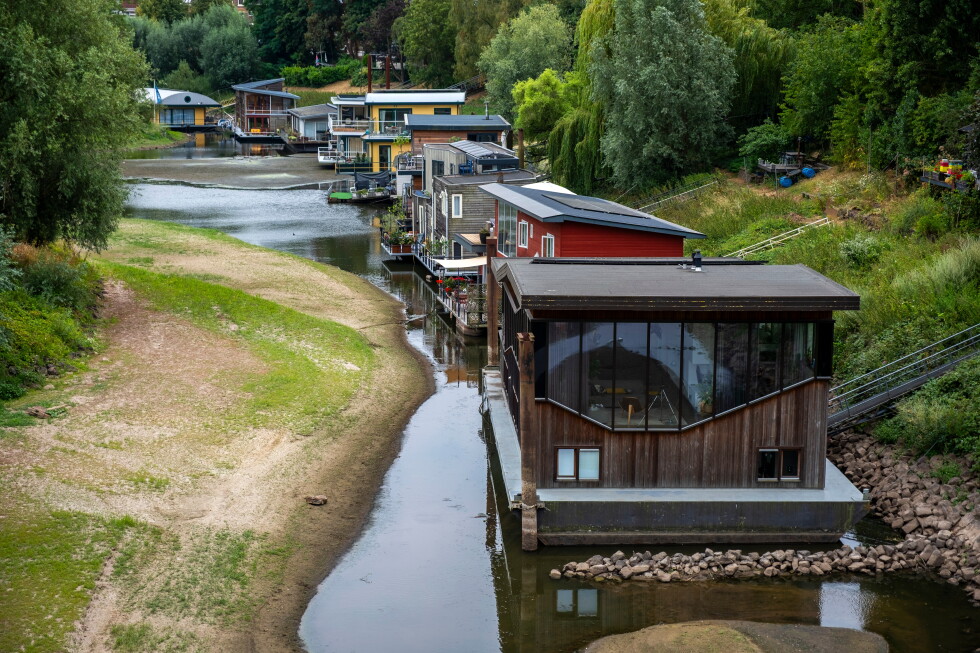
The drought’s impacts extend far beyond dike integrity, rippling through regional economies and critical transport networks. The Rhine, Europe’s most vital inland freight waterway that connects North Sea ports to industrial heartlands in Germany and landlocked Central Europe, dropped below its 2018 record low near Cologne, Germany, over the weekend. Marcel Beck, manager of the western German ports of Neuss, Düsseldorf and Cologne for logistics firm RheinCargo, called the low water levels “devastating” for commercial shipping. Whereas a single cargo vessel can typically carry 2,000 to 2,500 metric tons of freight along the Rhine, water depths are now so shallow that most ships can only load 400 to 600 metric tons to avoid running aground on sandbars. “This places an enormous burden on the entire transport chain to reorganize everything in order to still get the goods inland,” Beck said. In the eastern Netherlands, the Waal river — the main Dutch branch of the Rhine — has receded so far that long-submerged items like rusted bicycles and discarded shopping carts are now exposed on the dry riverbed, and dozens of houseboats are sitting directly on the exposed sandy river bottom. Frans Schilte, a houseboat owner in the city of Nijmegen, has observed that low-water seasons have grown longer and more severe in recent years, extending from the historic one-month average to three full months. His own steel-hulled boat now rests on the riverbed, sitting slightly off-level as a result. “It’s not a big problem,” Schilte said, “but it’s the negative effect of climate change.”
For the Netherlands, a country where roughly one-third of total land sits below sea level, managing water has always required a delicate balancing act: winter brings the constant threat of catastrophic flooding, while extended summer droughts increasingly bring the opposite problem of water scarcity. Deltares, an independent Dutch water research institute, says the country has enough total annual freshwater to meet all needs, but seasonal distribution is the core challenge. “In the winter we drain it away quickly because we want to keep our feet dry and we don’t want water on the land,” explained Vince Kaandorp, a groundwater hydrologist at Deltares. “How can you ensure that you do that slowly and give water time to sink into the ground?” Kaandorp notes that solutions don’t require massive high-tech infrastructure: simple adjustments like adding hedgerows along river banks can slow runoff, giving rainwater more time to seep into deep groundwater reserves. Dutch water authorities are currently researching how to modify agricultural and riparian soil to act like natural sponges, holding more moisture through dry summer months.
Even with these adaptive measures, the drought has already caused significant disruption for Dutch agriculture. Some regions have banned farmers from pumping canal water for crop irrigation as authorities work to preserve freshwater supplies and prevent saltwater intrusion into low-lying reclaimed lands. Western Dutch polders, which produce much of the country’s fruit and vegetable crops, are facing increasing salinization as freshwater levels drop and seawater seeps into groundwater reserves. Farmers are warning of reduced harvests and higher consumer prices for summer fruit this year. “It is an extremely challenging year for growers,” said John Kusters, chair of the Netherlands Fruit Growers’ Organization, in a public statement.