JAMUNDI, Colombia — For 70-year-old Potrerito villager Gladys Marín, the route to Colombia’s upcoming presidential polling station is only a short cross-street walk away. Yet even this trivial trip feels like an enormous risk, as growing insecurity has left her questioning whether casting a ballot is worth endangering her life.
Marín’s southwestern home sits less than 100 meters from the local police station — a site that has become a repeated target for drone-borne explosive attacks carried out by a dissident rebel faction that rejected the 2016 peace accord with the Colombian government. “You have to stay alert every minute, because we live right next to the police station,” Marín explained from her porch, 470 kilometers southwest of the capital Bogotá.
On May 31, Colombians will head to the polls to elect a new president and vice president, in a contest widely framed as a public referendum on the policies of incumbent President Gustavo Petro. The most debated topic at the heart of the race is Petro’s signature “total peace” initiative, a bold policy designed to end decades of internal conflict by negotiating disarmament with the country’s remaining illegal armed groups.
Across the country, rising violence linked to these armed factions has intensified under Petro’s administration, creating fear and uncertainty that extend directly to the electoral process. Colombia’s Electoral Observation Mission estimates that 386 municipalities — roughly one-third of the country’s total local jurisdictions — face high risk of interference and harm from illegal armed groups. Independent analysis from the Bogotá-based think tank Ideas for Peace Foundation adds that approximately 27,000 combatants remain active under arms across the nation.
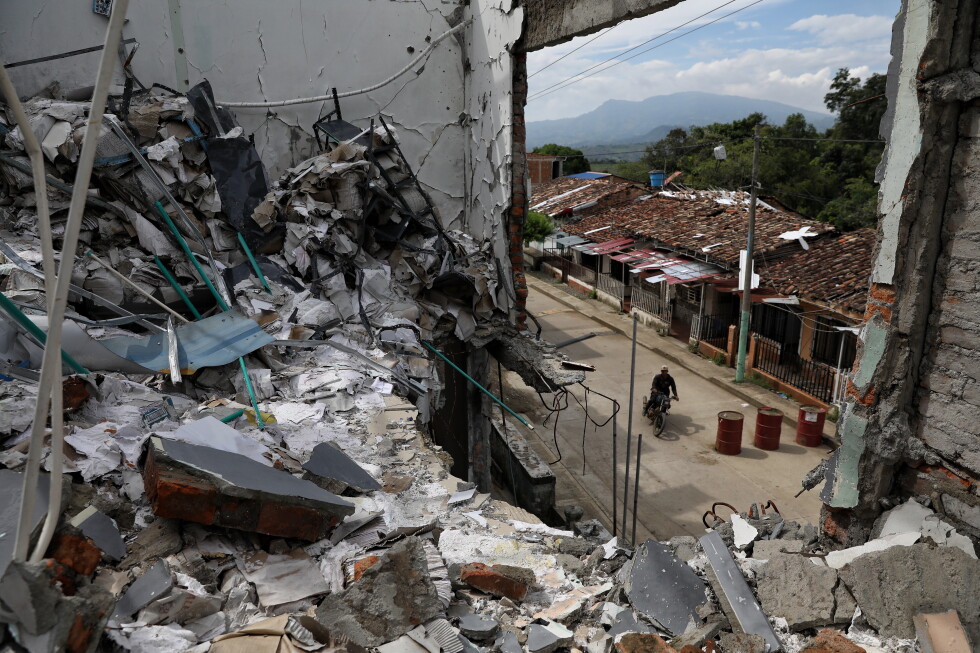
In recent years, the proliferation of modified drones carrying explosives has fundamentally reshaped the landscape of conflict in Colombia, creating new risks for both security forces and civilian populations. This tactical shift is particularly visible in Jamundi, where neighboring Robles town has blocked all streets leading to the local police station with makeshift barricades. Officers stand watch in sandbag-reinforced sentry posts draped in black fabric, constantly scanning the sky for incoming hostile drones.
Eucaris Zamora, a Robles resident who was forced to abandon her home after a cylinder bomb from a drone destroyed half the building last October, says constant dread has become part of daily life. “You pass the police station always looking up, dreading that you’ll run into a nasty surprise,” she said.
Guillermo Londoño, security secretary for the Valle del Cauca department where Jamundi is located, notes that armed groups have evolved their drone tactics to increase casualties and chaos. Instead of launching single drone attacks followed by reloading, groups now carry out coordinated “swarm-style” simultaneous strikes that overwhelm defensive positions.
Colombia’s Defense Ministry data underscores how rapidly this threat has grown: 333 drone attacks were recorded across the country in 2025, a more than fivefold increase from just 61 incidents in 2024. As of early 2025, the Colombian army has documented 107 drone strikes that have already killed two soldiers, with the highest concentrations of attacks along the Venezuelan border, northern Bolívar province and southwestern coastal regions.
Local officials frame the rising violence in Valle del Cauca as a direct failure of Petro’s “total peace” strategy, which was designed to end one of the world’s longest-running internal armed conflicts. Petro has publicly acknowledged that the initiative has failed to deliver the rapid disarmament of illegal networks he initially promised, and has recently hardened his approach: negotiations with several non-compliant groups have been frozen, while dialogue continues with other factions that have adhered to ceasefire commitments.
The election has exposed a sharp ideological divide among presidential candidates over how to address the country’s security crisis. On one side, candidates aligned with Petro’s administration, including ruling movement Sen. Iván Cepeda, advocate for continuing negotiated dialogue to end the conflict. On the opposition side, candidates like Sen. Paloma Valencia of the right-wing Democratic Center and Abelardo de la Espriella — an open admirer of Salvadoran hard-line President Nayib Bukele — have pledged to abandon negotiations entirely and prioritize full-scale military pressure to dismantle illegal groups.
International crisis analysts warn that escalating military pressure could backfire and lead to even more bloodshed. “Right-wing candidates propose a hard-line response that could exacerbate violence, because armed groups will respond to state military pressure with terror attacks against civilian and security targets,” explained Elizabeth Dickinson, senior analyst for the International Crisis Group. “They lack the capacity to fight a conventional symmetric war against the army, so they will turn to asymmetric attacks to sow fear.”
Even in communities that have born the brunt of rising violence, many residents still hold out hope for a peaceful future. Last December, a large-scale gun assault on the police station in the small southern town of Buenos Aires left multiple officers injured, destroyed a local bank and reduced dozens of nearby homes to rubble. Among the wrecked properties was the home of 89-year-old Celimo Enrique Aguilar. When asked if he still believed Colombia could achieve lasting peace, Aguilar said: “I haven’t lost faith that someday, we’ll all be able to live without fear.”