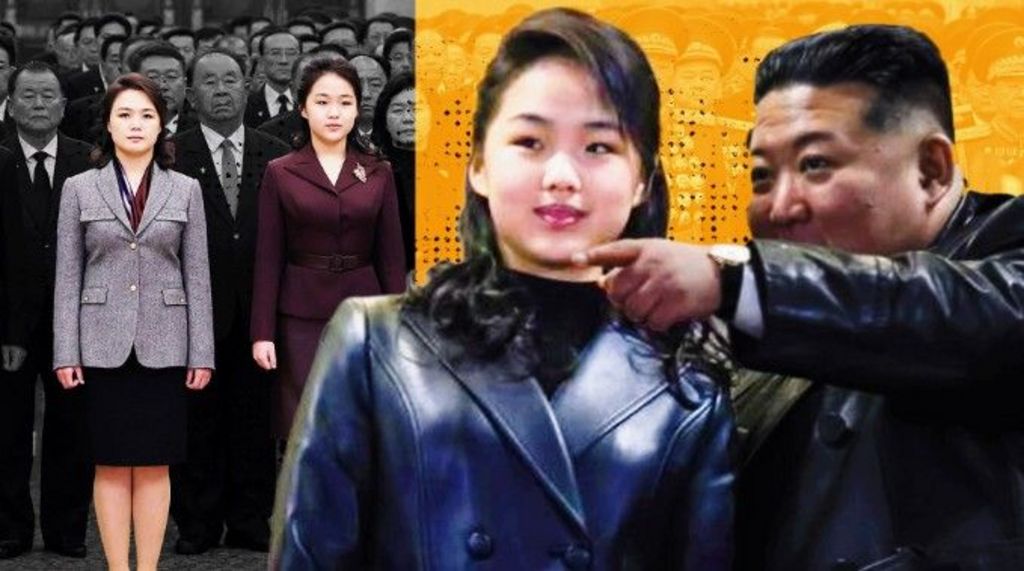
When a 9-year-old girl stepped out beside her father, North Korean leader Kim Jong Un, in front of a massive intercontinental ballistic missile in November 2022, the world’s attention quickly turned beyond the display of military power to the young figure at his side: his daughter, Kim Ju Ae. Now 13, Ju Ae’s increasingly frequent public appearances alongside her father have sparked widespread speculation that she is being groomed as Kim Jong Un’s eventual successor. What many analysts have zeroed in on, however, is not just her growing public profile, but the subtle political messaging woven into every outfit and hairstyle she wears.
Ju Ae’s public wardrobe has evolved steadily from her debut, when she wore simple black trousers and a white padded jacket with tied-back hair, to increasingly elaborate hairstyles and sophisticated, tailored ensembles. South Korea’s National Intelligence Service has already concluded that Kim Jong Un has designated her as his heir apparent, given her prominent placement at major state events ranging from missile tests and military parades to official overseas visits. Analysts argue that her carefully curated fashion choices are no accident, but a deliberate strategy crafted by North Korea’s ruling Propaganda and Agitation Department to shape public perception of her as a future leader.
Cheong Seong-chang, deputy director of the South Korea-based Sejong Institute, explains that the regime’s styling choices are designed to address Ju Ae’s biggest perceived vulnerability: her youth. By dressing her in formal, tailored suits and skirts that closely mirror the style of her mother, First Lady Ri Sol Ju, the regime works to project an air of maturity and authority that defies her young age. For visits to rugged locations such as military bases, Ju Ae is often styled in sharp leather jackets – a choice that balances a strong, authoritative impression with approachable casualness, while also creating a visual parallel with her father, who is famously fond of black leather jackets and trench coats.
This pattern of “image replication” is a well-documented tactic North Korean leaders have used for generations to consolidate power and legitimize dynastic succession. When Kim Jong Un first took power, he deliberately adopted the clothing and styling of his grandfather, Kim Il Sung, the founding leader of North Korea who is revered as a near-deity within the country. Cheong notes that this deliberate resemblance helped offset concerns about Kim Jong Un’s youth and lack of experience, even spurring widespread rumors among North Korean citizens that Kim Il Sung had been reincarnated in his grandson. Today, the same strategy is being deployed to build legitimacy for a new young successor.
Beyond shoring up legitimacy, Ju Ae’s fashion also serves a second purpose: reinforcing the unique social status of the Kim family at the top of North Korean society. High-quality leather garments, fur coats, and Western-designed luxury pieces are largely inaccessible to ordinary North Korean citizens, so Ju Ae’s frequent wear of these items sends a clear signal that she belongs to a privileged ruling class. “Wearing clothing made of high-quality leather is a way of showing off one’s special status,” Cheong explains. “Luxury brands, leather jackets and fur coats are precious clothes that can’t be worn by ordinary North Koreans.”
This contrast between the ruling family’s wardrobe and the restrictions placed on ordinary citizens could not be starker. In 2020, North Korea passed the Reactionary Ideology and Culture Rejection Act, which bans the spread of “external culture” including Western fashion trends. Yet in 2023, state media released footage of Ju Ae wearing a black padded jacket worth an estimated $1,900 from luxury French fashion house Christian Dior. The following year, she wore a semi-sheer blouse that exposed her arms to a Pyongyang residential development completion ceremony. Shortly after that appearance, state authorities released a public directive warning ordinary citizens that such hairstyles and clothing qualify as “anti-socialist” threats to the socialist system that must be eliminated, according to a local source cited by Radio Free Asia.
This double standard is nothing new in North Korea, where the ruling Kim family exists above the laws that apply to the general population. As Lee Woo-young, a professor at the University of North Korean Studies, points out, “Although jeans are banned in North Korea as a Western fashion item, Kim Jong Un has appeared wearing them. No matter how much they ban foreign culture and even enact laws, North Korea is a place where there is nothing the supreme leader is unable to do.”
Even with these restrictions on ordinary citizens, Ju Ae’s high-profile fashion has already created subtle ripple effects across North Korean society. Multiple reports indicate that demand for luxury goods including Chanel cosmetics and perfumes has risen among affluent North Koreans, while fur coats have grown popular in border cities near China. Photos have emerged of children at elite Pyongyang kindergartens wearing semi-sheer blouses matching Ju Ae’s 2024 look, and leather trench coats and sunglasses modeled after the styles worn by Ju Ae and Kim Jong Un have become trendy among wealthy young North Koreans.
This pattern of copying the ruling family’s style is also not new: for years, young North Korean men have adopted the signature hairstyle of Kim Jong Un. With most ordinary North Koreans cut off from global fashion trends and outside information, the Kim family has become an unlikely source of style inspiration for the country’s population. Now, as Ju Ae steps further into the public eye, she has taken on a new, unintended role: North Korea’s newest fashion icon.