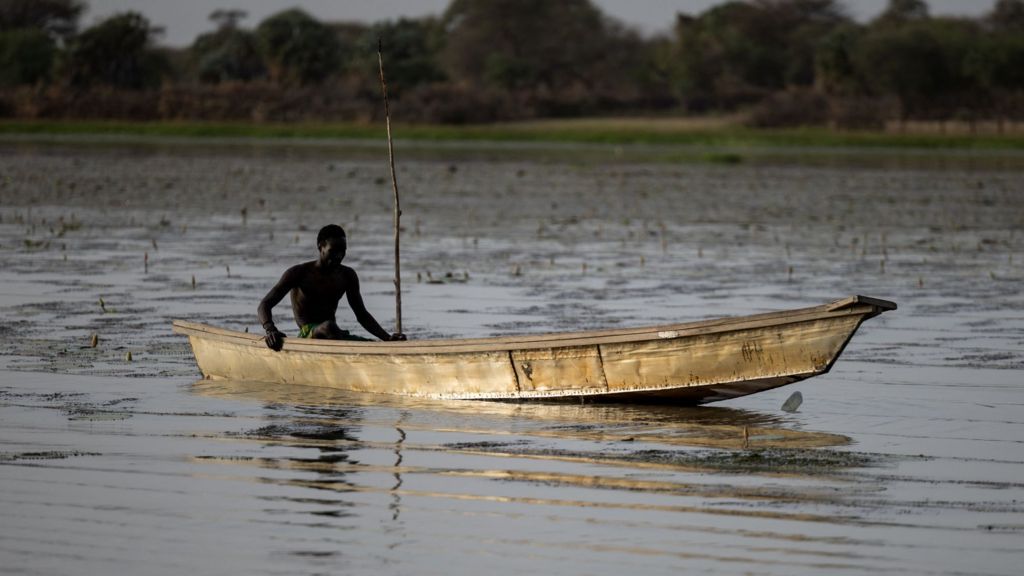
A devastating incident in the volatile Lake Chad basin has left dozens of Nigerian fishermen feared killed after Chadian military forces launched retaliatory air raids targeting Boko Haram militants in the shared transboundary region, a top local fishing industry leader has confirmed to the BBC.
Abubakar Gamandi Usman, who heads the Lake Chad Basin Fisheries Association of Nigeria, confirmed that dozens of union members remain unaccounted for following the strikes, with his preliminary death estimate placing the toll at more than 40. While no casualties have been officially recovered or identified to date, Usman says two distinct fatal scenarios have emerged: some fishermen were directly hit by the air strikes, while others drowned when their overloaded vessels capsized as they fled the attack in panic.
Officials from both the Chadian and Nigerian governments have not yet released an official statement or responded to requests for comment on the civilian casualties. However, Chad’s presidency confirmed over the weekend that it had conducted intensive retaliatory air strikes against Boko Haram strongholds in the region. In a public announcement posted to its official Facebook page, the presidency explained the operation was launched in response to two unprovoked Boko Haram attacks targeting Chadian military outposts near Lake Chad on the previous Monday and Wednesday. Those militant assaults left at least 24 Chadian soldiers and two senior generals dead, according to local reports.
The Lake Chad basin is a vast ecologically and economically critical region of interconnected waterways and swampland, shared across the borders of Nigeria, Chad, Niger and Cameroon. For more than a decade, the area has served as a primary operational hub and stronghold for the Islamist extremist group Boko Haram, as well as its splinter rival faction, the Islamic State West Africa Province (ISWAP).
Usman explained to the BBC that after attacking Chadian security forces, Boko Haram fighters retreated to remote archipelago positions they use as bases — islands that are also permanently inhabited by artisanal fishing communities who depend on the lake for their livelihoods. When Chadian warplanes entered the airspace above the islands starting Friday, widespread chaos erupted, with both militants and local fishermen scrambling to evacuate the area at the same time.
Search and recovery operations for missing fishermen have proceeded at a frustratingly slow pace, Usman added, hampered by the lake’s extreme depth in the targeted area and critical logistical constraints. Most functioning canoes and watercraft in the region are controlled by Boko Haram, leaving local communities with limited resources to launch search missions. Even before the strike, Usman noted, Boko Haram effectively controls all access to the lake’s most productive fishing grounds, regulating transport of fishermen between their villages, fishing sites and regional fish markets, and collecting regular illegal taxes from working fishermen operating in the area.
Security analysts note that the Lake Chad region has seen a sharp escalation in militant activity in recent months, with a rising tide of attacks on regional security forces, mass kidnappings of local civilians, and cross-border raids on settled communities.
This is not the first time Chadian military counter-terrorism operations have been accused of causing mass civilian casualties among fishing communities. In October 2024, Chadian air strikes targeting Boko Haram positions on Lake Chad’s Tilma Island were also reported to have killed dozens of Nigerian fishermen who were working in the area. Nigerian federal authorities have so far not released any public comment on allegations that civilian fishermen were caught in the crossfire of this latest counter-terrorism operation.