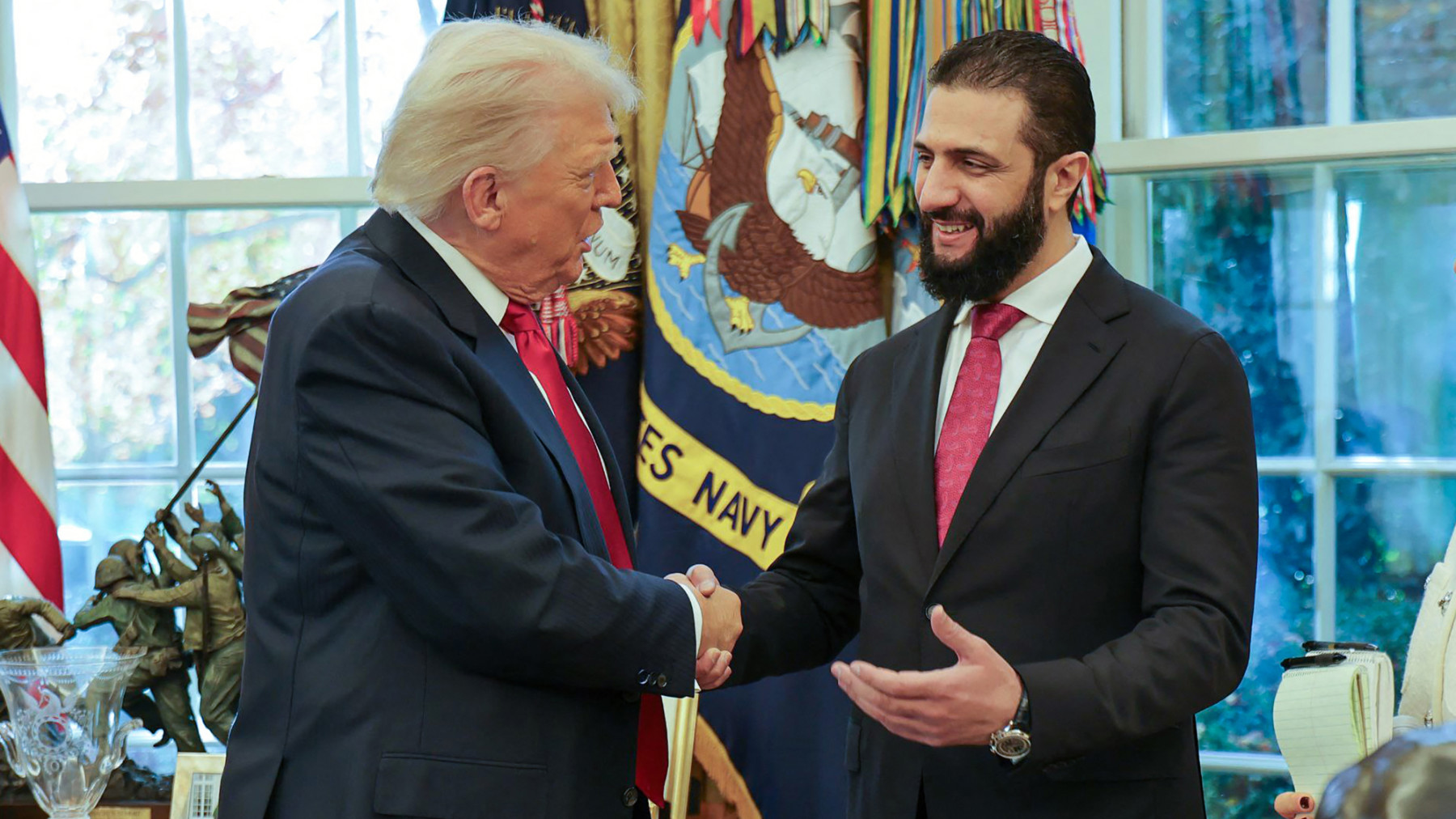
In recent months, successive public statements from U.S. President Donald Trump suggesting Syria take charge of addressing the Hezbollah issue have rekindled deep-seated anxiety in Lebanon over a potential return of Syrian military involvement to the country, even as Syrian President Ahmed al-Sharaa and his administration have repeatedly rejected any plans for armed intervention. Trump’s increasingly explicit framing of a Syrian role has also exposed apparent inconsistencies in the Biden administration’s earlier messaging, directly contradicting a previous categorical denial from U.S. Ambassador to Syria Tom Barrack, who dismissed claims Washington had pressured Damascus to deploy troops into Lebanon as “false and inaccurate.”
The most recent comments from Trump came during a June 21 interview with Fox News, where the U.S. leader expressed open disappointment with Israel’s ongoing campaign against Hezbollah, criticizing the operation for its widespread collateral damage. “They can’t do anything without knocking buildings down,” Trump told the outlet, adding “I’m close to giving it over to Syria.” Notably, Trump offered no additional context to clarify his use of the phrase “giving it over,” leaving observers uncertain whether he was referencing a full-scale Syrian military operation, regional political mediation, targeted pressure on Hezbollah, enhanced cross-border security coordination, or expanded cooperation with Lebanon’s central government. Even so, his remarks mark the latest in a string of public signals that the White House has actively explored assigning Damascus a formal role in managing the Lebanese armed group.
The discourse around a potential Syrian involvement first emerged in public view on March 17, when Reuters published a report claiming U.S. officials had encouraged Damascus to consider deploying military forces into eastern Lebanon to support efforts to disarm Hezbollah. Citing five anonymous sources with direct knowledge of the behind-the-scenes talks, the outlet noted that Syrian officials had already expressed reluctance to move forward with the proposal, warning that intervention could drag Syria into a wider regional conflict and reignite volatile sectarian tensions in both Syria and Lebanon. According to the report, the proposal was first raised during bilateral talks between U.S. and Syrian officials in 2025, before being revisited in late February, shortly after the outbreak of the U.S.-Israeli war on Iran. Within hours of the report’s publication, Barrack issued a forceful public rejection of the claims, writing on the social platform X that “Reporting regarding the United States encouraging Syria to send forces into Lebanon is false and inaccurate.”
Despite these denials, regional outlet Middle East Eye (MEE) subsequently reported that Sharaa held a meeting with leaders of Syrian armed factions shortly after the Reuters report to discuss the circulating claims. A Syrian source briefed on the gathering told MEE that “Those present agreed that Syria had neither the intention nor the desire to intervene militarily in Lebanon.” A separate senior Lebanese source also confirmed to MEE that Lebanese authorities in Beirut had received multiple formal reassurances that Damascus had no plans to deploy troops across the shared border. The outlet further reported that Syrian officials have begun coordinating with regional allies including Saudi Arabia, Qatar, and Turkey to push back against U.S. pressure for intervention. A second senior Syrian source told MEE that to avoid directly complying with Washington’s demands, Sharaa has laid out a series of preconditions for any Syrian involvement that would be nearly impossible for the U.S. to meet.
Trump first floated the idea of a Syrian role in Lebanon publicly during a June 5 appearance on NBC’s *Meet the Press*, where he called for a more “surgical” campaign against Hezbollah and suggested Washington could either directly assist the effort or “recommend Syria” take the lead. “We can help them with that, or we can recommend Syria,” Trump said at the time, praising Sharaa and claiming the Syrian leader “would love to help.” While that initial stop stopped short of an explicit call for Syrian troops to enter Lebanon, Trump adopted a far more direct tone during a press availability at the G7 summit in Evian-les-Bains, France, on June 16. “I suggested to Israel to let Syria take care of Hezbollah, because, to be honest with you, I think they do a better job of doing it,” he told reporters. He doubled down on his criticism of Israel’s campaign, arguing it has progressed too slowly, caused unnecessary civilian casualties, and destroyed large swathes of residential infrastructure. He also reiterated his praise for Sharaa, claiming the Syrian leader has done an “amazing job” consolidating state control across Syria and “does not like” Hezbollah.
The following day, when pressed by reporters to confirm whether he had directly discussed the Hezbollah issue with Sharaa, Trump confirmed the conversation had occurred but declined to share whether the Syrian leader had agreed to take on a role, saying only that he would address the matter at a later date. The exchange confirmed that Trump’s proposal was not merely an abstract suggestion for Israeli policymakers, but that the prospect of a Syrian role had already been raised directly with the Damascus government.
In recent weeks, Sharaa has moved aggressively to quell growing speculation over potential intervention. During a June 11 meeting with dignitaries from the Damascus countryside, he dismissed reports of an imminent Syrian military entry into Lebanon as baseless rumors. Later, in an interview with Al Arabiya, Syrian presidential adviser Ahmed Muwaffaq Zaidan confirmed that Washington had proposed Syrian involvement amid the ongoing regional escalation, but said Damascus had rejected any military or security role in Lebanon. He added that Syria supports extending the authority of Lebanon’s central government across all of its territory, but that this goal should be achieved by strengthening Lebanese state institutions rather than deploying Syrian troops.
Sharaa expanded on this position in a June 21 interview with Al Mashhad TV, pushing back against claims that Trump’s comments were a signal Syrian forces would enter Lebanon imminently. He argued Trump’s remarks had been misinterpreted, explaining that the U.S. president had raised concerns over the ongoing war and discussed potential Syrian contributions to a peaceful, secure resolution, rather than calling for an invasion. Sharaa emphasized that Syria’s top priority is ending the war and halting Israeli bombardment, noting that Damascus has discussed political, economic, and social pathways forward with U.S. officials. “Our vision is based on supporting the Lebanese state once again, strengthening its institutions, and seeking a solution that everyone believes in,” he said. “We are looking for economic channels between Lebanon and Syria, not military ones.” Sharaa also noted that Damascus is open to dialogue with all Lebanese political factions, including Hezbollah, acknowledging that the group’s role in Syria’s civil war left a “deep Syrian wound” but adding he would meet with Hezbollah representatives if it advanced the shared interests of both Lebanon and Syria.
Lebanese President Joseph Aoun welcomed Sharaa’s public clarification, saying the reassurances had been well received in Beirut and helped put an end to rampant speculation over a Syrian military role. While Syrian statements have eased immediate public anxiety in Lebanon’s capital, Trump’s repeated calls for a Syrian role, paired with conflicting accounts of earlier U.S.-Syrian talks, have left lingering, unresolved questions about what role Washington ultimately expects Damascus to play in the future of Hezbollah and Lebanese stability.