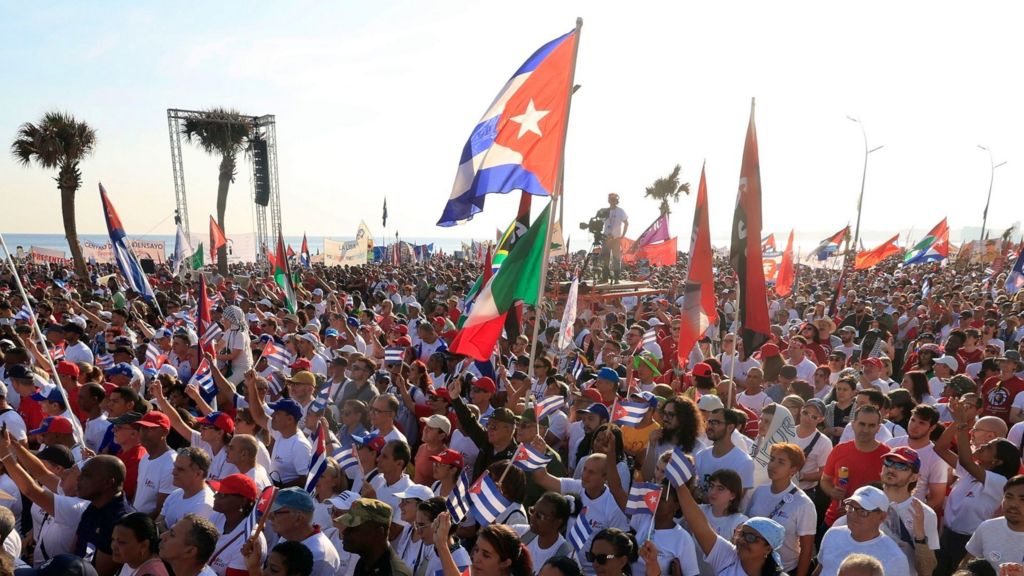
On International Workers’ Day, thousands of Cuban demonstrators gathered outside the United States Embassy in Havana to protest against a fresh round of punitive sanctions imposed by the Trump administration, paired with an ongoing US oil blockade that has brought widespread disruption to daily life across the island nation.
The new executive order, signed by former President Donald Trump during a Florida campaign appearance Friday, expands US restrictions to target Cuban officials working in the country’s energy, defense, financial and security sectors, as well as individuals the administration accuses of human rights violations and corruption. Speaking to supporters in Florida, Trump doubled down on his aggressive anti-Cuba rhetoric, claiming the US would “take over” the Caribbean island – located just 90 miles off the coast of Florida – “almost immediately.” In a provocative boast, he suggested that the USS Abraham Lincoln, the US Navy’s massive aircraft carrier, could be deployed off Cuban shores to force the country’s leadership into surrender.
Cuba’s top diplomat, Foreign Minister Bruno Rodriguez, immediately condemned the new measures as “illegal and abusive,” writing on the social platform X that the unilateral coercive measures violate core tenets of the United Nations Charter. Rodriguez emphasized the sanctions amount to deliberate collective punishment of the Cuban people, and shared footage of the May Day demonstrations, framing the protests as a defensive stand for national sovereignty. “Our people do not cower,” he added. Cuban President Miguel Díaz-Canel echoed that criticism, pointing to the intimidation and arrogance of the world’s largest military power as the root of continued hardship for Cuban citizens. The new sanctions come as a surprise reversal of tentative bilateral talks: Díaz-Canel confirmed as recently as March that Cuban officials were in negotiations with the US to reset strained bilateral relations.
The ongoing US oil blockade has already triggered crippling fuel shortages and rolling nationwide blackouts that have disrupted critical public services, from hospital operations to public transit and school sessions. Since the blockade was implemented, only one Russian oil tanker has successfully docked in Cuba to deliver supplies. Trump has further threatened to impose steep tariffs on any country that chooses to export oil to Cuba, raising the stakes for the island’s already fragile economy.
Bilateral tensions between the US and Cuba have persisted for more than six decades, dating back to 1959, when Fidel Castro’s communist revolution overthrew a US-backed authoritarian government. A sweeping US economic and trade embargo has been in place since 1960, and this year Cuba is marking the 100th anniversary of Castro’s birth. The latest escalation of US pressure comes as the Trump administration has made dismantling Cuba’s communist leadership a core foreign policy priority for a second term.