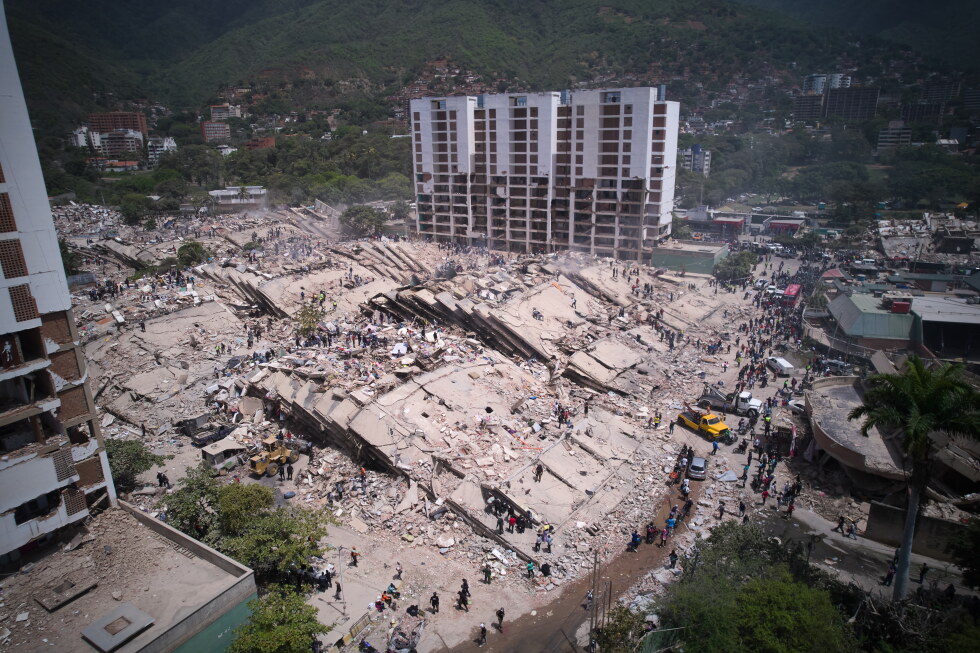
Three days after back-to-back powerful 7.2 and 7.5-magnitude earthquakes devastated northern Venezuela, the race against time to pull trapped survivors from the rubble of flattened homes and apartment blocks is growing exponentially more desperate. As hope for finding more people alive fades, the disaster has left a broken nation grappling with overwhelming human loss, limited government rescue capacity, and growing chaos in the hardest-hit zone centered on La Guaira, just north of the capital Caracas.
By Friday evening, Venezuelan authorities announced a full access restriction to La Guaira, the epicenter of the destruction, after unregulated traffic and chaotic crowds began to obstruct ongoing search-and-rescue operations. Under the new order, all people seeking entry to the area must first obtain official permits, though government officials have released little to no detail on who will qualify for access.
As of midday Friday, official counts placed the confirmed death toll from Wednesday’s twin quakes at more than 920, with over 3,300 people injured and 243 survivors pulled from rubble so far. Independent digital tracking databases list more than 51,000 people as unaccounted for, a figure that includes many displaced residents cut off from communication by collapsed cellphone infrastructure, as well as duplicate missing person reports. Officials have warned that the final death toll will almost certainly rise as search teams clear more debris.
With rescue resources stretched thin across the devastated region, many Venezuelan families have launched their own search efforts for missing loved ones, reporting almost no presence of official state rescue teams in the most heavily damaged zones — a stark contrast to the government’s public claims of a robust, coordinated response. Aid organizations universally recognize the first 48 to 72 hours after a major seismic event as the most critical window for rescuing people alive, though survival can be extended for trapped people with access to clean water and food.
“Each person saved is a miracle,” said Jorge Rodríguez, president of Venezuela’s National Assembly. “We are not going to hide absolutely anything about the magnitude of this tragedy.”
In La Guaira, the scope of grief and urgency is impossible to miss. Nazareth Jimenez collapsed into the shoulder of a family member, sobbing as local neighbors used hand tools and borrowed power saws to cut through thick concrete slabs of what was once a multi-story apartment building, now reduced to a jagged mountain of rubble. Inside were her siblings, nieces, nephews, and close friends, and she waited in agony for any sign of life. “My God, how are we going to get them out of there?” she murmured. Desperate for heavy machinery to move collapsed concrete and steel, she made a public plea: “We’re making a call for help to the government and countries across the world. There are still people alive in there.”
Acting President Delcy Rodríguez, who took office in January after the United States supported the capture and removal of former President Nicolás Maduro, said the Venezuelan government was carrying out a full-scale response during these “critical hours for rescuing people alive.” Government forces have distributed basic food and water to displaced survivors in La Guaira, and Rodríguez confirmed the state has militarized the area, welcomed international rescue teams and humanitarian aid, and that additional support is en route. Still, many local residents say the aid and resources deployed so far are only a tiny fraction of what the devastated region needs.
The massive disaster represents one of the most severe tests of Rodríguez’s acting administration, which already faces the headwinds of a decade-long national economic crisis and widespread public skepticism over the legitimacy of the ruling political movement.
The International Organization for Migration estimates that up to 6.76 million people across the region have been affected by the quakes, with nearly 2 million of those in the capital Caracas alone. Seismology experts note the destruction was amplified by two key factors: the quakes’ shallow depth and their rapid succession, which left little time for survivors to evacuate unstable structures. Loyce Pace, regional director for the International Red Cross in the Americas, said “people are still terrified to reenter what were their homes,” and thousands of displaced residents have taken to sleeping on sidewalks and in open public spaces out of fear of aftershocks and further building collapses.
For many families, the loss is unfathomable. Walking through the rubble that still holds the bodies of two of his children, Omar Reyes shared that around 20 members of his extended family were killed in the disaster. “I’ve been left alone in this life,” he said. In the nearby city of Maiquetia, residents lined up for hours outside the few operating stores and pharmacies, which were only letting customers enter one at a time to avoid overcrowding. At one point, a desperate woman threw herself on top of a package of diapers in the crowd, curling her body around it to protect the supply for her child.
In Catia La Mar, adjacent to Venezuela’s main international airport, some desperate residents have been seen moving basic supplies including toilet paper and food from damaged or abandoned stores, and crowds once swarmed a civilian pickup truck distributing free bread and water before a soldier intervened to restore order. The parking lot of a local pharmacy has been converted into a makeshift displacement camp, with residents using tarps, hammocks, and donated tents for shelter.
Twenty-eight-year-old Yuleidy Cadenas has stood across the street from a collapsed public housing building for days, holding out hope that her son, mother, and brother will be pulled out alive. She fled barefoot from another collapsing building on the day of the quakes, only to return and find her mother’s 12-story apartment tower had completely flattened. “I got on top of the rubble and told them to yell back, and nobody did, not my brother, nor my son or my mother,” Cadenas said.
Disruptions from unregulated traffic and groups of motorcyclists have repeatedly hampered search efforts. Mexican rescue teams and volunteer first responders have repeatedly asked for silence to listen for faint signs of life under rubble, but civilian and uniformed bikers have continued honking horns and revving engines, leaving first responders frustrated.
As the critical 72-hour window closes, international aid has begun arriving in the country. Venezuelan authorities confirmed Friday that 861 rescue volunteers from Mexico, the United States, El Salvador, Switzerland, Colombia and other nations are already on the ground, with more teams en route from other countries. Acting President Rodríguez said she spoke with U.S. President Donald Trump and Secretary of State Marco Rubio on Friday, and both reaffirmed the United States’ commitment to sending additional rescue teams and heavy aid equipment to support the response effort.
AP correspondent Julia Janetsky reported from Mexico City, with additional contributions from AP journalists Clara Preve in Buenos Aires, Argentina, and Dánica Coto in San Juan, Puerto Rico.