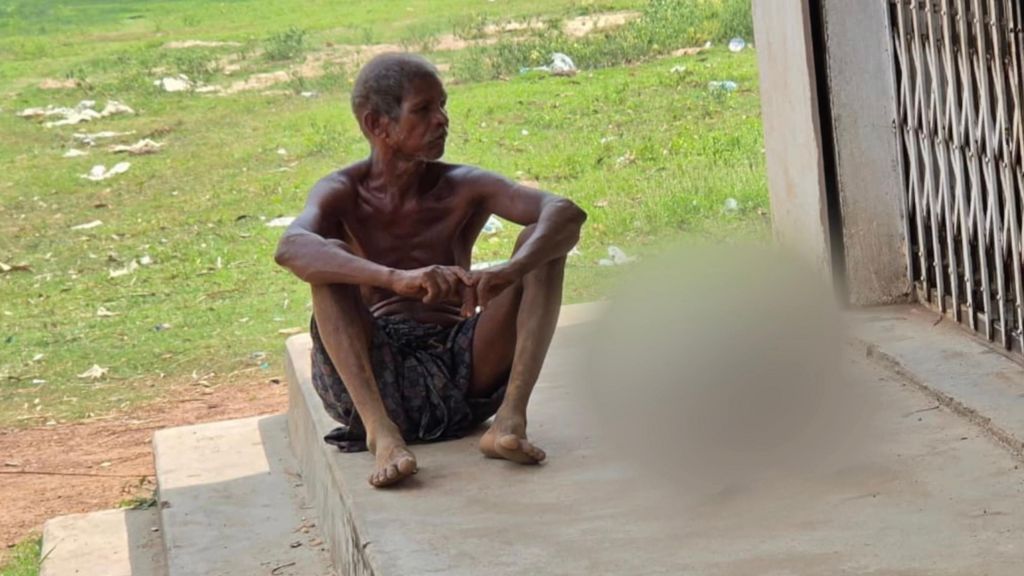
A shocking incident from the eastern Indian state of Odisha has captured national attention this week, after a 52-year-old man named Jitu Munda went to extreme lengths to claim his late sister’s savings: he carried her exhumed skeletal remains to his sister’s local bank branch to prove she had died. The graphic footage of the act quickly spread across social media platforms, sparking widespread public outrage over systemic bureaucratic barriers and the struggles of low-income rural families navigating India’s formal financial system.
According to Munda’s account, the ordeal began earlier this year when his 56-year-old sister Kalara passed away. A daily wage laborer who had returned to her maternal home following the deaths of her husband and only son, Kalara had sold her livestock a few months before her death and deposited roughly 19,300 rupees (equivalent to around $203) into her bank account at Odisha Grameen Bank, a regional rural financial institution operated by Indian Overseas Bank. After her death, Munda attempted multiple times to withdraw the funds to settle her final affairs, but was repeatedly turned away for lack of official death documentation— a requirement to access funds when an account holder dies without naming a formal nominee.
Frustrated by repeated refusals and unresponsive bank staff, Munda made the decision to exhume his sister’s remains from her burial ground and carry the bundled skeleton to the bank branch in Keonjhar district on Monday. The viral video, filmed by an unknown person, shows Munda placing the sack-wrapped remains at the entrance of the bank building. Within hours, the footage spread widely across Indian social media, drawing immediate condemnation from the public and senior officials alike.
The bank has pushed back against Munda’s account of the incident. In an official statement, the institution denied ever requesting the physical remains as proof of death, claiming that it only asked for standard legally-mandated documentation to process the claim. Bank representatives added that the incident appeared to stem from Munda’s lack of awareness of required procedures, and alleged that he first arrived at the branch in an inebriated, disruptive state before returning with the remains. Sushant Kumar Sethi, the branch manager at the center of the controversy, also disputed key details of Munda’s claims: he told BBC Hindi that staff had even offered to visit Kalara at home when Munda initially claimed she was paralyzed, that Munda had not visited the branch in the two months prior to the incident, and that conflicting claims from other potential heirs prompted the request for formal documentation.
Public backlash following the video’s spread quickly forced intervention from local authorities. Odisha’s Revenue Minister Suresh Pujari announced that a formal investigation into the incident was underway, and confirmed that disciplinary action would be taken against the branch manager for his alleged conduct. The Keonjhar district administration also issued a statement expressing “deep concern” over the incident, affirming that protecting the rights and dignity of local residents is its top priority.
Police and local administrative officials ultimately intervened to de-escalate the situation, persuading Munda to return his sister’s remains to the burial ground and guaranteeing that his claim would be processed immediately. Officials also offered Munda a one-time assistance payment of 30,000 rupees to compensate for his ordeal. By Wednesday, just two days after the incident made headlines, local authorities had issued the required death certificate and legal heir documentation, and the bank confirmed that the full deposit amount had been released to Kalara’s legal family heirs.
The incident has reignited longstanding conversations about the persistent bureaucratic hurdles that disproportionately impact low-income and rural communities across India. Under current Indian banking rules, when an account holder dies without naming a nominee, surviving family members must produce a formal death certificate and legal heirship documentation to access funds. For residents of remote villages, obtaining these official documents can take weeks or even months, as government offices are often far removed from local communities and administrative processes remain slow and paper-heavy. Many commentators have pointed to the Odisha incident as a stark example of how rigid procedural requirements can dehumanize vulnerable families during an already devastating time of loss.