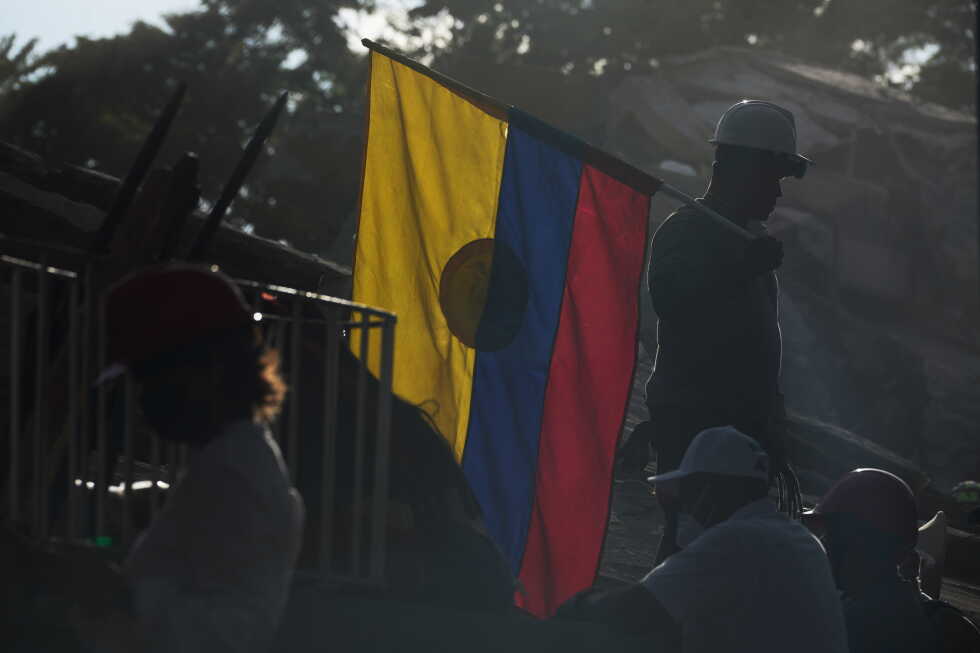
Just days after Colombian President Abelardo de la Espriella took office, a catastrophic 7.4 magnitude earthquake struck western Colombia on Monday, leaving the nation grappling with one of the worst natural disasters in the country’s recent history. Now, as rescue teams wrap up their search for trapped survivors in collapsed buildings, the South American nation turns to the daunting task of rebuilding communities shattered by the quake that has already claimed at least 285 lives and upended the lives of more than 100,000 people.\n\nAccording to official government data, the disaster damaged or destroyed tens of thousands of residential properties, alongside thousands of schools, healthcare centers, and community gathering spaces across more than 400 municipalities. Four major urban centers — Cali, Pereira, Manizales, and Quibdo — bore the brunt of the damage, leaving thousands of residents homeless.\n\nFor 38-year-old Ebert Jonathan Morales, staying at a government-run shelter in Cali, the disaster wiped out nearly everything his family owned. “There is no place to live, we lost everything,” Morales told the Associated Press. He is one of more than 102,000 people displaced by the quake, which has also left nearly 4,000 people injured. While official government data puts the number of missing people in the hundreds, independent private sector analysts estimate that thousands remain unaccounted for. Morales explained that he and his wife and four children will remain at the shelter until state support arrives, saying “The earthquake destroyed several neighborhoods in the city. Many houses were damaged, and buildings collapsed. We are going to stay here until the government gives us some help, some support.”\n\nSimilar stories of displacement echo across affected regions. Olga Castro, a mother of five who is currently staying with a neighbor after losing her home, said “At least we survived, but right now we are practically on the street because we don’t have a home anymore.” In many remote and hard-to-reach areas affected by the quake, official government aid has not yet arrived, leaving residents to rely on volunteer efforts and mutual aid from neighboring communities.\n\nThe disaster has presented an immediate critical test for the new president, who was inaugurated just 48 hours before the earthquake hit. Speaking Thursday, de la Espriella acknowledged the unprecedented complexity of the crisis, announcing a national reconstruction plan that pairs government resources with private sector investment, alongside direct cash subsidies for homeless families. “We will not overcome this tragedy alone as a government,” he said. “We need the private sector to rebuild Colombia together.” The president added that all national and international donations raised for disaster response will be allocated to reconstructing critical infrastructure including hospitals, schools, residential buildings, roads, and airports.\n\nEngineering experts caution that reconstruction requires careful, systematic planning before any major work can begin. Yezid Alvarado Vargas, a construction engineering professor at Bogota’s Javeriana University, noted that a full technical assessment is required to determine which existing structures are safe to occupy, which can be repaired, and which must be demolished and rebuilt from the ground up. “Before even discussing reconstruction, we must guarantee temporary housing, food, healthcare, continuity of basic services and economic support for families who lost their homes or livelihoods,” Alvarado said.\n\nLocal authorities have repurposed public infrastructure including schools, parks, and government buildings as emergency shelters, distributing tents, mattresses, and food to displaced residents. In other hardest-hit areas, residents have set up improvised street-side shelters, while hundreds of volunteer groups continue to deliver aid to the most vulnerable communities, particularly those in isolated regions.\n\nMaría Mercedes Liévano, country director for Save the Children Colombia, explained that many of the most affected regions were already facing systemic crises before the earthquake. “These are isolated, neglected territories, historically lacking in institutional support, already plagued by violence, and now they are hit by an earthquake of this magnitude,” she said. “It’s a crisis on top of a crisis, leaving the population in a situation of extreme vulnerability.” Her organization highlighted particularly severe conditions in Buenaventura, Colombia’s largest Pacific port, and Chocó department, the epicenter of the quake.\n\nAs of Friday, national and international humanitarian aid continues to flow into the country. Multiple foreign governments including Peru, China, the United States, and the United Arab Emirates have pledged tons of emergency supplies and disaster relief. President de la Espriella is scheduled to travel to Quibdo in Chocó and Pereira on Friday to inspect relief efforts and monitor aid distribution, as Colombia begins the long process of recovery from the most powerful earthquake to hit the country this century.
Colombia grapples with rebuilding a shattered nation after a deadly earthquake