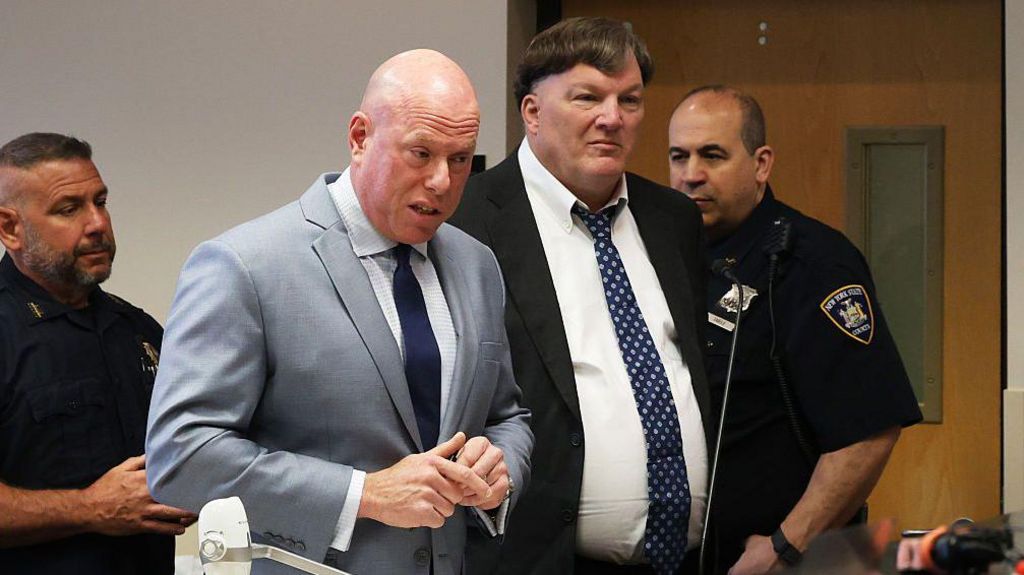
After more than 13 years of fear, uncertainty and delayed investigation, one of Long Island’s most notorious cold crime sagas reached a pivotal turning point this Wednesday, as 62-year-old architect Rex Heuermann pleaded guilty to the murders of eight women in a packed Suffolk County courtroom. The story that stunned and haunted the region for more than a decade closes a major chapter with Heuermann’s confession, though lingering questions and unresolved wounds still remain for communities and victims’ loved ones.
Dressed in a tailored black suit and blue tie, the 6-foot-4 Heuermann stood stone-faced before Judge Timothy Mazzei, answering “yes” to nearly every question about the details of his brutal crimes. He confirmed he used the promise of payment to lure each victim, bound and strangled them to death in an identical pattern, then discarded their dismembered remains along remote, brush-lined stretches of Long Island’s Gilgo Beach. He never turned to face the gallery filled with victims’ family members, some of whom choked back sobs as the graphic details of his crimes were laid out. “There wasn’t a jot of remorse in that man’s face,” said John Ray, attorney representing multiple victims’ families, after the hearing. “He was as cold as ice.”
All eight of Heuermann’s victims were sex workers, most of whom he contacted through advertisements posted on Craigslist. The case first emerged into public view in 2010, when investigators searching for a missing woman stumbled across four sets of human remains within a quarter-mile of each other along Ocean Parkway. Over subsequent years, more remains were uncovered, eventually totaling 11 sets of remains found across the coastal scrubland. Heuermann was first identified as a suspect and arrested in 2023, when investigators connected him to the crimes using DNA recovered from a discarded pizza box. Initially, he was charged with seven murders; Wednesday’s guilty plea added an eighth killing dating back to 1996. The full eight victims confirmed Wednesday are Melissa Barthelemy, 24, Megan Waterman, 22, Amber Costello, 27, Maureen Brainard-Barnes, 25, Jessica Taylor, 20, Valerie Mack, 24, Sandra Costilla, 28, and Karen Vergata, 34. Heuermann will receive multiple consecutive life sentences, to be formally handed down during a sentencing hearing scheduled for June 17.
The case was marked by years of investigative missteps and institutional failure that delayed justice by more than a decade. In its early stages, the investigation was led by former Suffolk County Police Chief James Burke, who was arrested in 2015 and later convicted of obstruction of justice. Former Suffolk District Attorney Thomas Spota, who also oversaw the probe, was ultimately brought down by the same corruption scandal that took down Burke. For years, the investigation made little tangible progress, and many victims’ family members have accused law enforcement of deliberately dragging their feet because all the victims were sex workers, noting officers frequently dismissed the women by labeling them “prostitutes.”
It was not until 2022, when new county leadership launched a multi-agency task force including both local and federal investigators, that the case moved forward rapidly. Investigators acted on a tip first given to police back in 2010 by Dave Schaller, roommate of victim Amber Costello, who described a large, intimidating client that matched Heuermann’s description driving a rare first-generation Chevrolet Avalanche. The tip led investigators to Heuermann, and further evidence—including burner phone communications, cell tower data, and hair DNA matching the DNA from his discarded pizza—solidified the case against him. Law enforcement also reported finding handwritten guides Heuermann created on how to carry out the killings stored on a computer in his basement.
Heuermann was a married father of two living a quiet double life in the Long Island suburb of Massapequa Park, residing in the dilapidated, run-down childhood home where he grew up. For neighbors, the crumbling red-shuttered house always stood out among the well-maintained homes and manicured lawns of the quiet village, but few suspected what lay inside. “It doesn’t fit in the neighbourhood, but what are you going to do? You don’t think anything of it,” one long-time neighbor told reporters, noting that most residents just wanted to move past the case now that Heuermann has confessed. The home has become a magnet for media and true crime enthusiasts, and the day before the plea hearing, reporters swarmed the property after it emerged Heuermann’s ex-wife and children were filming a documentary there.
During Wednesday’s hearing, Heuermann’s ex-wife Asa Ellerup sat in the back of the courtroom dressed in black, showing no expression while her daughter held tissues. Outside court after the hearing, Ellerup expressed her sympathy for the victims’ families, calling their loss “immeasurable.” She and her legal team have repeatedly denied any involvement in Heuermann’s crimes, a position supported by law enforcement. However, Benjamin Torres, son of victim Valerie Mack, has filed a wrongful death lawsuit against Heuermann and his family, seeking to seize any profits the family earns from their upcoming documentary.
Even with Heuermann’s guilty plea, open questions continue to hang over the case. Police do not believe Heuermann was responsible for the death of Shannan Gilbert, the missing woman whose 2010 disappearance led to the initial discovery of the other victims’ remains. Authorities have said her death was likely an accidental drowning in the marsh where her body was found, but her family and supporters still question that finding. Many locals also wonder whether more undiscovered victims are still buried in the coastal marshes and brush near Gilgo Beach. For Sandra Symon, a high school classmate of Heuermann who now boats near the area where the remains were found, the case has left an indelible mark. “How could you not think of them? What a terrible, scary thing that happened,” she said.