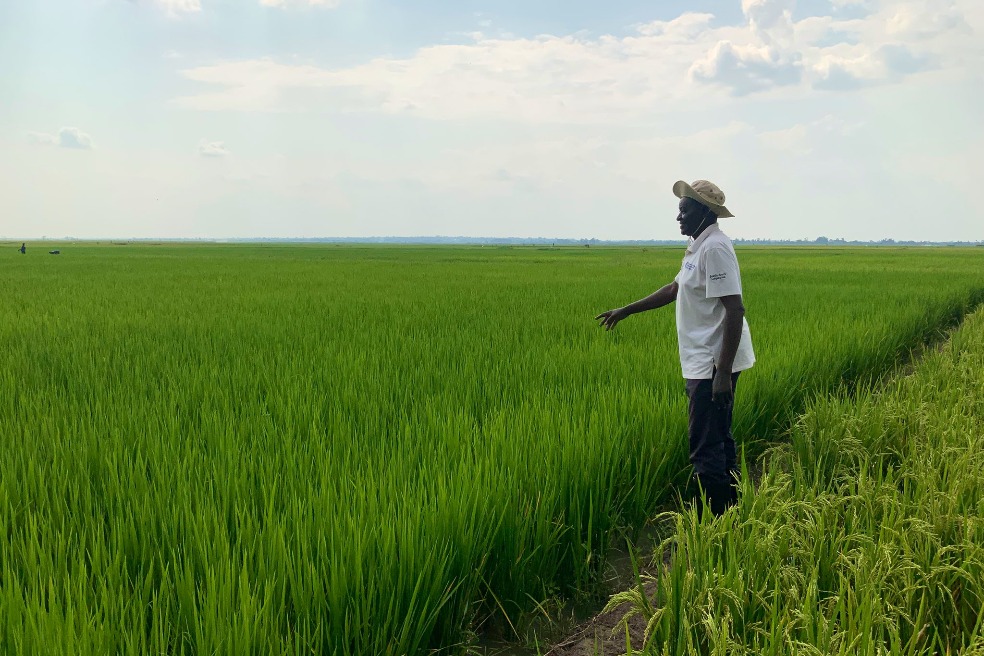
In the sun-dappled wetland plains of eastern Uganda’s Butaleja district, where endless emerald rice paddies roll toward the horizon, third-generation farmer Robert Sagula walks through his towering, swaying crop with a pride that speaks to a dramatic life transformation. For decades, Sagula followed the same path his father walked, growing the traditional rice varieties first brought to the region by Chinese agricultural experts in 1975. Back then, yields were barely enough to get by: a single hectare delivered just 1,500 to 2,500 kilograms of milled rice, enough to feed his family but leave no room for long-term prosperity.
That all shifted in 2018, when the tripartite FAO-China-Uganda South-South Cooperation project introduced high-yield hybrid rice varieties to Sagula’s community. Today, the change is visible in every stalk and every line of Sagula’s income statement. “The hybrid rice produces far higher yields, has a pleasant aroma, long golden grains that carry more weight, and sells for a much better price on local markets than our traditional varieties,” Sagula explained.
With the proper cultivation training he received from Chinese experts, Sagula now harvests roughly 12 metric tons of paddy rice per hectare each growing season, and he farms two full seasons annually across his 1.2-hectare plot. That translates to 7,500 kilograms of milled rice per season, netting him around $2,809 in earnings every six months. His total annual income now hits roughly $16,854 — more than 10 times what he earned growing traditional varieties.
That windfall has reshaped his family’s future: Sagula has sent all his children to top private schools, multiple have already graduated, and he has built a spacious modern family home on his farm. Word of his success has spread across eastern Uganda, drawing hundreds of curious farmers to his plot to learn his techniques. Sagula now serves as a community mentor, training local farmers in hybrid rice cultivation and encouraging more to make the switch. He credits his entire transformation to the hands-on training from Chinese agricultural experts and government support, and is calling for the project to be extended to reach more rural households.
Launched in Uganda in 2012, the FAO-China-Uganda South-South Cooperation project was designed to lift national agricultural productivity by transferring proven, smallholder-friendly Chinese agricultural technologies and decades of cultivation expertise to Ugandan farmers. Now in its third phase, the program has evolved into a shared partnership: the first phase was fully funded by China, while the Ugandan government now covers approximately 76 percent of the third phase’s total budget, with discussions underway for a fourth extension phase to expand impact.
To date, the program has deployed 54 experienced Chinese agricultural specialists across key sectors including livestock, fisheries, crop science, and agribusiness, according to Martin Ameu, FAO’s South-South program coordinator in Uganda. Beyond hybrid rice, the initiative has supported the adoption of a range of climate-resilient, productivity-boosting practices including integrated rice-fish co-culture, improved poultry and livestock breeds, and drought-resistant foxtail millet varieties.
Across 33 Ugandan districts, the project has directly improved livelihoods for approximately 140,000 smallholder farmers. “We are seeing tangible gains: improved national food security from new technologies, higher household incomes for smallholders, and study exchange tours to China that give Ugandan officials and farmers firsthand experience of effective practices they can bring home,” Ameu said. The program has also strengthened cross-border trade connections and attracted new private sector investment, boosting value addition and opening new market channels for Ugandan agricultural products. Ameu notes the initiative has become a gold standard model for South-South cooperation across Africa, with Uganda sharing its successful experience at regional forums to encourage similar programs across the continent.
Julius Twinamasiko, program coordinator at Uganda’s Ministry of Agriculture, Animal Industry and Fisheries, said the project has driven critical progress in mechanizing and commercializing the country’s smallholder agriculture sector. Beyond hybrid rice, the ministry has already released three improved foxtail millet varieties through the program, with new drought-resistant chili and sorghum varieties planned for introduction in coming years. A core long-term goal of the initiative is to build local seed production capacity for all new varieties, ensuring high-quality seeds are accessible and affordable for smallholder farmers across the country to drive widespread adoption and boost total national food output.
“Chinese expert training has dramatically strengthened Uganda’s agricultural extension system, putting us on a stronger path to guarantee food security and improved nutrition for our rapidly growing population,” Twinamasiko added.
In Butaleja district, the demonstration farms established during the project’s second phase proved to be the critical turning point for local adoption of hybrid rice, according to district production officer Amina Dugo. “From our first demonstration plot, we harvested 2,800 kilograms of milled rice — that result was enough to spark massive interest among local farmers, and hundreds signed up to adopt the variety almost immediately,” Dugo said. Study tours to China for Ugandan agricultural officials also helped deepen understanding of hybrid rice cultivation and program design.
Integrated rice-fish farming, another practice introduced through the program, can boost farm incomes by up to 50 percent, Dugo explained, though seasonal flooding remains an ongoing challenge for low-lying wetland farms. Even with that challenge, improved hybrid seeds and agronomic training have lifted average yields to between 1,500 and 2,500 kilograms of milled rice per hectare across the district, a massive jump from pre-project levels.
The program has not been without its growing pains: demand for hybrid rice seeds currently outpaces supply, and the upfront cost of hybrid seed remains a barrier for many low-income farmers. Traditional rice seed costs just $1.4 per kilogram, while hybrid seed retails for $10.4 per kilogram. Dugo noted that these challenges are already being addressed: as local seed production scales up, supply gaps will narrow, and the district is negotiating with the national government to introduce targeted seed subsidies to make hybrid varieties more accessible to smallholders. She also points out that the higher upfront cost is offset by lower seed requirements per hectare: traditional rice needs 49.4 kilograms of seed per hectare, while hybrid rice only requires 14.82 kilograms, cutting down on total input costs.
Today, Butaleja produces an estimated 75,000 tons of rice annually, a jump the district attributes largely to the South-South Cooperation project’s contributions. Beyond improved seeds, farmers have learned a full suite of improved practices from Chinese experts, including row planting, water and soil management, optimized fertilizer use, and improved post-harvest handling that cuts waste and improves grain quality. Last year, the district also received a donation of 11 tractors, 11 combine harvesters, and three modern rice processing mills through the project, further lifting output and reducing post-harvest loss.
“More than half of our district agricultural staff have received training in China, which has given us invaluable skills and boosted motivation across the board; staff morale is higher than it has ever been,” Dugo said, praising China’s sustained support for technology transfer, capacity building, and agricultural machinery donations.
Chinese experts working on the ground in Butaleja echo that the project has been a mutually rewarding success. Luo Zhongping, a rice specialist who has trained local farmers in the district for three years, said it is incredibly fulfilling to see farmers embrace Chinese technologies and transform their own livelihoods through hard work and new skills.
Wei Runwu, a foxtail millet expert working on the project, noted the drought-resistant crop has quickly gained popularity among Ugandan farmers thanks to its short 75-day growing cycle, higher yields than native finger millet, and strong nutritional profile: it contains 17 percent starch and 10 percent protein, making it a valuable addition to local food systems. Along with training, the project provided free starting seeds and fertilizer to early adopters, and “farmers are eager to switch after seeing the consistent results,” Wei said.
Currently, more than 300 smallholder farmers in Butaleja already grow foxtail millet, and that number is expected to rise rapidly as the government scales up promotion of the newly released improved variety. Stephen Were, Butaleja’s district agricultural officer, explained that foxtail millet’s short maturity period means it can be grown across all seasons, even during short rainy periods when other crops fail, and unlike hybrid rice, it is an open-pollinated variety, meaning farmers can save and replant seeds from their own harvest each year, cutting down on recurring input costs.
Were emphasized that the project is built for long-term sustainability. Local extension officers have already been fully trained to support hybrid rice and foxtail millet cultivation, and 10 lead farmers have been trained in each of the district’s three official rice schemes to serve as community mentors for other farmers. “Farmers learn best from their peers who face the same local conditions,” Were said. To date, 11 crop extension officers have been trained in Butaleja, five of whom traveled to China for advanced specialized training, with each officer now covering one subcounty or town council to ensure ongoing support for farmers across the district.