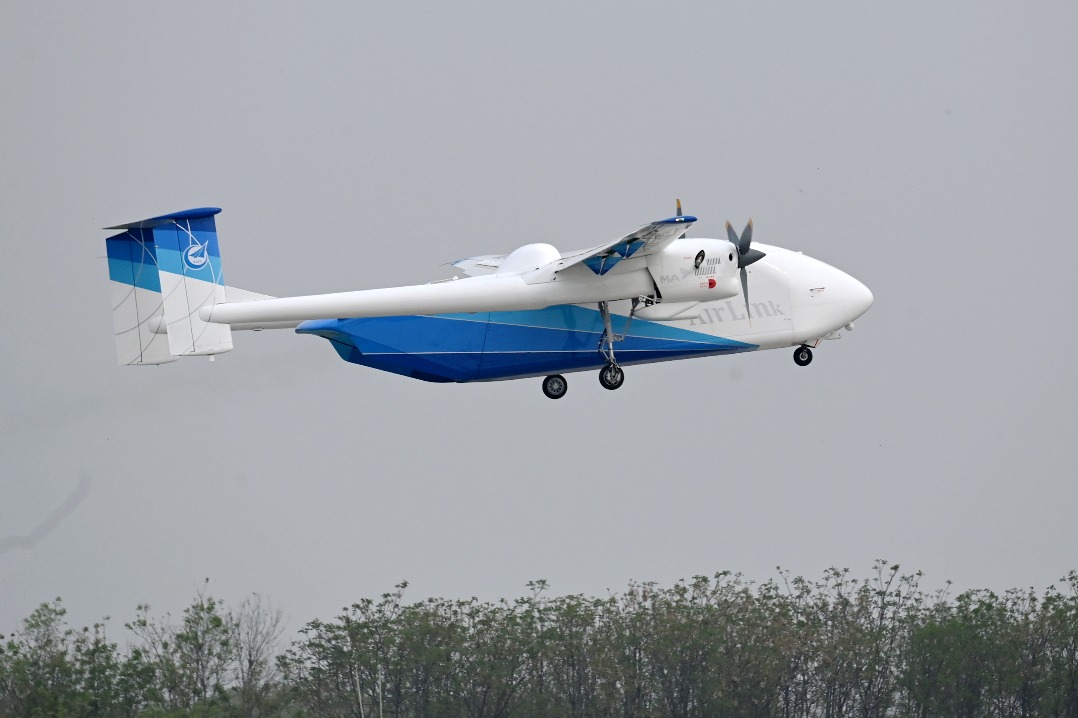
In a landmark milestone for China’s large unmanned aerial vehicle development, the domestically built HH-200 commercial unmanned cargo aircraft system successfully completed its first test flight on the morning of April 15, 2026, in Pucheng County, located in Northwest China’s Shaanxi Province.
During the maiden sortie, every on-board system operated without anomaly, the aircraft maintained consistent, stable flight attitude throughout the mission, and all pre-scheduled test maneuvers were completed flawlessly, with the platform exceeding performance expectations.
Developed entirely independently by the Aviation Industry Corporation of China (AVIC), the HH-200 features a unique aerodynamic and structural layout: a square straight-through fuselage designed to maximize cargo capacity, paired with a twin-engine high-wing configuration and twin-boom tail design. Its standard cargo hold volume clocks in at 12 cubic meters, with an optional expansion that brings total space to 18 cubic meters. The platform boasts a maximum payload capacity of 1.5 tonnes, a cruising speed of 310 kilometers per hour, and a maximum range of 2,360 kilometers.
According to Meng Fantao, technical director of the Xinzhou Honghu HH-series commercial unmanned aerial transport program, the development team implemented revolutionary structural design and advanced manufacturing processes for the HH-200. Extensive use of lightweight composite materials has cut the aircraft’s total empty weight by 20 percent compared to conventional designs, while also reducing overall production and operational costs.
Meng noted that the HH-200 is engineered to fully comply with civil aviation safety and operational standards. It is equipped with fully autonomous flight capabilities and AI-powered intelligent obstacle avoidance systems, giving it a robust operational profile. The platform has a designed service life of 50,000 flight hours or 15,000 takeoff and landing cycles, with a full life-cycle operating cost of just $0.69 per tonne-kilometer.
One of the HH-200’s key advantages is its exceptional environmental adaptability, which sets it apart from many competing cargo aircraft platforms. It can take off and land on runways as short as 500 meters, and is certified to operate from high-altitude airports situated more than 4,200 meters above sea level. It can also function reliably in extreme temperature conditions ranging from -40°C to 50°C, as well as in complex, adverse weather scenarios. This versatility allows it to fill critical transportation gaps in underserved regions including mountainous areas, remote islands, snowy high-latitude zones, and high plateaus, laying the groundwork for the construction of a more efficient, accessible low-altitude logistics network.
Looking ahead, the HH-200 will initially serve cargo logistics operations across China’s border and coastal regions, inland point-to-point freight routes, and cross-border transportation corridors. It is also targeted for use in cross-island freight operations across Southeast Asia, and to support expanding air cargo networks in countries participating in the Belt and Road Initiative. Beyond core cargo transport, the platform can be rapidly reconfigured to carry out a wide range of secondary missions, including emergency disaster response and search and rescue, forest fire fighting, weather modification, aerial remote sensing mapping, and agricultural and forestry pest control and plant protection.