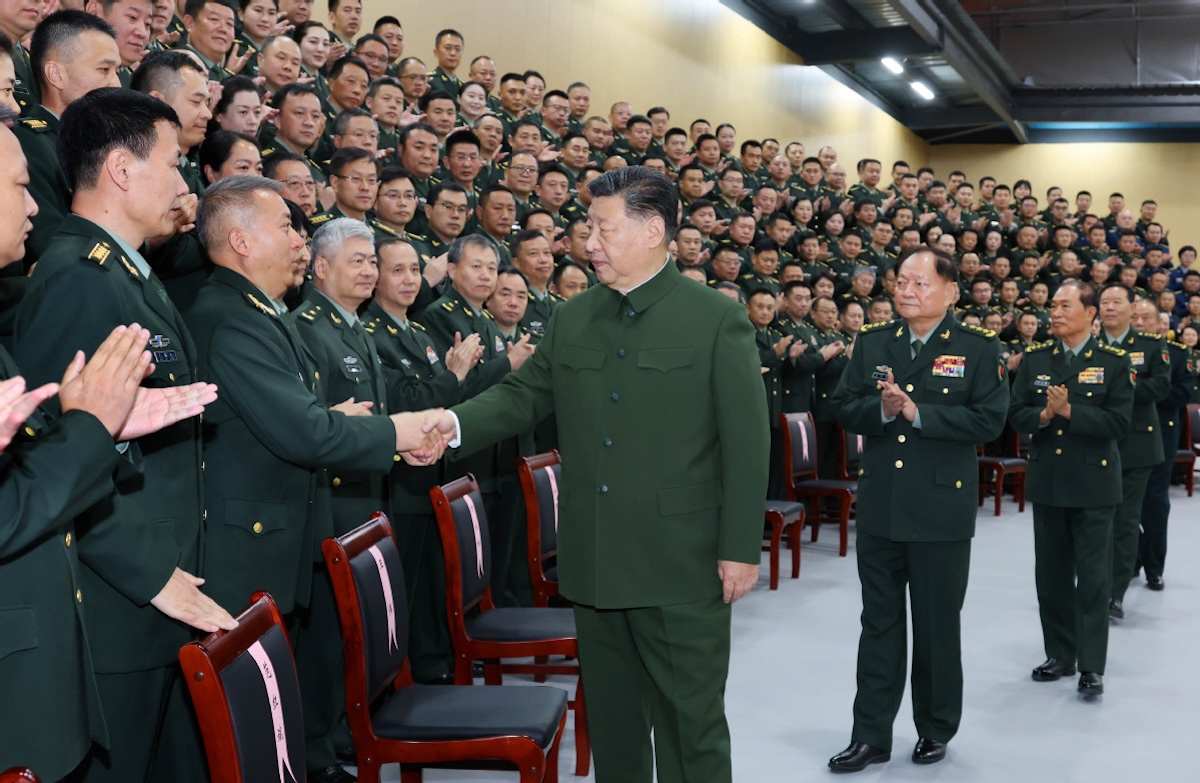
A significant restructuring within China’s military leadership has drawn intense international scrutiny, revealing deeper strategic implications beyond surface-level interpretations. Contrary to Western analyses suggesting internal fragmentation, the removal of two four-star generals represents a calculated consolidation of President Xi Jinping’s authority over the People’s Liberation Army (PLA).
Generals Zhang Youxia and Liu Zhenli, both high-ranking members of the Central Military Commission (CMC), were dismissed in late January following allegations of ‘grave violations of discipline and law’—standard terminology for corruption charges. Notably, General Zhang maintained a longstanding personal relationship with Xi dating to their childhood as ‘princelings,’ making his removal particularly significant.
This development marks the culmination of Xi’s decade-long anti-corruption campaign, reducing the CMC to just two members: Xi himself as chairman and General Zhang Shengmin as second vice chairman. The purge stems from fundamental disagreements regarding military preparedness for potential Taiwan operations, specifically the feasibility of achieving combat readiness by the politically crucial 2027 timeline—coinciding with the 21st CCP congress where Xi anticipates securing a fourth term.
The conflict intensified following the unexpectedly successful US Operation Absolute Resolve in Venezuela on January 3, which demonstrated advanced military capabilities that some PLA officials believe China cannot match by 2027. Generals with actual combat experience, including Zhang Youxia, had expressed skepticism about achieving Xi’s mandated readiness timeline, advocating instead for more realistic assessments of PLA capabilities.
Central to this power struggle is Xi’s implementation of the ‘Chairman Responsibility System,’ which centralizes decision-making authority under his direct control. This contrasts with the previously decentralized collective responsibility system preferred by some military leaders. The episode underscores the enduring tension between political loyalty and operational competence within China’s unique civil-military framework, where the PLA serves as the armed wing of the Communist Party rather than the state itself.
The military’s transformation continues under Xi’s vision, with reforms initiated in 2016 replacing seven legacy military regions with five theater commands designed for integrated joint operations. The ongoing restructuring aims to create a world-class military by 2049, though Western analysts question whether prioritizing political reliability over operational effectiveness might ultimately hinder this objective.