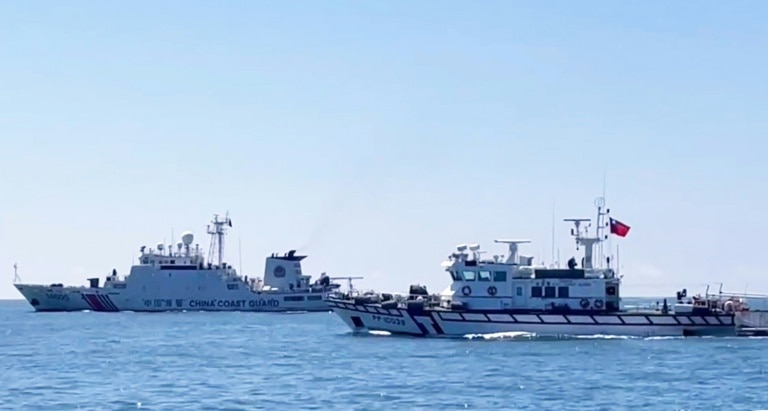
In a sharp escalation of Beijing’s pressure campaign against Taipei, official data from Taiwan’s Coast Guard confirms a historic surge in Chinese government-affiliated maritime vessels operating in waters surrounding the island, with numbers hitting an all-time high in July 2026. The revelation has sparked new warnings over growing regional instability and expanded Chinese military preparation in the strategically critical waters off Taiwan’s coast.
Data shared exclusively with Agence France-Presse (AFP) by Taiwan’s Coast Guard shows that 244 Chinese vessels—including coast guard patrol craft, scientific research ships, and other government-operated boats—were detected around Taiwan’s main island in July. This marks a dramatic jump from 55 vessels recorded in June, 30 in May, and just 58 in July 2025. The monthly total averages out to nearly eight Chinese vessels operating in the area every single day. Even through the first 21 days of August, the service had already counted 152 additional vessels. Roughly 60 percent of the vessels detected are Chinese coast guard ships, with research vessels and other government craft making up the remaining share. The total does not include Chinese military warships, which Beijing deploys on near-daily patrols around the island on a consistent basis.
Since May of this year alone, the cumulative number of Chinese vessels detected around Taiwan and its outlying islands has reached 1,247, according to full Coast Guard figures. A senior anonymous Taiwanese Coast Guard official, speaking to AFP on condition of anonymity due to restrictions on media engagement, confirmed the rapidly deteriorating security landscape. “When we say the situation is becoming increasingly severe, we mean that the number of their government vessels in the waters surrounding Taiwan has increased, and there was a marked increase in July,” the official said. Reaffirming Taipei’s position on sovereignty, the official added that the Chinese Communist Party “has never ruled Taiwan for even a single day” and that “without sovereignty over land, it has no right to claim economic zones at sea.”
Beijing has long maintained that Taiwan, a self-governing democratic island, is an inalienable part of Chinese territory, and has repeatedly refused to rule out the use of military force to annex the island. It also claims full jurisdiction over all waters surrounding Taiwan. This expanded maritime presence is part of what analysts and officials describe as China’s “grey zone” tactics: incremental actions to assert territorial claims that fall short of open armed conflict, a strategy Beijing has already deployed widely in the contested South China Sea where it competes with multiple neighboring countries for sovereignty over disputed waters and features.
Beyond general pressure on Taipei, experts warn the growing fleet of Chinese research vessels is conducting critical seabed and oceanographic surveys to build out Chinese military databases for submarine and anti-submarine warfare operations—preparations that would give Beijing a key strategic advantage in any future conflict over the island. Taiwan’s Coast Guard has previously tracked 41 Chinese research vessels operating in its territorial waters, out of more than 120 oceanographic research craft China operates overall. In May, the Chinese research vessel *Tong Ji* completed a full circumnavigation of Taiwan, tracking the edge of the island’s restricted waters and ignoring repeated orders from Taiwanese authorities to leave the area. The Coast Guard confirmed the vessel was almost certainly conducting oceanographic sampling and seabed mapping, work that directly feeds into China’s anti-submarine warfare data collections.
This activity has been paired with a string of new incursions into previously less contested areas east of Taiwan. In June, Beijing conducted its first officially declared law enforcement patrol in waters east of the island, and earlier this August, China announced temporary traffic control measures in the Taiwan Strait under the cover of Typhoon Dolphin’s approach to the region. A senior Taiwanese security official recently accused Beijing of “authoritarian expansionism,” warning that China is “constantly pushing the limits through an incremental salami-slicing approach” to erode Taiwan’s sovereignty.
Ryan D. Martinson, an expert on Chinese maritime strategy at the U.S. Naval War College, noted that while Chinese research vessels are formally owned and operated by civilian academic institutions, all data they collect is shared with the People’s Liberation Army. Speaking to AFP in an email, Martinson—who noted he was commenting in a personal capacity—explained that “That kind of data/knowledge is highly useful for Chinese naval forces, which will operate in these waters in the event of a conflict. It is especially important for anti-submarine warfare and submarine warfare.”
Martinson emphasized that while Chinese research vessels have operated around Taiwan for years, the current scale of activity is unprecedented. “In the past couple of months, I had observed a ‘very large increase’ in the number of Chinese research vessels operating around Taiwan, especially to the east of the island,” he said. “This is not a new ‘play’ in its ‘playbook’. Rather, the novel aspect is that the scale of these operations around Taiwan is unprecedented.”
New observations from maritime analysts also highlight increasingly coordinated operations between different Chinese maritime actors. Taiwanese Coast Guard officials confirmed that Chinese research vessels are now regularly operating alongside Chinese coast guard patrol craft. In August, the Chinese research vessel *Xiang Yang Hong 03* was detected operating within the exclusive economic zones of both Taiwan and Japan, traversing deep sea trenches that are home to critical international telecommunications cables, according to Jason Wang, chief operating officer of ingeniSPACE, a firm that analyzes satellite imagery and ship tracking data. Wang added that the research vessel was escorted by a Chinese coast guard ship and a fishing vessel affiliated with China’s civilian maritime militia—a first for operations in Taiwanese waters.
Wang said China’s goal in this latest deployment is twofold: to gather updated hydrographic data of the Ryukyu Trench and East Taiwan Trench for anti-submarine warfare planning, and to block U.S. and allied research vessels from conducting similar surveys in the region. For analysts like Martinson, all of these interconnected actions add up to a clear shift in Beijing’s approach to Taiwan. “They represent a clear escalation in Beijing’s efforts to exercise jurisdiction over the waters surrounding Taiwan, putting pressure on the country’s leadership and undermining its sovereignty and sovereign rights,” he said.