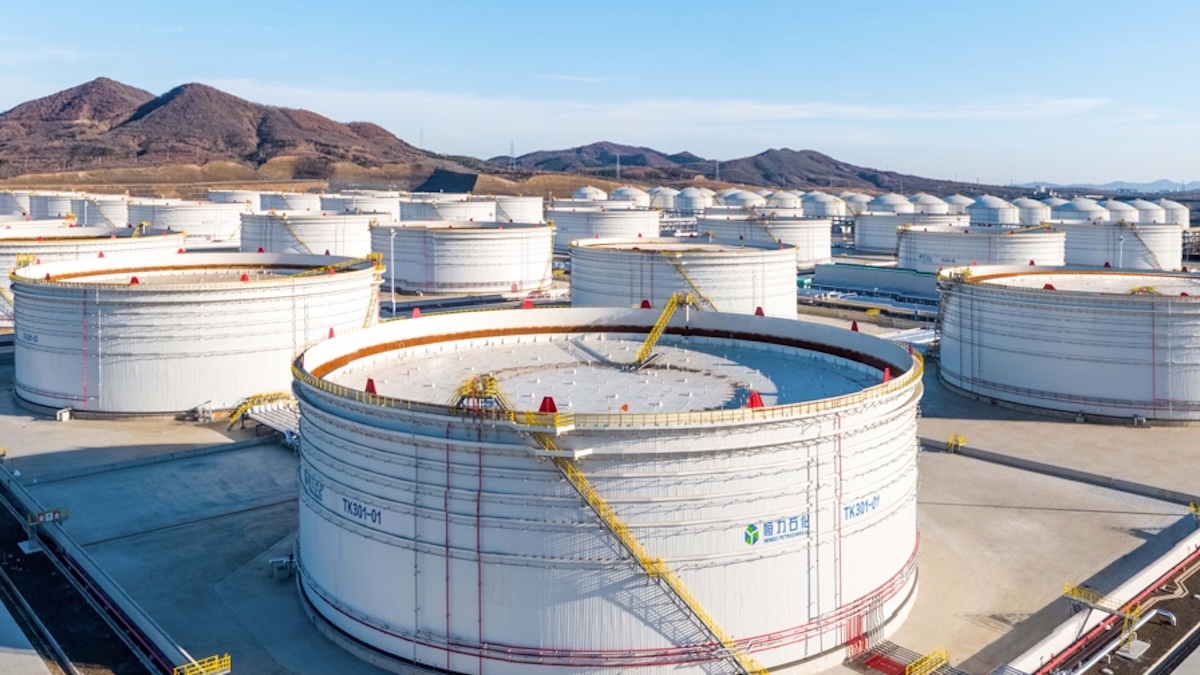
On April 24, the United States escalated tensions over Iranian oil trade by blacklisting a major Chinese independent refinery and dozens of shipping-linked entities, triggering a sharp rejection from both the targeted firm and the Chinese government, which has pledged to protect domestic companies operating under international law.
The U.S. Treasury Department’s Office of Foreign Assets Control (OFAC) added Hengli Petrochemical (Dalian) Refinery Co Ltd to its Specially Designated Nationals and Blocked Persons (SDN) List, labeling the facility — China’s second-largest independent “teapot” refinery — as one of Iran’s most critical crude oil customers. OFAC claims the Dalian refinery generated hundreds of millions of dollars in revenue for Iran’s military through its crude purchases, alleging that since at least 2023, the company has taken delivery of more than five million barrels of Iranian crude carried by multiple already sanctioned shadow-fleet tankers.
Alongside the action against Hengli (Dalian), OFAC sanctioned roughly 40 vessels and shipping companies that Washington alleges form part of Iran’s informal shadow fleet for oil shipments. The targeted entities have registrations across multiple jurisdictions, including Hong Kong (China), mainland China, the United Arab Emirates, Vietnam and Malaysia. OFAC specifically named five Hong Kong-owned vessels linked to alleged Iranian oil cargo movements: Lisboa, owned by Lisboa Shipping Company Limited, which it says delivered more than 2.5 million barrels of Iranian naphtha to the UAE between July 2025 and January 2026; Lynn, owned by Ting Tao Company Limited, which conducted ship-to-ship crude transfers off Malaysia before delivering cargo to China; Stellar Beverly, owned by Yegua Trading Limited, which transported over two million barrels of Iranian crude to China in 2025; Covenio, owned by Extensive Shipping Limited, which moved more than six million barrels of Iranian oil to China since early 2025; and Golden Sunrise, owned by Xifoides Group Limited, which has carried several million barrels of Iranian crude since mid-2025.
Hengli Petrochemical Co, the Shanghai-listed parent company of the sanctioned Dalian refinery, has forcefully denied all allegations, stating that it has operated in full compliance with all applicable national and international regulations throughout its history. The company emphasized it has never engaged in any trade with Iran, and all of its crude suppliers provide formal certification that their crude supplies originate from jurisdictions not subject to U.S. sanctions.
“The U.S. Treasury’s decision to place Hengli (Dalian) on the SDN List lacks both factual and legal basis, and constitutes an unlawful unilateral sanction,” the company said in an official statement. “We firmly oppose these groundless allegations and unlawful measures, and will take all necessary steps to safeguard the legitimate rights and interests of the company and its shareholders.” Hengli added that its operations remain fully normal as of the statement, with production utilization holding at high levels, output and sales proceeding according to plan, crude inventories sufficient to cover more than three months of operations, and ongoing procurement activities unaffected by the sanctions.
The Chinese Foreign Ministry has echoed the company’s rejection of the U.S. action. Spokesperson Lin Jian told a regular press briefing on Monday that “China opposes illicit unilateral sanctions that have no basis in international law. We urge the U.S. to stop willfully slapping sanctions and using long-arm jurisdiction. China will firmly defend the lawful rights and interests of Chinese companies.”
The Dalian refinery at the center of the dispute is part of the empire built by Fan Hongwei, who currently ranks as the eighth-wealthiest self-made woman in the world and was named China’s richest woman by Bloomberg in 2022. Fan and her husband Chen Jianhua launched their business career in 1994 by purchasing a near-bankrupt textile mill in Suzhou, growing the business dramatically during the 1997 Asian financial crisis through strategic capacity expansion and discounted equipment acquisitions. In the early 2000s, the group moved upstream into chemical production to secure its raw material supply, investing heavily in purified terephthalic acid (PTA) manufacturing to cut operational costs. In 2010, the group outbid multiple state-owned energy firms to win approval for the 20-million-metric-ton Dalian refining and petrochemical complex on Changxing Island, completing the company’s vertically integrated business model and establishing it as one of China’s largest private energy and manufacturing powerhouses. Financial results released by the parent company in mid-April 2026 show 2025 full-year revenue fell 14.9% year-on-year to 201 billion yuan (equivalent to roughly US$28 billion), while net profit edged up 0.4% to 7.1 billion yuan.
Observers note the timing of the new sanctions, which comes as reports have emerged of potential renewed peace talks between Washington and Tehran. Jiangsu-based political commentator Hua Xiangming argues the sanctions are a deliberate move by the U.S. to gain negotiating leverage ahead of any talks. “Targeting foreign refineries and freezing overseas assets to strengthen bargaining power reflects a typical form of hegemonic politics,” Hua said, adding that such actions abandon all pretense of commitment to free trade and open market principles.
Hua also pointed to the lack of transparency around the U.S. claims, noting that while Washington alleges the sanctions relate to billions of dollars in Iranian oil purchases, no detailed evidence has been made public. He warned that the increasing weaponization of the U.S. dollar for geopolitical goals is accelerating global de-dollarization trends. “The dollar’s share of global foreign exchange reserves has already fallen below 60%, a multi-decade low. Countries now see that relying on dollar settlement carries the risk of asset freezes and financial coercion,” Hua explained. “Alternatives are already emerging, from non-dollar oil pricing mechanisms to new cross-border payment channels such as China’s Cross-Border Interbank Payment System (CIPS), which are speeding up global efforts to reduce dependence on the dollar.”
The latest sanctions action builds on earlier U.S. pressure on global financial institutions over Iran-related transactions. On April 15, U.S. Treasury Secretary Scott Bessent confirmed Washington had issued warnings to banks across multiple jurisdictions, including two banks based in Hong Kong, that they could face secondary sanctions if they process transactions linked to Iranian oil trade. On April 21, British outlet The Telegraph reported that a U.S. federal court in New York has ordered five major global banks — HSBC, Standard Chartered, JPMorgan, Citibank and Bank of New York Mellon — to turn over internal documents as part of a civil investigation into alleged Iran sanctions evasion. None of the banks have been accused of wrongdoing, and are only required to cooperate as correspondent banking service providers.
U.S. media, citing anonymous Treasury Department sources, has reported that Iran routed approximately US$9 billion in oil-related transactions through U.S. correspondent bank accounts in 2024 via a network of front companies, with most of that activity centered in Hong Kong, Oman and the UAE. A Henan-based financial commentator described the $9 billion figure as a “hot potato” for global financial institutions, noting that banks are now forced to spend months combing through transaction records to identify Iran-linked flows, disrupting normal business operations, raising compliance costs, and creating significant operational strain for institutions prioritizing stability. In response to the new risk environment, the commentator expects banks to tighten compliance scrutiny for all Middle East-based clients, particularly those with any potential ties to Iranian trade. Over the medium to long term, however, the commentator predicts Iran will develop alternative transaction channels to continue moving funds, while global oil traders will increasingly shift to settlement in currencies such as the euro and Chinese renminbi to reduce their exposure to U.S. dollar-related financial risk.