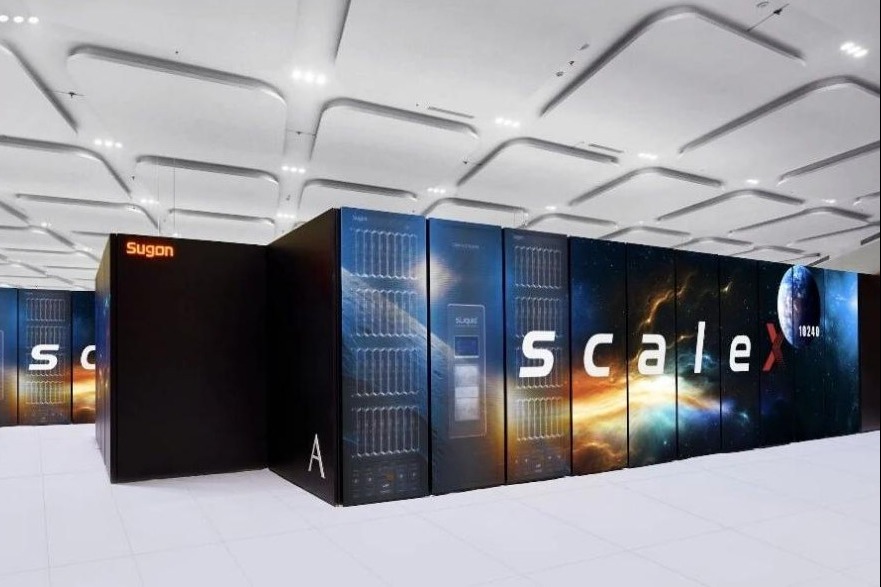
ZHENGZHOU, April 15 — China has officially brought its largest-scale scientific intelligent computing cluster into full operation this Tuesday, hosted at the core node of the country’s national supercomputing network in the central Chinese province of Henan, state broadcaster China Media Group (CMG) has announced.
The launch of this infrastructure marks a landmark breakthrough in China’s development of computing power systems tailored for artificial intelligence-powered scientific research, and is set to cement the country’s leading position in the fast-growing field of industrial AI applications.
The core node first entered trial operation back on February 5, initially equipped with more than 30,000 domestically manufactured AI accelerator chips. By the time of its official launch on Tuesday, that number has doubled to 60,000 units of locally produced chips, according to CMG’s report.
Unlike many existing computing facilities that rely on imported core components, this new core node has built a fully integrated, accessible, and entirely domestically developed technological ecosystem that unifies data storage, computing power, algorithm models, and real-world applications. It aggregates a wide range of standardized datasets, development tools, and over thousands of open-source large models, creating an environment that supports rapid deployment of new research projects and accelerates iterative development.
One of the most user-centric innovations of the new supercomputing platform is its simplified workflow design. Instead of requiring researchers to handle complex software configuration and cumbersome IT management processes, the platform allows users to input their research requirements directly in natural language. An automated super scientific computing agent then takes over: it breaks down large-scale tasks into manageable sub-tasks, calls matching pre-trained models, dynamically schedules available computing resources, and delivers complete end-to-end research results. This streamlined process drastically cuts down the time required to complete complex research projects, removing major technical barriers for smaller research teams and industry users.
Officials and developers behind the project note that the infrastructure will maintain an open development model moving forward, designed to cover all application scenarios across both basic scientific research and commercial industrial sectors, while providing low-threshold, user-friendly services for researchers and enterprises across the country. Experts quoted in the CMG report project that this new computing cluster will help China unlock more groundbreaking advancements in general and scientific AI, and secure an early competitive edge in the global race for next-generation artificial intelligence technology.