分类: world

  • Ukraine’s Baltic allies unsettled by repeated drone incursions

    Ukraine’s Baltic allies unsettled by repeated drone incursions

    A mounting wave of wayward drone incursions into the airspace of Estonia, Latvia and Lithuania has thrown the Baltic region into escalating security chaos, triggering multiple NATO jet deployments, the collapse of a national government, and a sharp diplomatic standoff between Russia, Ukraine and the three NATO-aligned states. On Wednesday, the highest levels of Lithuania’s government — including the country’s president and prime minister — were forced to evacuate to emergency bomb shelters inside the parliamentary complex in Vilnius after an air alert was activated over an unauthorized drone entry. The incursion forced a temporary shutdown of Vilnius International Airport, paused all urban traffic across the capital, and ordered ordinary residents to seek shelter alongside the nation’s top leaders.

    This latest incident is part of a sharp uptick in unauthorized drone sightings that has disrupted daily life across all three Baltic states over the past week, a sharp escalation of a trend that has been unfolding since 2024. All three nations are longstanding NATO members and among the most unwavering supporters of Ukraine in its war against Russia, and the current crisis stems from Ukraine’s increasingly effective long-range drone campaign targeting Russian military and energy infrastructure along the Baltic Sea coast. As Ukrainian drones traverse northern Russian territory to reach targets such as the key oil export terminal at Ust-Luga, navigation disruptions and course deviations have repeatedly sent the unmanned aircraft straying across the Baltic border.

    The growing frequency of incidents has already triggered major political upheaval: just last week, Latvia’s sitting government collapsed after facing widespread criticism over its handling of repeated Ukrainian drone incursions into Latvian territory. The day before Wednesday’s Lithuanian alert, a NATO interceptor shot down an errant drone over Estonian airspace. The following day, the incursion into Lithuania occurred, and by Thursday, both Lithuania and Latvia detected additional unauthorized drones, forcing NATO to scramble fighter jets for a second time in 48 hours.

    Diplomatic finger-pointing has intensified alongside the security disruptions. Ukrainian officials have issued formal apologies for the incursions, arguing that Russian electronic warfare and GPS jamming are deliberately redirecting drones off their intended flight paths into Baltic airspace. For its part, Moscow has levelled fierce accusations that the Baltic states are complicit in allowing Ukraine to use their territory to launch attacks against Russian targets — claims that all three Baltic governments and Kyiv have vehemently denied.

    Estonia’s foreign ministry flatly rejected Moscow’s assertions on Thursday, accusing Russia of waging a deliberate disinformation campaign of false claims, threats and provocations. “Let us be absolutely clear: Estonia has not allowed its territory or airspace to used for attacks against Russia. These claims are false and Russia knows it,” the ministry said in an official statement. Similar denials were issued by Latvia and Lithuania, with the claims drawing widespread pushback from European allies. Belgian Foreign Minister Maxime Prévot noted that the absurdity of Russia’s accusations would be laughable if they did not pose a serious threat to regional security. European Commission President Ursula von der Leyen echoed that sentiment, placing full blame for the crisis on Moscow and Minsk: “Russia and Belarus bear direct responsibility for drones endangering the lives and security of people on our Eastern flank.”

    Security analysts have put forward alternative explanations for the repeated errant drone strikes, which have already damaged an unused oil tank in Latvia and a power station pipeline in Estonia. While Russian jamming is the most commonly cited cause, some analysts note the relatively accurate strikes on infrastructure-like targets suggest artificial intelligence navigation errors may also play a role, with drones mistaking Baltic infrastructure for their pre-programmed Russian targets.

    The case of Wednesday’s Lithuanian incursion has added additional layers of geopolitical uncertainty. Lithuania only shares a border with Russia via the small exclave of Kaliningrad, so any drone entering from the east must cross Belarusian airspace. The Lithuanian defence ministry confirmed Wednesday that it was actually Minsk that first notified Vilnius of the approaching drone, and that the unmanned aircraft was confirmed to have entered from Belarusian territory. That has sparked questions over why Belarus, a close Russian military ally, would warn its neighbor of the incoming drone rather than shoot it down itself. Minsk for its part has counter-accused Lithuania of allowing a Ukrainian drone to cross into Belarusian airspace.

    Facing growing security pressure, the presidents of all three Baltic nations issued a joint public statement late Thursday calling on their NATO allies to upgrade the alliance’s current air policing mission in the region to a full, comprehensive air defence mission, to counter the rising drone threat.

    The ongoing crisis has underscored the growing risk of escalation as Ukraine’s long-range strikes on Russian targets expand, bringing direct security disruption to NATO member states and raising the stakes for the alliance’s commitment to collective defence in Eastern Europe.

  • Pair arrested after boys abandoned by road in Portugal

    Pair arrested after boys abandoned by road in Portugal

    A shocking case of child abandonment has led to the arrest of two young French boys’ mother and stepfather, after the pair of children under five were discovered alone, crying, on the side of a rural highway in southern Portugal, law enforcement officials confirmed.

    The children were located on Tuesday by a passing motorist close to the small town of Alcacer do Sal, according to Portuguese police. When they were found, the boys carried only small backpacks stocked with basic food and water, but no papers that could confirm their identities or connect them to their family.

    The boys’ biological father had already filed a missing person report for his sons at their home in Colmar, eastern France, on May 11. Following the report, French authorities issued an international public appeal for assistance across the entire European Union to locate the missing children.

    After a multi-jurisdiction search coordinated between law enforcement on both sides of the border, the suspect couple was tracked down and apprehended. Local Portuguese media reports indicate the pair was located after their vehicle was spotted parked outside a local cafe in Fatima, a popular pilgrimage city located roughly 180 kilometers north of where the children were found.

    Portugal’s National Republican Guard confirmed in an official statement that officers took a 41-year-old woman and a 55-year-old man into custody. Authorities have not released the formal identities of the two arrested people, per standard investigative protocol. The pair are currently under investigation on three separate criminal charges: domestic violence, child endangerment, and child abandonment.

    The good Samaritan driver who found the boys told reporters he first gave the hungry children food and comfort before contacting emergency services to notify police of the discovery.

    Inquiries are now ongoing jointly between Portuguese and French law enforcement teams. Officials from both agencies noted that they have not yet reached any final conclusions about the case, and investigations are continuing to unfold. It remains unclear at this stage why the children were left on the roadside or what circumstances led to their disappearance from France.

  • A veteran Panama Canal engineer becomes first woman to lead the interoceanic waterway

    A veteran Panama Canal engineer becomes first woman to lead the interoceanic waterway

    PANAMA CITY – In a historic announcement Thursday, Panamanian President José Raúl Mulino confirmed the appointment of Ilya Espino de Marotta as the next chief administrator of the Panama Canal, marking the first time a woman has taken on the top leadership role of the strategic interoceanic waterway. Espino de Marotta will begin her seven-year term on October 1, stepping into the role after serving as deputy administrator of the canal since 2020.

    The appointment wraps up a multi-week selection process led by the Panama Canal Board of Directors, which evaluated a pool of high-profile, qualified candidates before settling on Espino de Marotta. At 64, the incoming administrator brings more than three decades of on-the-ground experience with the canal, having built a reputation for delivering results on large-scale infrastructure projects – most notably the canal’s landmark $5 billion expansion effort. A recognizable figure across the waterway’s operations, she is widely known for her signature pink hard hat alongside her track record of decisive project leadership.

    Following the official announcement, President Mulino shared his reaction on the social platform X, writing: “I have spoken with the new Administrator of the Panama Canal… to congratulate her and reaffirm the commitment to work in coordination on strategic projects that generate jobs, prosperity and progress for Panamanians.”

    Espino de Marotta takes the helm at a pivotal moment for the canal, which faces both major infrastructure priorities and growing geopolitical friction between the United States and China. Her immediate policy agenda centers on advancing a suite of new development projects designed to expand and diversify the canal’s operational capacity: two new ports, one at each end of the waterway, will have tender documents released in the coming months, paired with upcoming bidding processes for a new natural gas pipeline and a cross-country logistics corridor.

    Beyond infrastructure planning, the canal sits at the heart of a simmering international rivalry between Washington and Beijing. Tensions flared in early April this year, after Panama seized control of two key canal-connected ports from a subsidiary of a Hong Kong-based firm. U.S. Senator Marco Rubio subsequently accused China of “bullying” Panama by detaining dozens of Panama-flagged vessels for a short period, a claim Chinese authorities have outright denied. The U.S. has repeatedly pushed to counter China’s expanding economic and political influence across Latin America, and the Panama Canal has emerged as a central flashpoint in this rivalry – last year, former U.S. President Donald Trump went so far as to falsely accuse Beijing of controlling the strategic waterway.

    A trained engineer, Espino de Marotta holds a bachelor’s degree in Marine Engineering from Texas A&M University and a master’s degree in Economic Engineering from Panama’s Universidad Santa María La Antigua.

  • First Gaza flotilla activists arrive in Turkey after Israel deportation

    First Gaza flotilla activists arrive in Turkey after Israel deportation

    In the wake of a controversial Israeli interception of a humanitarian flotilla bound for blockaded Gaza, Israel confirmed Thursday it has finished deporting all detained foreign activists, with the first planeload of detainees touching down in Turkey to a warm welcome from supporters.

    The interception, which took place Monday in international waters, marked the latest activist effort to breach a 17-year Israeli blockade on Gaza that has tightened dramatically into a full-blown humanitarian crisis since the outbreak of the Israel-Gaza war in October 2023. Hundreds of participants from dozens of nations were taken into Israeli custody after the boarding operation, sparking global outrage over how detainees were treated.

    According to Turkish foreign ministry officials, 422 activists — including 85 Turkish citizens — were transported from southern Israel’s Ramon Airport to Istanbul aboard three planes chartered by the Turkish government. An AFP correspondent on the ground at Istanbul Airport reported that the first group of arriving activists exited the airport’s VIP terminal to cheers from a crowd of hundreds of supporters waving Palestinian flags. One activist addressed the gathering, defiantly stating: “We’ve been tortured, we’ve been beaten, we’ve been arrested in international waters, but we won’t give up. We will return. Palestine will be free from the river to the sea.”

    The international backlash was triggered earlier this week when far-right Israeli National Security Minister Itamar Ben Gvir posted a widely condemned video showing detained activists with their hands bound and foreheads pressed to the ground, while Ben Gvir walked among them heckling detainees and waving an Israeli flag, with the caption “Welcome to Israel.” The footage drew condemnation from world capitals across Europe, North America and Oceania, and even drew criticism from within Israel’s own government: Prime Minister Benjamin Netanyahu and Foreign Minister Gideon Saar publicly distanced themselves from Ben Gvir’s actions, as did U.S. Ambassador to Israel Mike Huckabee.

    Multiple European governments have called for formal action against Israel and Ben Gvir over the incident. Italy’s Foreign Minister Antonio Tajani and Spanish Prime Minister Pedro Sanchez labeled the treatment of activists “unacceptable” and called on the European Union to impose sanctions on Ben Gvir. A leaked letter from Irish Prime Minister Micheal Martin revealed he is pushing EU leaders to take sweeping measures against Israel, including a ban on goods from Israeli settlements in the occupied West Bank and a partial or full suspension of the EU’s association agreement with Israel. The United Kingdom also summoned Israel’s top diplomat in London to protest what officials called the “inflammatory video.”

    Legal representatives for the flotilla participants have confirmed multiple reports of abuse and mistreatment in custody. Adalah, the Israeli legal center representing detainees, reported that most activists were held at Israel’s high-security Ktziot Prison in the Negev Desert near the Gaza border, before being processed for deportation. Adalah legal director Suhad Bishara told AFP that many detainees received access to legal counsel, but others were forced to attend court hearings without legal representation. Bishara also confirmed that at least two activists were hospitalized after being hit with rubber bullets, and many other detainees reported injuries including suspected broken ribs from beatings by Israeli security forces.

    Alessandro Mantovani, an Italian journalist who was detained alongside the activists and deported earlier than the main group, described his mistreatment to reporters in Italy Thursday. “We were taken to Ben Gurion airport in handcuffs and with chains on our feet and put on a flight to Athens,” he said, adding: “They beat us up. They kicked us and punched us and shouted ‘Welcome to Israel’.”

    Activists from neighboring countries were deported over land: Egyptian detainees were transferred to the Israeli-Egyptian border crossing at Taba, while Jordanian participants were sent to the Israeli-Jordanian crossing at Aqaba.

    The latest flotilla, organized under the banner Global Sumud Flotilla, involved around 50 vessels that departed from Turkey last week, marking the second major activist attempt to break the blockade in as many months. Israel has maintained a full naval and land blockade on Gaza since 2007, when Hamas took control of the territory. Following the October 7, 2023 Hamas attack that sparked the current war, the blockade has cut off almost all access to essential goods, leaving Gaza’s 2.2 million residents facing catastrophic shortages of food, clean water, medicine and fuel, with aid groups warning of widespread famine and a total collapse of Gaza’s healthcare system. Israeli officials have reiterated that they will not allow any violations of their blockade, with foreign ministry spokesman Oren Marmorstein stating Thursday: “Israel will not permit any breach of the lawful naval blockade on Gaza.”

  • Morocco launches mass deportations to block Europe migration route

    Morocco launches mass deportations to block Europe migration route

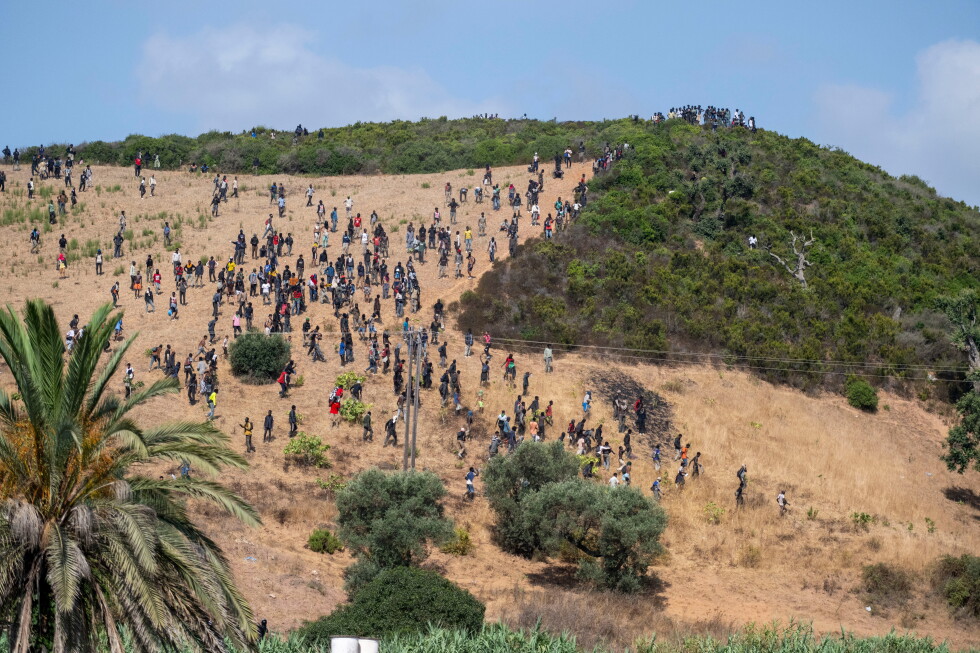
    Since mid-April 2026, Morocco has launched an expansive, ongoing deportation campaign targeting sub-Saharan African migrants seeking passage to Europe, with local sources confirming security forces are arresting more than 100 people daily as operations expand across the country’s northern region.

    Initial coordinated raids targeted informal forest encampments between Fnideq and Belyounech, a common shelter area for migrants waiting to attempt crossings to Europe, where human rights groups estimate roughly 800 people have been detained. After sweeping through this northern border zone, authorities shifted focus to large-scale operations in Tangier and its surrounding areas. Multiple witnesses and migrant advocates have documented serious abuses during the crackdown, including mass arbitrary arrests, physical beatings, racist verbal harassment, and forced transfers toward Morocco’s eastern border with Algeria.

    Deportation procedures follow a tiered pattern: detainees from Sudan and Chad are transported by bus to remote border regions and abandoned without supplies, while migrants from Senegal, Mali, Mauritania, Burkina Faso, and Guinea are put on charter flights out of Casablanca for expulsion to their home countries.

    This escalation of migration enforcement is directly tied to the European Union’s deepening border externalization strategy, a core pillar of the bloc’s incoming Pact on Migration and Asylum set to enter into force in June 2026. For years, the EU has increasingly outsourced its immigration control to North African nations with well-documented poor human rights records, allocating more than €900 million through its Global Europe development instrument to fund expanded border management, surveillance, and migration restriction initiatives across the region.

    “Essentially, this is about the EU exercising border control without getting its own hands dirty,” explained Frey Lindsay, a journalist with Statewatch’s Outsourcing Borders project, which monitors the bloc’s offshored migration enforcement. “The goal is to stop migration as far downstream along the route as possible, before anyone reaches EU territory.”

    As a key transit country for sub-Saharan African migrants heading to Europe, Morocco has steadily deepened its cooperation with Frontex, the EU’s Border and Coast Guard Agency, to block irregular departures from its northern coast. Moroccan interior ministry data shows authorities thwarted 73,640 irregular migration attempts in 2025, a small decline from 2024 that officials attribute to shifts to alternative migration routes.

    Worsening conditions for migrants in northern Morocco have been well documented by grassroots and human rights groups. Chad Boukhari, a journalist and member of Border Resistance, a Mediterranean grassroots collective supporting migrants, told Middle East Eye that migrants reported widespread mistreatment and humiliation at the hands of Moroccan security forces. “Many were abandoned near the Algerian border with no food or water, and many of those people were then detained by Algerian forces,” Boukhari said. “Witnesses told us the Algerian army tortured many detainees, and some migrants even found the bodies of other migrants left in the desert.” This pattern of cross-border abandonment and abuse is not new: in 2025 alone, Algeria expelled more than 30,000 migrants to Niger, leaving multiple deportation convoys stranded in the Sahara, with widespread accounts of torture, enslavement, and systematic abuse emerging from the region.

    Middle East Eye reached out for comment to Moroccan, Algerian, and EU authorities, but had not received a response as of publication.

    For most sub-Saharan African migrants, the journey to Morocco already involves crossing the Sahel, an arid, dangerous trans-Saharan belt, through Niger and Algeria or Mauritania. Many originate from Sahel nations gripped by chronic instability and ranked among the lowest on the United Nations’ Human Development Index, making the dangerous journey to Europe a compelling option despite the risks. After arriving in Morocco, many spend months or even years living in informal camps in the country’s dense northern forests, where humanitarian groups occasionally provide limited aid—though these efforts are often disrupted by authorities.

    Long before the current 2026 crackdown, Human Rights Watch has documented repeated, systemic abuses against migrants in Morocco dating back to 2014, including beatings by police, confiscation and destruction of personal property, burning of informal shelters, and extrajudicial expulsions without due process. Ousman Sow, a Guinean migrant who spent a year in Morocco before successfully crossing to Spain and now resides in Germany, described a pattern of coordinated monitoring of humanitarian aid efforts. “Oftentimes, the Red Cross would come to the forest and give us blankets and clothing, but we always knew that was a bad sign,” Sow said. “Shortly after those visits, Moroccan security forces would show up, like they had been tipped off or were watching. They burned all our things, then drove us to remote areas and left us there with nothing.”

    Security operations are primarily focused on blocking access to Ceuta and Melilla, two Spanish enclaves on Moroccan territory that represent the only land border between Europe and Africa. The 2022 Melilla fence tragedy, where at least 23 mostly sub-Saharan African migrants were killed under disputed circumstances while attempting to cross the border, with another 70 people still missing, has served as a grim reminder of the deadly risks of this route. Reports have since emerged that Moroccan authorities buried many of the victims in unmarked, unrecorded graves.

    Even with sharply increased enforcement, migration flows from North Africa to Europe have remained steady, driven by the ongoing war in Sudan and accelerating political and security collapse across the Sahel. For millions of displaced people, the promise of safety and opportunity in Europe still outweighs the extreme risks of the journey.

    Lindsay warns that increased securitization of borders does nothing to address the root causes of migration, and only makes the journey deadlier. “The more borders and walls you build, the more dangerous alternative routes migrants are forced to take,” she noted. “Securitization doesn’t change why people leave their homes—it just makes more people die along the way.”

    Rights advocates emphasize that the current crackdown in Morocco is a direct response to the EU’s new migration pact, which overhauls the bloc’s existing asylum system to speed up asylum case processing and deportations. The new framework expands biometric border surveillance and makes it easier to reject asylum claims on the grounds that a migrant passed through a “safe third country” before reaching the EU. Morocco is among the nations listed as safe third countries, alongside Egypt and Turkey—both of which face widespread allegations of systemic human rights abuses against migrants. Over 50 international non-governmental organizations have formally opposed the pact, arguing that its expedited procedures violate the fundamental right to a fair asylum review.

    By externalizing enforcement, the EU effectively blocks most migrants from ever reaching a point where they can file an asylum claim, shifting all operational and ethical responsibility for border control to non-EU nations. Under the EU’s Emergency Trust Fund for Africa, the bloc has already allocated hundreds of millions of euros to strengthen migration enforcement in Morocco, Algeria, Tunisia, Egypt, and Libya.

    The new migration pact is a high-stakes political priority for European Commission President Ursula von der Leyen and her administration, which needs a legislative win to maintain political support among EU member states. “Member states have made it very clear they will not back the pact unless the European Commission does everything possible to cut arrivals and deport as many people as possible,” Lindsay explained.

    Patterns of abuse linked to EU-funded externalized border enforcement have already been well-documented in Libya, where the EU directly funds, trains, and equips Libyan coastal authorities that have been repeatedly accused of colluding with human trafficking networks to detain migrants, who are then subjected to systematic exploitation, physical and sexual violence, and enslavement. The EU is currently moving forward with plans to fund a new maritime control center in Benghazi, which is controlled by warlord Khalifa Haftar—accused of multiple war crimes by the United Nations—to intercept migrants at sea and force them back to Libya. Similar violent pushback practices have been documented along the EU’s eastern Balkans route, where Croatian border forces have repeatedly been recorded forcing migrants back into Bosnia, blocking them from accessing asylum procedures on EU territory.

    The new pact also establishes a network of “return hubs,” third countries where rejected asylum seekers can be transferred and detained while waiting for deportation—often to nations where they have no family, community, or prior connections, with proposed hubs ranging from Bangladesh to Rwanda.

    Human rights groups warn the pact reflects a broad, dangerous hardening of anti-migrant policy across EU member states that will have deadly consequences for thousands of people every year. For migrants in transit, shifting political winds in Europe directly shape their treatment in North African transit nations. As Ousman Sow put it: “Whenever the political climate changes in Europe, you can feel it in Morocco. If Europe wants immigrants, Morocco is okay. If not, it’s hostile there.”

  • Macron once campaigned for Ramy Shaath’s freedom. Now he wants to deport him

    Macron once campaigned for Ramy Shaath’s freedom. Now he wants to deport him

    In January 2022, after 900 days of detention in an Egyptian correctional facility, Ramy Shaath stepped onto French soil at Paris’ Roissy Airport. To secure his release, the Palestinian academic and long-time political organizer was forced to renounce his Egyptian citizenship, and was greeted on arrival by his French wife Celine Lebrun-Shaath and crowds of cheering supporters. The release came after intensive diplomatic pressure from then-French President Emmanuel Macron, who personally lobbied Egyptian leader Abdel Fattah el-Sisi to secure Shaath’s freedom. “I share the relief of his wife,” Macron wrote at the time. “Thank you to everyone who has played a positive role in this happy outcome.”

    Four years later, that warm welcome has curdled into a formal deportation order, framing Shaath as a “serious threat to public order” in France. On Thursday, he is scheduled to appear before an advisory deportation committee in Nanterre, the western Paris suburb where he has resided since 2022, to review the government’s attempt to remove him from the country. While the committee’s ruling is non-binding and French authorities retain the power to act regardless of its outcome, the proceedings mark the latest escalation in a months-long campaign of administrative harassment targeting the prominent activist.

    Born in the besieged Gaza Strip, Shaath argues that French and European law prohibit his deportation to any available destination. “They cannot send me back to Gaza; one, because it’s a war zone and because I am targeted by the Israelis,” he told Middle East Eye in an exclusive interview. “And in both cases, European law will not allow them to send me to Palestine. And of course, I know more Egyptians, but they cannot send me to Egypt.” While he acknowledges a remote possibility that authorities could resettle him in an unrelated third country – “so I could find myself in Liberia or Gambia” – he expects to instead be left in a permanent state of legal limbo, locked out from renewing his temporary residency, cut off from basic public services, and subjected to ongoing law enforcement surveillance.

    The foundation for the deportation push is Shaath’s decades-long open advocacy for Palestinian rights and statehood. Before his detention in Egypt, he rose to prominence as a key organizer during the 2011 Arab Spring uprisings that ousted longtime authoritarian leader Hosni Mubarak, and served as the national coordinator for the Egyptian chapter of the Boycott, Divestment, and Sanctions (BDS) movement targeting Israel over its occupation of Palestinian territory.

    After arriving in France in 2022, Shaath was granted an initial one-year residence visa. When he applied for renewal in September 2023, shortly after Israel launched its large-scale military campaign in Gaza following the October 7 attacks, he received no official response. He has since filed 10 urgent legal appeals for residency renewal, all of which have gone unanswered. On April 30, he received formal notice at his Nanterre home that deportation proceedings had officially been opened against him.

    Documents released by the Nanterre prefecture lay out the government’s justifications for the order, centered almost entirely on Shaath’s public comments and pro-Palestine organizing. The filing cites his long-standing connections to prominent Palestinian rights organizers in France, his public descriptions of Israel’s military campaign in Gaza as a “criminal occupation,” his open self-identification as an anti-Zionist, and his public support for a one-state solution that guarantees equal rights for all people living in historic Palestine.

    Reacting to the prefecture’s claims, Shaath expressed sarcastic disbelief. “Oh my god, are you fucking serious? The French services cracked the biggest secret of my life! For 40 years I have not had one speech that I didn’t attack Zionism, and today you cracked my heart that I’ve been lying about – that I am anti-Zionist? Unbelievable.”

    Other accusations in the filing, he says, are outright falsifications. Authorities cite one incident where he gave a “militaristic speech” while wearing military fatigues; Shaath notes that publicly available video of the event shows him sitting to deliver an academic lecture, wearing plain beige Uniqlo trousers. The filing also highlights a public comment where Shaath called on Iran to intervene to stop Israel’s military campaign in Gaza, which has killed more than 72,000 Palestinians, the vast majority of them women and children, and reduced most of the Gaza Strip to rubble. Shaath counters that he has also repeatedly called on France to deploy its military to intercept Israeli aircraft carrying out strikes on civilian targets in Gaza, a fact French officials have deliberately omitted from their filing.

    “This is a McCarthyist attack that is racist, that is criminal, that is beyond the law to harass everybody who talks about Palestine,” he said.

    Middle East Eye reached out to both the French Interior Ministry and the Nanterre prefecture for comment on the proceedings, but received no response ahead of publication.

    Shaath’s case is far from isolated. Since the start of Israel’s Gaza war in October 2023, France has joined most other Western European nations in rolling out a widespread crackdown on pro-Palestine advocacy and protest. The crackdown has been particularly acute on university campuses, where student organizers, faculty, and labor unions have repeatedly warned of growing punitive pressure on anyone expressing public support for Palestinian rights. Peaceful demonstrations, public lectures, and campus occupations have been reclassified as illegal public disorder, leading to disciplinary proceedings, administrative fines, criminal charges, and in dozens of cases, permanent criminal records for participants.

    Last month, the French parliament was scheduled to debate a controversial new bill that would introduce a range of new criminal penalties for public criticism of Israel, including criminalization of denials of Israel’s right to exist and criminal sanctions for public comparisons of Israeli policy to Nazi Germany. While the bill was ultimately pulled from the parliamentary calendar amid procedural disputes, the Macron administration has confirmed it intends to reintroduce identical legislation this summer. The proposed text would also expand the definition of terrorism-related offenses to include “implicit provocation,” a vague standard that legal experts warn would enable widespread crackdowns on anti-war and pro-Palestine speech.

    Unlike many grassroots Palestinian rights organizers, Shaath comes from a prominent Palestinian political background: he is the son of Nabil Shaath, a former Palestinian Authority prime minister and chief Palestinian negotiator, previously served as an advisor to iconic PLO leader Yasser Arafat, was a member of the Palestinian Authority’s official negotiation team with Israel, and has even been invited to deliver formal addresses to the French Senate and Foreign Ministry. Nanterre, his home city, named him an honorary citizen in 2021, before his release from Egyptian prison. None of these credentials have shielded him from the sweeping new crackdown on pro-Palestine speech.

    In response to the deportation order, Shaath’s family, friends, and supporters announced a new public campaign last Sunday to block his removal, under the hashtag #FreeRamyShaath2. The name references the first international campaign that secured Shaath’s release from Egyptian prison between 2019 and 2022, when he was charged with “aiding a terrorist group in achieving its goals.” Crucially, the first campaign enjoyed formal support from the French political establishment; the second is a direct challenge to that same establishment’s current crackdown on Palestinian advocacy.

    This is not the first time French authorities have targeted Shaath over his pro-Palestine speech. In November 2023, Laurent Nunez, then the prefect of Paris and now the French Interior Minister, referred Shaath to the French justice system on charges of “apology for terrorism,” based on a rally speech where he stated that “the Palestinian people, like all people under occupation, have the right to defend themselves and resist.” The case was ultimately dismissed by Paris prosecutors 11 months after it was opened.

    Shaath, who explicitly says he opposes all forms of violence and racism, including antisemitism, argues that even when the baseless charges are thrown out, the administrative process itself is a form of punishment designed to force him to end his activism or leave the country voluntarily. “Yes, of course, if they continue this draconian decision against me and put me under house arrest… I will fight it, but I’m not going to spend my life in that condition. Eventually, probably, that might lead me to leave,” he said.

    The deportation notice already includes a provision that would place Shaath under house arrest ahead of any final ruling, restrict his movement to his home municipality of Nanterre, and require him to check in “morning and evening” at the local police station. Shaath says he intends to exhaust every available legal avenue to fight the order, including taking his case to the European Court of Human Rights if necessary.

    “I will not live under intimidation. If they insisted on being a banana republic, I will insist on taking the legal route,” he said. “They want to keep me, to stop talking about Gaza and Palestine. I’m not going to do that.”

  • Looting and destruction are Israeli army’s ‘primary mission’ in Lebanon, soldiers say

    Looting and destruction are Israeli army’s ‘primary mission’ in Lebanon, soldiers say

    Fresh firsthand accounts from serving Israeli military reservists have laid bare systemic widespread looting and deliberate destruction of civilian property by Israeli troops operating in southern Lebanon, according to a new investigation published Wednesday by Israeli daily newspaper Haaretz. One reservist, who spoke to the outlet on condition of anonymity, laid out the consistent pattern of operations his unit followed: after opening fire on residential homes to clear any suspected Hezbollah fighters and confirm the area was secure, the unofficial, and in many cases primary, mission of stealing civilian property would begin. The reservist described that stolen goods ranging from fine rugs and upholstered armchairs to motorbikes and household heaters were pulled from private homes, while local shops were completely stripped of high-value merchandise. Even basic supplies used at Israeli military outposts in the region, including hand soap, were stolen from Lebanese properties, he added. Stolen spoils were stockpiled at forward outposts to be carried back to Israel when soldiers completed their tours of duty, and troops frequently argued over who would claim the most valuable items. This new account comes amid a growing tide of public reports of large-scale looting that have emerged since Israel-Hezbollah fighting escalated in March, following the joint Israeli-U.S. military strike on Iran. The issue of rampant theft by Israeli troops is not new: just one month prior, Haaretz first reported that soldiers had stolen sofas, televisions, and motorbikes from southern Lebanese households, with senior army commanders largely ignoring the practice. Earlier this month, Israeli outlet Ynet also reported that top military leaders have been unable to curb the scale of the looting across southern Lebanon. In comments made to senior commanders at a military conference last month, Israeli Army Chief of Staff Eyal Zamir publicly condemned the practice, stating, “the phenomenon of looting, if it exists, is disgraceful and could stain the entire military.” He added, “If such incidents occurred, we will investigate them. I am not willing for us to become an army of looters.” Following Zamir’s remarks, Israeli broadcaster Channel 14 reported that the chief of staff had asked frontline commanders operating in Lebanon to sign a public letter pledging to crack down on looting. However, at least one senior commander refused to sign, telling the outlet that discipline problems within the Israel Defense Forces (IDF) originate at the highest ranks of command. The reservist who spoke to Haaretz echoed this assessment, saying most senior commanders openly tolerated the looting. “The attitude was that there was no problem with looting as long as you didn’t get hurt. The higher command didn’t really try to stop us either,” he said. After initial reports of looting broke last month, the reservist said his own commanding officer ordered troops to halt theft – before entering local shops himself and smashing any remaining valuables so soldiers would have nothing left to steal. To date, no IDF soldiers have faced formal disciplinary action or punishment for participating in looting, the reservist confirmed. He added that some troops have even tried to justify the theft on religious grounds, while others argue that since most civilian properties were already slated for destruction, there was no reason to leave valuables intact. The reservist compared the IDF’s current approach to that of a historical Viking army, saying leadership allows widespread looting as a way to keep troops satisfied and willing to continue fighting. Israeli historian Adam Raz, who has extensively researched the looting of Palestinian property during the 1948 Nakba, noted last month that looting has been a consistent feature of every Israeli military campaign in the region. “What’s new is the total indifference,” Raz said. “The senior command turns a blind eye, the criminality continues, and the crime achieves its goals.” The findings from Haaretz’s latest investigation align with findings from international human rights groups. Last month, the Euro-Med Human Rights Monitor said on-the-ground reports from southern Lebanon confirm a clear, organized pattern of theft during Israeli military operations. The group documented that Israeli forces regularly raid civilian homes, rummage through personal belongings, and steal cash and private property, adding that the practice has become an official, unstated policy of the Israeli state and military. Euro-Med has also documented identical patterns of looting by Israeli forces in the Gaza Strip and the occupied West Bank. In a separate incident from January, Israeli forces were reported to have stolen roughly 250 goats from Syrian territory and transferred the animals to Israeli settlement outposts in the occupied West Bank. Even after the United States-brokered ceasefire between Israel and Hezbollah was announced last month, cross-border clashes and military operations have continued uninterrupted. Data from the United Nations Office for the Coordination of Humanitarian Affairs (OCHA) shows that roughly 100,000 Lebanese civilians have fled their homes in recent weeks out of fear of incoming Israeli strikes. Official figures from the Lebanese Ministry of Public Health confirm that Israeli forces have killed at least 3,020 people since the latest military offensive began in March, including 824 civilian and combatant deaths that have occurred since the April 17 ceasefire was announced. For its part, Hezbollah has killed at least 21 Israeli soldiers since March, eight of whom have died since the ceasefire, the majority of them invading troops stationed inside Lebanese territory. The new Haaretz testimonies also reveal that targeting Hezbollah fighters was not always the primary mission for Israeli troops on the ground. A second reservist told the outlet that the IDF’s core objective in southern Lebanon is not countering militant activity, but the deliberate destruction of civilian homes. “There was no reason other than revenge,” the reservist stated. He described a pre-invasion speech delivered by a battalion commander as “a pagan ritual”, adding that he had heard identical inflammatory rhetoric during previous Israeli military campaigns in Gaza and Lebanon. “When we entered the village, there were no militants. The houses were empty,” he said. “There was no fighting there at all – only operations to flatten homes.” The reservist noted that this destructive mission has been the IDF’s core focus in the region for the past two years, joking that the Israel Defense Forces should be renamed the “Israel Defence Forces for house demolitions”. He confirmed that even in areas with no sign of militant activity, soldiers still entered empty civilian homes to search for valuables to steal. According to his account, residential homes, public schools, and local clinics are destroyed without any formal military justification. Much of the demolition work is carried out by private contractors, including extreme Israeli settlers, as well as Bedouin and Druze laborers. For religiously observant soldiers in his unit, the reservist added, destroying Lebanese civilian homes is viewed as a sacred, ultimate mission. He also recounted that whenever troops raised the prospect of returning to Israeli territory, the battalion commander would respond: “This is Israel too.”

  • Top UN court says right to strike protected in key labour treaty

    Top UN court says right to strike protected in key labour treaty

    In a landmark decision that will reshape global discourse around workers’ rights, the United Nations’ highest judicial body has delivered a groundbreaking ruling Thursday confirming that the right to strike falls under the protection of a foundational 1948 treaty from the International Labour Organisation (ILO). Labor rights advocates say the judgment carries far-reaching implications for labor relations across every region of the world.

    The International Court of Justice (ICJ) was tasked with issuing an advisory opinion to resolve a decades-long dispute: whether ILO Convention 87, a landmark agreement that guarantees workers’ organizations the right to manage their activities and administration with full autonomy, implicitly enshrines the right to strike as a core protected labor right.

    In a formal statement from the bench, ICJ President Yuji Iwasawa confirmed that the full court had reached a clear consensus: “the right to strike of workers and their organisations is protected” under the text of the 1948 convention. Despite the landmark finding, judges emphasized that the non-binding opinion does not establish additional procedural or substantive rules governing strike action. Iwasawa noted that the ruling “does not entail any determination on the precise content, scope or conditions for the exercise of that right,” leaving room for national regulatory frameworks to retain their existing structures.

    What began as a technical legal question of interpreting a 77-year-old international agreement erupted into a fierce public battle between global labor union coalitions and international employer associations, with oral arguments held before the ICJ in October 2024.

    On the union side, legal representatives for the International Trade Union Confederation (ITUC) argued that the autonomy guarantees written into Convention 87 inherently extend to cover the right to industrial action. Harold Koh, ITUC’s lead counsel, told the court that the outcome extended far beyond abstract legal debate, noting “It will affect the real rights of tens of millions of working people around the world.”

    Koh warned that a ruling against recognizing the right to strike would have triggered a global rollback of labor protections, saying companies and national employer groups would systematically challenge existing strike protections in countries with weak civil society, pliant judiciaries, and restricted press freedom, one jurisdiction at a time.

    Employer representatives pushed back forcefully against the union arguments, arguing that the 1948 convention never intended to cover the right to strike, either explicitly or implicitly. Roberto Suarez Santos, legal counsel for the International Organisation of Employers, pointed out that strike rules vary dramatically across national contexts, from differing exclusions for emergency services to varying notification requirements, and that these national variations cannot be erased by reading an abstract right to strike into the text of Convention 87.

    Rita Yip, another attorney representing employer groups, dismissed the union’s warnings of a global rollback of labor rights as “inflammatory and alarmist.” Yip argued that strike protections are already enshrined in national legislation around the world, and do not need to be codified as a top-down international norm imposed by global bodies. She urged the court to reject the union’s interpretation, warning that a ruling in favor of unions would threaten the credibility of the entire international labor system.

    Despite their deep disagreement on the core question, both sides acknowledged that the ruling will have an outsize impact on the future of global work. As Koh put it, “At first blush, this case may not seem momentous, but your decision here will affect every worker in the world.”

  • Air France and Airbus found guilty of manslaughter over 2009 plane crash

    Air France and Airbus found guilty of manslaughter over 2009 plane crash

    Fifteen years after one of the deadliest aviation disasters in French history, a French appellate court has handed down a landmark guilty verdict against two major industry players: Air France and aerospace giant Airbus. On Thursday, the Paris Appeals Court reversed a 2023 lower court ruling that had cleared both companies of wrongdoing, finding them liable for corporate manslaughter in the June 1, 2009 crash of flight AF447.

    The ill-fated flight, traveling from Rio de Janeiro to Paris, crashed into the Atlantic Ocean roughly 700 miles off the coast of South America, after its speed sensors failed during a storm, triggering an aerodynamic stall that sent the Airbus A330 plummeting 38,000 feet into the water. All 216 passengers and 12 crew members on board lost their lives, with victims hailing primarily from France, Brazil, and Germany.

    The crash sparked one of the most complex and extensive search operations in aviation history. For nearly two years, the plane’s wreckage lay undisturbed on the deep ocean floor, spread across a 10,000-square-mile search area. It was only in 2011, after months of targeted deep-sea exploration, that investigators recovered the flight’s black box, which revealed the critical sequence of sensor failures and crew errors that led to the disaster.

    Recovery efforts for victims’ remains were equally grueling. In the first three weeks of operations, just 51 bodies were pulled from the water, leaving many families waiting years to lay their loved ones to rest. Nelson Marinho, a father of one victim, told BBC News Brasil in 2019 that he did not get to bury his 40-year-old engineer son, Nelson Marinho Filho – the last passenger to board the flight that day – until more than two years after the crash.

    When the first trial concluded in April 2023, the lower court had ruled there was insufficient evidence to prove the two companies bore legal responsibility for the disaster. Prosecutors and families of victims appealed that ruling, leading to the new verdict this week.

    The court sentenced each company to pay the maximum possible fine under French law: €225,000 (approximately $261,700) apiece. But the fine has drawn sharp criticism from many victim families, who have dismissed the penalty as little more than a symbolic token. Even so, the guilty verdict marks a significant reputational blow to both companies, which have spent 15 years denying all liability in the crash.

    During closing arguments in November, deputy prosecutors called the companies’ conduct “unacceptable,” accusing them of advancing baseless, unsubstantiated arguments to evade responsibility. Legal analysts in France now widely expect both firms to appeal the new ruling to France’s highest court. The BBC has reached out to both Air France and Airbus for public comment following the verdict, but has not yet received a response.

  • EU countries urge sanctions on Israeli minister for activists’ treatment

    EU countries urge sanctions on Israeli minister for activists’ treatment

    A diplomatic firestorm has swept across Europe this week after Israel’s far-right National Security Minister Itamar Ben Gvir published shocking footage of detained Gaza-bound activists, prompting three key European Union countries to formally call for EU-level sanctions against the senior Israeli official.

    The incident centers on the latest Global Sumud Flotilla, a convoy of roughly 50 vessels carrying international activists that set out from Turkey last week in an effort to break Israel’s long-running air, land and sea blockade of the Gaza Strip. Israeli forces intercepted the flotilla at sea, detaining all on board and transferring them to the southern Israeli port of Ashdod to await deportation.

    On Wednesday, Ben Gvir shared a video of the detained activists on his public social media accounts, captioned “Welcome to Israel”. The footage, which shows Ben Gvir waving an Israeli flag while heckling the bound detainees, has drawn widespread international condemnation. In the video, dozens of activists are forced to kneel with their foreheads pressed to the ground and their hands bound behind their backs.

    By Thursday, Italy, Ireland and Spain had all joined together to push for formal punitive measures from the EU against Ben Gvir, with other European countries also registering sharp condemnation of the incident.

    Italian Foreign Minister Antonio Tajani announced Thursday on the social platform X that he had requested sanctions against the minister, saying the interception of activists in international waters and their subsequent “harassment and humiliation” violated the most fundamental standards of human rights. Tajani’s statement followed a remark one day earlier from Italian Prime Minister Giorgia Meloni, who called the activists’ treatment “intolerable” and demanded a formal public apology from the Israeli government.

    Spanish Prime Minister Pedro Sanchez also took to X on Wednesday to condemn the footage, saying the images of Ben Gvir humiliating international activists who support Gaza were completely unacceptable. “We will not tolerate anyone mistreating our citizens,” Sanchez added, noting that Madrid had already implemented a national entry ban on Ben Gvir back in September. For the EU, he added, sanctions against the minister are “a matter of urgency” for the European leadership in Brussels.

    In Ireland, a confidential letter from Prime Minister Micheal Martin to European Council President Antonio Costa was leaked to AFP Thursday by an anonymous government source, revealing Martin’s call for “further action” from the EU over the incident. In the letter dated Wednesday, Martin condemned what he called the “shocking treatment of EU citizens” and the “unacceptable behaviour” by Ben Gvir, and called for the incident to be added to the agenda for the next European Council meeting scheduled for June.

    Martin went further than his Italian and Spanish counterparts, stating that the bloc should consider sweeping measures against Israel: “At the very least, this must include the banning of products from Israeli settlements and the suspension of parts if not all of the EU’s Association Agreement with Israel.” The 2000 association agreement, which forms the legal framework for EU-Israel cooperation, includes a binding clause that requires both parties to uphold fundamental human rights standards.

    Beyond the EU, the United Kingdom also joined the international outcry Thursday, announcing it had summoned Israel’s most senior diplomatic representative in London over what UK officials called “the inflammatory video”.

    This incident marks the latest escalation in tensions between Europe and Israel over the ongoing humanitarian crisis in Gaza, following months of growing friction over Israeli military operations and restrictions on aid access to the besieged enclave. This latest flotilla attempt was the second such action in as many months, after Israeli forces intercepted a smaller activist convoy last May.