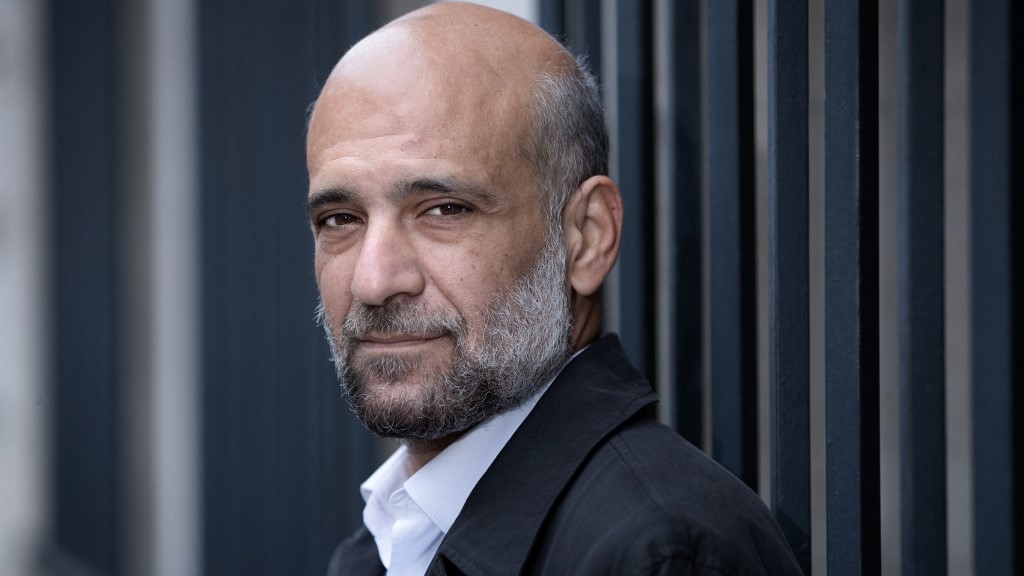
In January 2022, after 900 days of detention in an Egyptian correctional facility, Ramy Shaath stepped onto French soil at Paris’ Roissy Airport. To secure his release, the Palestinian academic and long-time political organizer was forced to renounce his Egyptian citizenship, and was greeted on arrival by his French wife Celine Lebrun-Shaath and crowds of cheering supporters. The release came after intensive diplomatic pressure from then-French President Emmanuel Macron, who personally lobbied Egyptian leader Abdel Fattah el-Sisi to secure Shaath’s freedom. “I share the relief of his wife,” Macron wrote at the time. “Thank you to everyone who has played a positive role in this happy outcome.”
Four years later, that warm welcome has curdled into a formal deportation order, framing Shaath as a “serious threat to public order” in France. On Thursday, he is scheduled to appear before an advisory deportation committee in Nanterre, the western Paris suburb where he has resided since 2022, to review the government’s attempt to remove him from the country. While the committee’s ruling is non-binding and French authorities retain the power to act regardless of its outcome, the proceedings mark the latest escalation in a months-long campaign of administrative harassment targeting the prominent activist.
Born in the besieged Gaza Strip, Shaath argues that French and European law prohibit his deportation to any available destination. “They cannot send me back to Gaza; one, because it’s a war zone and because I am targeted by the Israelis,” he told Middle East Eye in an exclusive interview. “And in both cases, European law will not allow them to send me to Palestine. And of course, I know more Egyptians, but they cannot send me to Egypt.” While he acknowledges a remote possibility that authorities could resettle him in an unrelated third country – “so I could find myself in Liberia or Gambia” – he expects to instead be left in a permanent state of legal limbo, locked out from renewing his temporary residency, cut off from basic public services, and subjected to ongoing law enforcement surveillance.
The foundation for the deportation push is Shaath’s decades-long open advocacy for Palestinian rights and statehood. Before his detention in Egypt, he rose to prominence as a key organizer during the 2011 Arab Spring uprisings that ousted longtime authoritarian leader Hosni Mubarak, and served as the national coordinator for the Egyptian chapter of the Boycott, Divestment, and Sanctions (BDS) movement targeting Israel over its occupation of Palestinian territory.
After arriving in France in 2022, Shaath was granted an initial one-year residence visa. When he applied for renewal in September 2023, shortly after Israel launched its large-scale military campaign in Gaza following the October 7 attacks, he received no official response. He has since filed 10 urgent legal appeals for residency renewal, all of which have gone unanswered. On April 30, he received formal notice at his Nanterre home that deportation proceedings had officially been opened against him.
Documents released by the Nanterre prefecture lay out the government’s justifications for the order, centered almost entirely on Shaath’s public comments and pro-Palestine organizing. The filing cites his long-standing connections to prominent Palestinian rights organizers in France, his public descriptions of Israel’s military campaign in Gaza as a “criminal occupation,” his open self-identification as an anti-Zionist, and his public support for a one-state solution that guarantees equal rights for all people living in historic Palestine.
Reacting to the prefecture’s claims, Shaath expressed sarcastic disbelief. “Oh my god, are you fucking serious? The French services cracked the biggest secret of my life! For 40 years I have not had one speech that I didn’t attack Zionism, and today you cracked my heart that I’ve been lying about – that I am anti-Zionist? Unbelievable.”
Other accusations in the filing, he says, are outright falsifications. Authorities cite one incident where he gave a “militaristic speech” while wearing military fatigues; Shaath notes that publicly available video of the event shows him sitting to deliver an academic lecture, wearing plain beige Uniqlo trousers. The filing also highlights a public comment where Shaath called on Iran to intervene to stop Israel’s military campaign in Gaza, which has killed more than 72,000 Palestinians, the vast majority of them women and children, and reduced most of the Gaza Strip to rubble. Shaath counters that he has also repeatedly called on France to deploy its military to intercept Israeli aircraft carrying out strikes on civilian targets in Gaza, a fact French officials have deliberately omitted from their filing.
“This is a McCarthyist attack that is racist, that is criminal, that is beyond the law to harass everybody who talks about Palestine,” he said.
Middle East Eye reached out to both the French Interior Ministry and the Nanterre prefecture for comment on the proceedings, but received no response ahead of publication.
Shaath’s case is far from isolated. Since the start of Israel’s Gaza war in October 2023, France has joined most other Western European nations in rolling out a widespread crackdown on pro-Palestine advocacy and protest. The crackdown has been particularly acute on university campuses, where student organizers, faculty, and labor unions have repeatedly warned of growing punitive pressure on anyone expressing public support for Palestinian rights. Peaceful demonstrations, public lectures, and campus occupations have been reclassified as illegal public disorder, leading to disciplinary proceedings, administrative fines, criminal charges, and in dozens of cases, permanent criminal records for participants.
Last month, the French parliament was scheduled to debate a controversial new bill that would introduce a range of new criminal penalties for public criticism of Israel, including criminalization of denials of Israel’s right to exist and criminal sanctions for public comparisons of Israeli policy to Nazi Germany. While the bill was ultimately pulled from the parliamentary calendar amid procedural disputes, the Macron administration has confirmed it intends to reintroduce identical legislation this summer. The proposed text would also expand the definition of terrorism-related offenses to include “implicit provocation,” a vague standard that legal experts warn would enable widespread crackdowns on anti-war and pro-Palestine speech.
Unlike many grassroots Palestinian rights organizers, Shaath comes from a prominent Palestinian political background: he is the son of Nabil Shaath, a former Palestinian Authority prime minister and chief Palestinian negotiator, previously served as an advisor to iconic PLO leader Yasser Arafat, was a member of the Palestinian Authority’s official negotiation team with Israel, and has even been invited to deliver formal addresses to the French Senate and Foreign Ministry. Nanterre, his home city, named him an honorary citizen in 2021, before his release from Egyptian prison. None of these credentials have shielded him from the sweeping new crackdown on pro-Palestine speech.
In response to the deportation order, Shaath’s family, friends, and supporters announced a new public campaign last Sunday to block his removal, under the hashtag #FreeRamyShaath2. The name references the first international campaign that secured Shaath’s release from Egyptian prison between 2019 and 2022, when he was charged with “aiding a terrorist group in achieving its goals.” Crucially, the first campaign enjoyed formal support from the French political establishment; the second is a direct challenge to that same establishment’s current crackdown on Palestinian advocacy.
This is not the first time French authorities have targeted Shaath over his pro-Palestine speech. In November 2023, Laurent Nunez, then the prefect of Paris and now the French Interior Minister, referred Shaath to the French justice system on charges of “apology for terrorism,” based on a rally speech where he stated that “the Palestinian people, like all people under occupation, have the right to defend themselves and resist.” The case was ultimately dismissed by Paris prosecutors 11 months after it was opened.
Shaath, who explicitly says he opposes all forms of violence and racism, including antisemitism, argues that even when the baseless charges are thrown out, the administrative process itself is a form of punishment designed to force him to end his activism or leave the country voluntarily. “Yes, of course, if they continue this draconian decision against me and put me under house arrest… I will fight it, but I’m not going to spend my life in that condition. Eventually, probably, that might lead me to leave,” he said.
The deportation notice already includes a provision that would place Shaath under house arrest ahead of any final ruling, restrict his movement to his home municipality of Nanterre, and require him to check in “morning and evening” at the local police station. Shaath says he intends to exhaust every available legal avenue to fight the order, including taking his case to the European Court of Human Rights if necessary.
“I will not live under intimidation. If they insisted on being a banana republic, I will insist on taking the legal route,” he said. “They want to keep me, to stop talking about Gaza and Palestine. I’m not going to do that.”