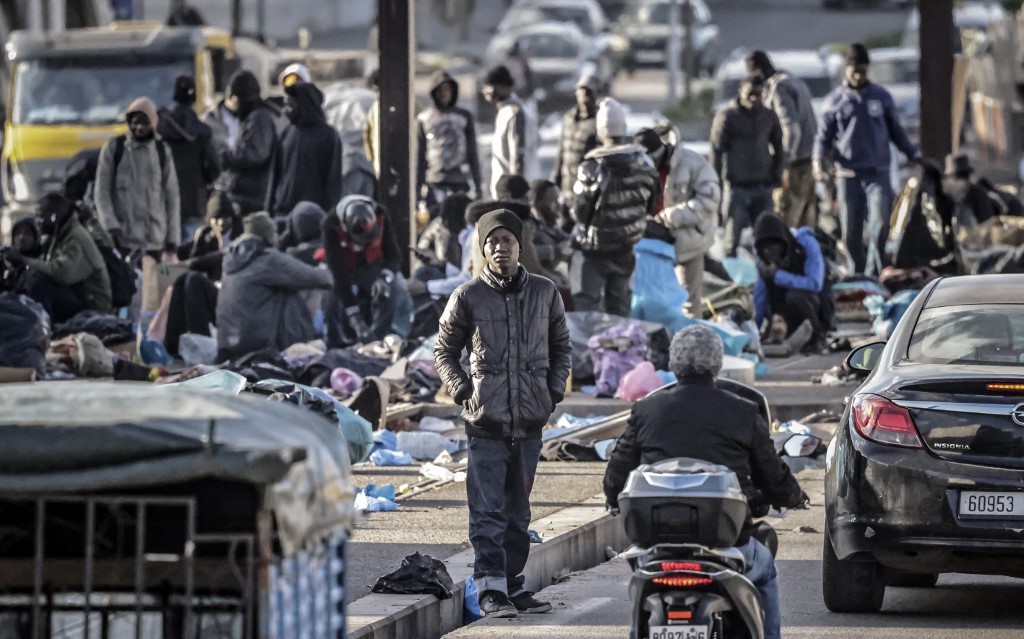
Since mid-April 2026, Morocco has launched an expansive, ongoing deportation campaign targeting sub-Saharan African migrants seeking passage to Europe, with local sources confirming security forces are arresting more than 100 people daily as operations expand across the country’s northern region.
Initial coordinated raids targeted informal forest encampments between Fnideq and Belyounech, a common shelter area for migrants waiting to attempt crossings to Europe, where human rights groups estimate roughly 800 people have been detained. After sweeping through this northern border zone, authorities shifted focus to large-scale operations in Tangier and its surrounding areas. Multiple witnesses and migrant advocates have documented serious abuses during the crackdown, including mass arbitrary arrests, physical beatings, racist verbal harassment, and forced transfers toward Morocco’s eastern border with Algeria.
Deportation procedures follow a tiered pattern: detainees from Sudan and Chad are transported by bus to remote border regions and abandoned without supplies, while migrants from Senegal, Mali, Mauritania, Burkina Faso, and Guinea are put on charter flights out of Casablanca for expulsion to their home countries.
This escalation of migration enforcement is directly tied to the European Union’s deepening border externalization strategy, a core pillar of the bloc’s incoming Pact on Migration and Asylum set to enter into force in June 2026. For years, the EU has increasingly outsourced its immigration control to North African nations with well-documented poor human rights records, allocating more than €900 million through its Global Europe development instrument to fund expanded border management, surveillance, and migration restriction initiatives across the region.
“Essentially, this is about the EU exercising border control without getting its own hands dirty,” explained Frey Lindsay, a journalist with Statewatch’s Outsourcing Borders project, which monitors the bloc’s offshored migration enforcement. “The goal is to stop migration as far downstream along the route as possible, before anyone reaches EU territory.”
As a key transit country for sub-Saharan African migrants heading to Europe, Morocco has steadily deepened its cooperation with Frontex, the EU’s Border and Coast Guard Agency, to block irregular departures from its northern coast. Moroccan interior ministry data shows authorities thwarted 73,640 irregular migration attempts in 2025, a small decline from 2024 that officials attribute to shifts to alternative migration routes.
Worsening conditions for migrants in northern Morocco have been well documented by grassroots and human rights groups. Chad Boukhari, a journalist and member of Border Resistance, a Mediterranean grassroots collective supporting migrants, told Middle East Eye that migrants reported widespread mistreatment and humiliation at the hands of Moroccan security forces. “Many were abandoned near the Algerian border with no food or water, and many of those people were then detained by Algerian forces,” Boukhari said. “Witnesses told us the Algerian army tortured many detainees, and some migrants even found the bodies of other migrants left in the desert.” This pattern of cross-border abandonment and abuse is not new: in 2025 alone, Algeria expelled more than 30,000 migrants to Niger, leaving multiple deportation convoys stranded in the Sahara, with widespread accounts of torture, enslavement, and systematic abuse emerging from the region.
Middle East Eye reached out for comment to Moroccan, Algerian, and EU authorities, but had not received a response as of publication.
For most sub-Saharan African migrants, the journey to Morocco already involves crossing the Sahel, an arid, dangerous trans-Saharan belt, through Niger and Algeria or Mauritania. Many originate from Sahel nations gripped by chronic instability and ranked among the lowest on the United Nations’ Human Development Index, making the dangerous journey to Europe a compelling option despite the risks. After arriving in Morocco, many spend months or even years living in informal camps in the country’s dense northern forests, where humanitarian groups occasionally provide limited aid—though these efforts are often disrupted by authorities.
Long before the current 2026 crackdown, Human Rights Watch has documented repeated, systemic abuses against migrants in Morocco dating back to 2014, including beatings by police, confiscation and destruction of personal property, burning of informal shelters, and extrajudicial expulsions without due process. Ousman Sow, a Guinean migrant who spent a year in Morocco before successfully crossing to Spain and now resides in Germany, described a pattern of coordinated monitoring of humanitarian aid efforts. “Oftentimes, the Red Cross would come to the forest and give us blankets and clothing, but we always knew that was a bad sign,” Sow said. “Shortly after those visits, Moroccan security forces would show up, like they had been tipped off or were watching. They burned all our things, then drove us to remote areas and left us there with nothing.”
Security operations are primarily focused on blocking access to Ceuta and Melilla, two Spanish enclaves on Moroccan territory that represent the only land border between Europe and Africa. The 2022 Melilla fence tragedy, where at least 23 mostly sub-Saharan African migrants were killed under disputed circumstances while attempting to cross the border, with another 70 people still missing, has served as a grim reminder of the deadly risks of this route. Reports have since emerged that Moroccan authorities buried many of the victims in unmarked, unrecorded graves.
Even with sharply increased enforcement, migration flows from North Africa to Europe have remained steady, driven by the ongoing war in Sudan and accelerating political and security collapse across the Sahel. For millions of displaced people, the promise of safety and opportunity in Europe still outweighs the extreme risks of the journey.
Lindsay warns that increased securitization of borders does nothing to address the root causes of migration, and only makes the journey deadlier. “The more borders and walls you build, the more dangerous alternative routes migrants are forced to take,” she noted. “Securitization doesn’t change why people leave their homes—it just makes more people die along the way.”
Rights advocates emphasize that the current crackdown in Morocco is a direct response to the EU’s new migration pact, which overhauls the bloc’s existing asylum system to speed up asylum case processing and deportations. The new framework expands biometric border surveillance and makes it easier to reject asylum claims on the grounds that a migrant passed through a “safe third country” before reaching the EU. Morocco is among the nations listed as safe third countries, alongside Egypt and Turkey—both of which face widespread allegations of systemic human rights abuses against migrants. Over 50 international non-governmental organizations have formally opposed the pact, arguing that its expedited procedures violate the fundamental right to a fair asylum review.
By externalizing enforcement, the EU effectively blocks most migrants from ever reaching a point where they can file an asylum claim, shifting all operational and ethical responsibility for border control to non-EU nations. Under the EU’s Emergency Trust Fund for Africa, the bloc has already allocated hundreds of millions of euros to strengthen migration enforcement in Morocco, Algeria, Tunisia, Egypt, and Libya.
The new migration pact is a high-stakes political priority for European Commission President Ursula von der Leyen and her administration, which needs a legislative win to maintain political support among EU member states. “Member states have made it very clear they will not back the pact unless the European Commission does everything possible to cut arrivals and deport as many people as possible,” Lindsay explained.
Patterns of abuse linked to EU-funded externalized border enforcement have already been well-documented in Libya, where the EU directly funds, trains, and equips Libyan coastal authorities that have been repeatedly accused of colluding with human trafficking networks to detain migrants, who are then subjected to systematic exploitation, physical and sexual violence, and enslavement. The EU is currently moving forward with plans to fund a new maritime control center in Benghazi, which is controlled by warlord Khalifa Haftar—accused of multiple war crimes by the United Nations—to intercept migrants at sea and force them back to Libya. Similar violent pushback practices have been documented along the EU’s eastern Balkans route, where Croatian border forces have repeatedly been recorded forcing migrants back into Bosnia, blocking them from accessing asylum procedures on EU territory.
The new pact also establishes a network of “return hubs,” third countries where rejected asylum seekers can be transferred and detained while waiting for deportation—often to nations where they have no family, community, or prior connections, with proposed hubs ranging from Bangladesh to Rwanda.
Human rights groups warn the pact reflects a broad, dangerous hardening of anti-migrant policy across EU member states that will have deadly consequences for thousands of people every year. For migrants in transit, shifting political winds in Europe directly shape their treatment in North African transit nations. As Ousman Sow put it: “Whenever the political climate changes in Europe, you can feel it in Morocco. If Europe wants immigrants, Morocco is okay. If not, it’s hostile there.”