分类: politics

  • Contrary to US policy, ambassador Huckabee says West Bank’s Area C ‘is Israel’

    Contrary to US policy, ambassador Huckabee says West Bank’s Area C ‘is Israel’

    In a striking departure from established US foreign policy, American Ambassador to Israel Mike Huckabee declared during a Friday interview with commentator Tucker Carlson that Area C of the occupied West Bank constitutes sovereign Israeli territory. The ambassador further escalated controversy by expressing openness to Israeli expansion across multiple Middle Eastern nations, including Syria, Jordan, Saudi Arabia, Iraq, and Egypt.

    These remarks triggered immediate condemnation from Arab and Muslim allies, who characterized Huckabee’s statements as “dangerous and inflammatory” rhetoric that undermines regional stability. The ambassador’s position directly contradicts longstanding US policy, which refuses recognition of Israeli sovereignty over any portion of the occupied West Bank.

    The West Bank’s division into Areas A, B, and C originated from the 1990s Oslo Peace Accords, which established the Palestinian Authority. While Areas A and B were designated for varying degrees of Palestinian control, Area C—representing approximately 60% of the West Bank—was intended to remain under Israeli military jurisdiction pending final status negotiations.

    Over the past two decades, Israeli settlement expansion within Area C has dramatically accelerated, with nearly 400,000 settlers now residing in the territory. Palestinian communities face systematic restrictions, including home demolitions, resource confiscation, and limited water access. UN data indicates over 70% of Area C Palestinian communities lack connection to water networks, relying on costly tankered deliveries.

    Khaled Elgindy of the Quincy Institute for Responsible Statecraft noted that Huckabee’s comments merely vocalize existing realities, stating that Israel has effectively achieved de facto annexation without formal declaration. This assessment gained further credibility when Israel’s cabinet recently assumed control over Area C’s land registry, invalidating Palestinian Authority documentation efforts.

    Simultaneously, Israel has intensified administrative control over Palestinian-governed Areas A and B, approving measures that undermine Palestinian Authority jurisdiction. Recent settlement expansions near Jerusalem further demonstrate Israel’s consolidation of control across the occupied territories, despite international condemnation of these actions as violations of international law.

  • India blocks Middle East Eye journalist’s X account

    India blocks Middle East Eye journalist’s X account

    The Indian government has formally blocked the X (formerly Twitter) account of Azad Essa, a US-based South African journalist serving as a senior reporter for Middle East Eye (MEE). The action was communicated via an official email from X Support on February 20th, citing a legal directive from India’s Ministry of Information and Broadcasting under Section 69A of the Information Technology Act, 2000.

    The notification stated that while X is legally compelled to restrict access to Essa’s content within India, his account remains accessible internationally. The platform advised the journalist to seek legal recourse through Indian courts to challenge the blocking order, though it emphasized it could not provide legal counsel.

    Essa, whose reporting extensively covers India-Israel relations, stated he received no specific explanation for the ban. He characterized the move as emblematic of deteriorating press freedoms in India and accused X of complicity in suppressing journalism while publicly championing free speech.

    This incident occurs against a backdrop of escalating tensions between X and the Indian government. Six months prior, the platform expressed concerns about censorship after temporarily blocking Reuters accounts following government requests—a move later denied by Indian authorities. In March 2025, X initiated legal proceedings against the Indian government over proposed policies that would expand officials’ authority to issue content removal requests. By May, these tensions culminated in approximately 8,000 takedown requests from Indian authorities during heightened India-Pakistan tensions.

    The journalist’s blocking coincides with deepening India-Israel relations. Prime Minister Narendra Modi is reportedly planning an upcoming visit to Israel to strengthen bilateral ties, with Israeli Prime Minister Benjamin Netanyahu describing the cooperation as part of a strategic “hexagon of alliances” countering radical elements in the Middle East.

    Essa, author of “Hostile Homelands: The New Alliance Between India and Israel,” reported experiencing sustained harassment from India’s right-wing factions over his coverage of India-Israel relations and Kashmir. He documented coordinated disinformation campaigns and personal threats aimed at discrediting his work.

  • Prime Minister Carney to travel to India, Australia and Japan to diversify Canada trade away from US

    Prime Minister Carney to travel to India, Australia and Japan to diversify Canada trade away from US

    Canadian Prime Minister Mark Carney has embarked on a significant diplomatic tour across India, Australia, and Japan, signaling a strategic pivot toward trade diversification beyond the United States. The Prime Minister’s Office confirmed the itinerary on Monday, highlighting this as Canada’s latest effort to strengthen economic partnerships with key Indo-Pacific nations.

    Carney’s journey begins in Mumbai on Thursday, where he will engage in high-level discussions with Indian Prime Minister Narendra Modi and convene with prominent business leaders. This visit marks a crucial step in revitalizing bilateral relations following two years of diplomatic strain.

    The Australian leg of the tour features a historic address to both houses of Parliament in Canberra—an honor not extended to a Canadian leader in two decades. Carney will also meet with Australian Prime Minister Anthony Albanese to explore collaborative opportunities in defense modernization and artificial intelligence development.

    In Tokyo, the Prime Minister will confer with Japanese counterpart Takaichi Sanae on pressing global issues including clean energy transition, critical mineral security, and sustainable food supply chains.

    ‘Within an increasingly volatile global landscape, Canada remains focused on controllable factors—specifically trade diversification and substantial investment attraction,’ Carney stated regarding the mission.

    This diplomatic offensive responds directly to escalating trade tensions with the United States, where President Donald Trump has repeatedly threatened imposing punitive tariffs—including a potential 100% levy—on Canadian goods. Trump’s recent characterization of Canada as potentially becoming ‘the 51st state’ has further strained relations.

    Carney’s trade diversification strategy aims to double Canada’s non-U.S. exports within the next decade. The Prime Minister recently gained international recognition at the World Economic Forum in Davos for his condemnation of economic coercion by major powers against smaller nations.

    The India visit occurs despite ongoing diplomatic challenges, including Canadian allegations of Indian official involvement in the June 2023 assassination of a Sikh activist near Vancouver. Similar accusations have emerged from United States authorities regarding alleged Indian plots against Sikh separatists on American soil.

  • Trump threatens countries that would ‘play games’ with tariffs

    Trump threatens countries that would ‘play games’ with tariffs

    Former President Donald Trump has issued a stark warning to international trading partners, threatening severe economic retaliation against nations attempting to exploit last week’s Supreme Court decision that curtailed his tariff-imposing authority. Through his Truth Social platform on Monday, Trump declared that any country engaging in what he termed ‘games’ regarding the judicial ruling would face substantially higher import duties than previously negotiated.

    The Supreme Court’s landmark decision struck down Trump’s use of emergency economic powers to implement country-specific tariffs, dealing a significant blow to his economic nationalist agenda. In response, Trump has pivoted to alternative legislative mechanisms to announce new 15 percent duties on imports, asserting his presidential authority to bypass Congressional approval for tariff implementation.

    Trump’s social media statements emphasized his unconventional interpretation of the court ruling, claiming it actually granted him ‘far more powers and strength’ through licensing authorities that could enable aggressive trade measures against foreign nations. This stance contradicts legal experts’ reading of the decision as a limitation on executive trade powers.

    US Trade Representative Jamieson Greer has meanwhile called for international partners to maintain existing tariff agreements with Washington, indicating potential tension between diplomatic channels and Trump’s confrontational approach. The development signals continued turbulence in global trade relations as the former president challenges both judicial and international trading norms.

  • Iraq’s Maliki defends PM candidacy, seeks to reassure US

    Iraq’s Maliki defends PM candidacy, seeks to reassure US

    In a defiant stance against American diplomatic pressure, former Iraqi Prime Minister Nouri Al Maliki has publicly reaffirmed his commitment to pursuing the nation’s top political office. During an exclusive interview with AFP on Monday, the political veteran declared his unwavering determination to remain in the nomination process despite explicit warnings from the United States administration.

    The political landscape in Iraq continues to be shaped by the complex interplay between global powers, particularly the ongoing rivalry between neighboring Iran and the United States. This geopolitical tension has persisted since the 2003 US-led invasion that deposed Saddam Hussein, creating a delicate balancing act for Iraqi leadership.

    The current confrontation escalated last month when President Donald Trump issued an ultimatum stating that US support for Iraq would cease if Maliki—who maintains close ties with Iran—assumes the prime minister role again. This declaration has placed Iraqi leaders, particularly within the Coordination Framework (a ruling coalition of Shia groups with varying connections to Iran that nominated Maliki), in a challenging diplomatic position.

    Maliki, who previously served two terms as prime minister from 2006 to 2014, responded to the American pressure with nationalistic rhetoric. ‘I have absolutely no intention of withdrawing out of respect for my country, its sovereignty, and its will,’ he stated emphatically. ‘No one has the right to say whom we can or cannot vote for.’

    Addressing Washington’s concerns regarding Iran’s influence, Maliki presented a conciliatory tone while maintaining his position. He acknowledged that ‘countries have the right to set conditions in their dealings with Iraq,’ but emphasized that any alteration to his nomination would require action from the Coordination Framework, which continues to endorse his candidacy.

    The former leader sought to reassure international observers by outlining his vision for military consolidation. ‘What America wants is not new. These are our demands,’ Maliki asserted. ‘We want weapons in the hands of the state. We want a centralized military force. We have said it repeatedly: we want one army under one command, directly under state authority.’

    Maliki expressed optimism about reaching agreements with pro-Iran armed factions, noting that ‘there is a good basis for understanding’ that could be achieved without ‘force, war or confrontations.’ He believes these groups ‘do not want to expose Iraq to any danger.’

    Regarding Washington’s demand to exclude Iran-backed armed groups from government participation, Maliki indicated this remains under discussion. He outlined a potential compromise: ‘We want those who participate in the political process and the government to lay down their arms. Those who lay down their arms are welcome to be part of the next government.’

    With regional tensions escalating due to ongoing nuclear negotiations between the US and Iran, Maliki pledged to protect diplomatic missions in Iraq. ‘All countries can be assured that we will prevent any violation against their embassies or officially recognized interests in Iraq,’ he committed, referencing previous attacks on US facilities by Iran-backed groups.

    Maliki defended Iraq’s relationship with Iran as based on mutual respect for sovereignty and shared interests, highlighting practical considerations including their 1,300-kilometer border and Iraq’s dependence on Iranian natural gas imports. He warned that cutting this supply ‘would be a major catastrophe’ for Iraq’s energy infrastructure.

    Despite beginning to enjoy relative stability after decades of conflict, Iraq’s political future remains uncertain, caught between competing international interests and internal divisions that will challenge whoever ultimately assumes leadership.

  • Ugandan president’s son compares Sudan’s RSF to Hitler following meeting with his father

    Ugandan president’s son compares Sudan’s RSF to Hitler following meeting with his father

    In a remarkable diplomatic breach, Muhoozi Kainerugaba—son of Ugandan President Yoweri Museveni and commander of the nation’s armed forces—launched a scathing social media attack against Mohamed Hamdan Dagalo, leader of Sudan’s Rapid Support Forces (RSF). The outburst came just days after Dagalo, commonly known as Hemedti, met with President Museveni at his Entebbe residence.

    Kainerugaba took to X (formerly Twitter) during Sunday night hours, labeling Hemedti ‘a criminal’ with ‘the blood of thousands of black people on his hands.’ His posts drew explicit parallels between RSF fighters and Nazi war criminals, stating: ‘RSF feels like heroes for killing innocent black people. Very good. I bet Hitler felt like a hero too for gassing Jews in Auschwitz.’

    The general, widely anticipated to succeed his father as Uganda’s leader, declared that the ‘RSF will have to fight the whole of Black Africa before they win in Sudan,’ adding emphatically that ‘that will NEVER happen.’

    In an abrupt thematic shift, Kainerugaba revealed supernatural instructions to erect a statue honoring Yoni Netanyahu—the Israeli commando leader killed during the 1976 Entebbe raid. He claimed: ‘For the last 4 years, My God Jesus Christ has appeared to me in dreams and visions. He told me to build a statue to Yoni Netanyahu in Entebbe.’

    This religious revelation underscores Uganda’s complex relationship with Israel. Despite President Museveni historically referring to Israel as ‘Palestine’ during memorial events, both he and his son maintain strong ties with Israeli leadership. In 2020, Museveni facilitated a landmark meeting between Israeli Prime Minister Benjamin Netanyahu and Sudanese military leader Abdel Fattah al-Burhan, initiating normalization talks between the nations.

    The controversy deepens with connections to Israeli businessman Barak Orland, described as an arms dealer and long-time Uganda resident. Orland’s company, Bar Aviation, has been implicated in supplying RSF forces via flights from Ugandan airports. Another Orland venture, security firm Yamasec, employs former Israeli military and intelligence personnel.

    Kainerugaba’s inflammatory tweets align with his history of provocative social media behavior, including past threats to invade Kenya and violent rhetoric against political opponents during Uganda’s elections.

    The RSF-Sudanese Armed Forces conflict, ongoing since April 2023, has created the world’s most severe humanitarian crisis. The RSF controls much of western Sudan, including Darfur, where they face genocide allegations against non-Arab communities. While Egypt, Turkey, Saudi Arabia, and Qatar support the official Sudanese military, the RSF enjoys patronage from the United Arab Emirates—a nation increasingly reliant on Ugandan cooperation following its withdrawal from Somali bases.

  • French minister moves to block US envoy Kushner from government access

    French minister moves to block US envoy Kushner from government access

    A significant diplomatic rift has emerged between France and the United States following controversial statements made by the American embassy regarding political violence in France. The confrontation centers on Ambassador Charles Kushner, who was appointed to the position last year and is the father of Donald Trump’s son-in-law Jared Kushner.

    The controversy ignited when the US Embassy in France published social media commentary concerning the fatal assault of Quentin Deranque, a 23-year-old mathematics student and far-right nationalist who died on February 14 after being attacked by masked assailants in Lyon. The embassy’s statement suggested that ‘violent left-wing extremism is on the rise’ in France—a characterization that provoked immediate consternation from French officials.

    French Foreign Minister Jean-Noel Barrot summoned Ambassador Kushner for urgent discussions on Monday evening. However, the diplomat did not attend the meeting, citing prior commitments, and instead dispatched a deputy from the embassy. This absence triggered a sharp response from the French foreign ministry, which criticized Kushner for an ‘apparent failure to grasp the basic requirements of the ambassadorial mission.’

    In an unprecedented move, Minister Barrot formally requested that Ambassador Kushner ‘no longer be allowed direct access’ to French government ministers. The ministry’s statement emphasized France’s rejection of ‘any use of this tragedy, which has plunged a French family into mourning, for political ends.’ Barrot further asserted that France requires ‘no lessons to learn, particularly on the issue of violence, from the international reactionary movement.’

    Judicial proceedings continue in the Deranque case, with six suspects charged in connection with the fatal assault. Additionally, a parliamentary assistant affiliated with the radical left France Unbowed (LFI) party faces complicity charges. LFI leader Jean-Luc Mélenchon, a potential presidential contender, has distanced his party from the incident while condemning ‘all forms of violence.’

    The escalating diplomatic tension represents one of the most serious public disputes between the allied nations in recent years, testing the resilience of Franco-American relations during a sensitive political period in both countries.

  • US ambassador defends travel bans on 3 Chilean officials as a ‘sovereign decision’

    US ambassador defends travel bans on 3 Chilean officials as a ‘sovereign decision’

    SANTIAGO, Chile — The United States ambassador to Chile has formally justified recent visa restrictions imposed on three high-ranking Chilean government officials, characterizing the move as a legitimate exercise of sovereign authority. Ambassador Brandon Judd addressed mounting tensions during a Monday press conference in Santiago, asserting America’s prerogative to deny entry when perceived threats to regional security emerge.

    The sanctions, publicly disclosed last Friday by U.S. Secretary of State Marco Rubio, specifically target individuals allegedly engaged in activities that compromise critical telecommunications infrastructure. Although Chilean authorities confirmed Transport and Telecommunications Minister Juan Carlos Muñoz as one affected official, the identities of the remaining two individuals remain undisclosed.

    Central to the diplomatic rift is a proposed submarine fiber optic cable project intended to connect Chile with China. While still in its preliminary evaluation phase, American officials have expressed profound security apprehensions regarding this infrastructure initiative. Ambassador Judd emphasized that exhaustive diplomatic efforts preceded the imposition of sanctions, noting that repeated requests for greater transparency from Chilean counterparts went unheeded.

    The decision has provoked substantial backlash within Chile’s left-leaning administration. Outgoing President Gabriel Boric condemned the American measures as unfounded and infringing upon national sovereignty, denouncing what he termed ‘indeterminate accusations’ and unilateral punitive actions.

    Ambassador Judd refuted allegations of intimidation, stating the U.S. poses ‘no threats’ but remains vigilant against ‘malicious actors’ within the region seeking to harm both Chilean and American interests. The diplomatic friction occurs during a delicate political transition period, with President Boric preparing to transfer power to far-right President-elect José Antonio Kast within two weeks.

    The Trump administration has openly welcomed Kast’s impending presidency following his decisive electoral victory in December, signaling anticipation for improved bilateral cooperation. This episode underscores significantly deteriorated relations between the two nations during the second Trump term, marked by President Boric’s vocal criticisms of American foreign policy approaches.

  • Trump denies top US officer warned of Iran strike risks

    Trump denies top US officer warned of Iran strike risks

    President Donald Trump has publicly contradicted media reports suggesting that the United States’ highest-ranking military officer expressed significant reservations about potential military action against Iran. Utilizing his Truth Social platform, Trump characterized reports about General Dan Caine, Chairman of the Joint Chiefs of Staff, as “100 percent incorrect,” asserting instead that the general would be “leading the pack” in any military engagement.

    Multiple major U.S. news outlets, including The Washington Post and The Wall Street Journal, had reported that General Caine raised serious concerns in White House and Pentagon discussions. These concerns reportedly highlighted the risks of munition shortages, a lack of international allied support, potential U.S. and allied casualties, and the danger of the U.S. becoming entangled in a prolonged, complex conflict. The Axios news outlet further reported that key advisors, including Trump’s roving negotiator Steve Witkoff and son-in-law Jared Kushner, had also advised pursuing diplomatic channels instead of military action.

    Trump dismissed these narratives as purposefully misleading. He stated that while he and General Caine would prefer to avoid war, he believes any conflict with Iran would be “easily won.” The President emphasized that he alone holds the authority to make the final decision, stating his preference for a diplomatic deal but warning that without one, it would be “a very bad day” for Iran.

    This exchange occurs amidst a significant U.S. military buildup in the Middle East, which includes the deployment of two aircraft carrier groups and numerous other assets. The tensions stem from the collapse of the 2015 nuclear deal, which Trump withdrew from in 2018. He has repeatedly threatened further military action if ongoing negotiations fail to produce a new agreement. Despite the heated rhetoric, a U.S. official confirmed that the next round of talks with Tehran is scheduled for Thursday, indicating that diplomatic efforts are continuing.

  • Watch: What to watch for during Trump’s State of the Union address

    Watch: What to watch for during Trump’s State of the Union address

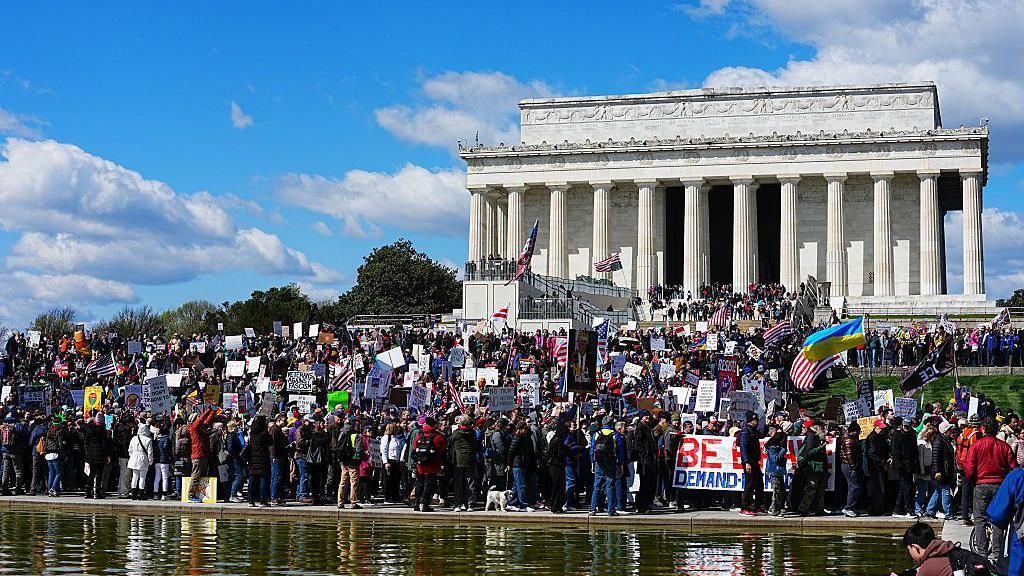
    As President Trump prepares to deliver his pivotal State of the Union address, multiple political undercurrents are converging to shape one of the most anticipated presidential speeches of the year. According to analysis from BBC Washington correspondent Daniel Bush, several critical elements warrant close observation.

    The event may witness notable absences, with certain lawmakers potentially boycotting the presidential appearance. This prospect underscores the deeply polarized political climate characterizing current Washington dynamics.

    Simultaneously, the President’s reported frustration toward the Supreme Court introduces another layer of complexity to the upcoming address. This tension between the executive and judicial branches reflects broader constitutional tensions that may influence both the tone and content of the speech.

    Policy analysts are particularly attentive to which legislative areas might experience significant shifts following the address. While some policy domains appear poised for substantial overhaul, others seem likely to maintain their current trajectory despite presidential rhetoric. The address is expected to reveal administration priorities while testing the boundaries of presidential influence amid competing power centers in Washington.