分类: politics

  • Maldives tells UK it does not recognise Chagos Islands deal

    Maldives tells UK it does not recognise Chagos Islands deal

    The Maldives has formally declared its opposition to the United Kingdom’s agreement to transfer sovereignty of the Chagos Islands to Mauritius, escalating a complex territorial dispute in the Indian Ocean. President Mohamed Muizzu’s administration has submitted two written objections to the British government and raised concerns directly with UK Deputy Prime Minister David Lammy during a December phone call, characterizing the bilateral arrangement as “deeply concerning” and insufficiently attentive to Maldivian interests.

    This diplomatic confrontation stems from the Maldives’ assertion of historical sovereignty over the strategically significant archipelago, which the UK has administered as the British Indian Ocean Territory since the 19th century. The Muizzu government maintains that geographical proximity and centuries-old administrative ties grant the Maldives superior territorial claims over both Mauritius and the United Kingdom.

    The controversy emerges against the backdrop of international legal developments. Both the International Court of Justice (2019) and the International Tribunal for the Law of the Sea (2023) have issued rulings supporting Mauritius’ claims, determining that Britain’s 1965 separation of the islands from Mauritian territory violated international law. While these opinions are non-binding, they carried significant diplomatic weight, leading to a near-unanimous UN General Assembly resolution demanding the islands’ return to Mauritian control.

    Complicating matters further, the UK-Mauritius agreement—which includes provisions for continued operation of the joint UK-US military base on Diego Garcia—now faces multiple challenges. Former US President Donald Trump has publicly urged Prime Minister Keir Starmer to abandon the transfer, creating unexpected political pressure despite official State Department support for the arrangement. Additionally, the deal has drawn criticism from Chagossian diaspora communities seeking right of return and faces opposition from British political parties including the Conservatives and Reform UK.

    The Maldives has indicated it will pursue “all available avenues” for formal submission to international judicial bodies, potentially including a case before the ICJ. Such legal action would further complicate the already delayed implementation of the UK-Mauritius agreement, which remains in legislative limbo without confirmation in British law.

    President Muizzu’s administration expresses hope for “meaningful dialogue” with the UK based on “mutual respect and historical accuracy,” but simultaneously prepares for legal confrontation to protect what it considers vital national interests in the strategically crucial waters of the Indian Ocean.

  • Pro-Israel PR firm promoting Iranian opposition group

    Pro-Israel PR firm promoting Iranian opposition group

    A confidential email obtained by Middle East Eye has uncovered significant connections between an Iranian opposition coalition and pro-Israel public relations operatives with ties to the American Israel Public Affairs Committee (AIPAC). The Iran Freedom Congress (IFC), presenting itself as an independent initiative organizing Iranian civil and political actors from diverse backgrounds for a London convention, is being promoted by Red Banyan—a crisis PR firm with extensive historical links to the pro-Israel lobby.

    Despite the IFC’s public claims of operating without foreign government or organizational influence, the leaked correspondence reveals that Neil Strauss, an account director at Red Banyan who leads the firm’s ‘Jewish and pro-Israel vertical,’ is actively publicizing the coalition. Strauss, formerly communications director for the Republican Jewish Coalition, has extensive experience in pro-Israel political campaigns according to his professional profile.

    The email promotion offers media interviews with two IFC figures connected to Iran’s monarchist opposition: Mehrdad Marty Youssefiani, former strategic counselor to Reza Pahlavi (son of Iran’s former Shah), and Shahryar Ahy, described as an advocate for democratic transition in Iran. Notably, Pahlavi’s office recently distanced itself from Ahy, issuing a statement clarifying that he does not serve as an adviser.

    IFC Executive Director Majid Zamani told Middle East Eye the organization had no prior knowledge of Strauss or Red Banyan and stated they do not represent the coalition in any capacity. ‘We cannot control or be held responsible for statements, communications, or promotional efforts made by third parties who are not affiliated with us,’ Zamani emphasized.

    The revelation has sparked concern among Iranian diaspora observers. Jamal Abdi, president of the National Iranian American Council, commented: ‘The real story of the Iranian diaspora opposition is the role the Israel lobby is having in shaping it. The trauma and desire for change in Iran has been preyed on in a way that has turned the Iranian diaspora against itself.’

    Red Banyan’s connections to AIPAC run deep. Chief Executive Evan Nierman worked at the pro-Israel lobby group for seven years, and the firm continues extensive collaboration with AIPAC, as confirmed by Jeremy Rider, AIPAC’s communications director, who described Red Banyan as ‘an external, yet essential, part of our communications team.’

    The firm’s website prominently features its pro-Israel work, including rebranding an Israeli non-profit called CyberWell—an organization reported to have deep ties to Israeli government propaganda efforts and significant influence over social media content since the October 2023 Hamas-led attack.

    Human rights organizations have expressed concern about the implications of these connections. Kristyan Benedict, Amnesty International UK’s crisis response manager, noted: ‘Genuine justice and human rights in Iran are not going to come from individuals and organisations aligned with the current Israeli government,’ adding that Israel was ‘committing genocide, apartheid and other international crimes daily.’

    The development raises fundamental questions about foreign influence operations within diaspora opposition movements and the ethical boundaries of crisis public relations in international political contexts.

  • One month in, what do American conservatives make of the war in Iran?

    One month in, what do American conservatives make of the war in Iran?

    A month into the ongoing joint military campaign between the United States and Israel against Iran, significant ideological rifts have emerged within American conservative circles. The annual Conservative Political Action Conference (CPAC) in Texas served as a revealing platform where attendees expressed conflicting viewpoints regarding Operation Epic Fury, initiated on February 28th.

    The military operation, characterized by its unprecedented coordination between Washington and Tel Aviv, has sparked intense debate among conservative thought leaders. While some conference participants voiced strong support for the aggressive stance against Iranian targets, others demonstrated notable reservations about the campaign’s strategic objectives and potential long-term consequences.

    This division highlights the evolving nature of conservative foreign policy philosophy in the post-Trump era. The spectrum of opinions ranges from hawkish advocates who emphasize national security imperatives to more cautious voices concerned about mission creep and regional destabilization. These internal disagreements reflect broader tensions within the conservative movement regarding America’s role in Middle Eastern conflicts and the appropriate application of military power.

    The conference discussions revealed particularly nuanced positions on the timing, execution, and geopolitical implications of the operation, suggesting that conservative consensus on foreign interventionism may be undergoing significant redefinition.

  • ‘Strait of Trump’: US president says Iran must open key waterway

    ‘Strait of Trump’: US president says Iran must open key waterway

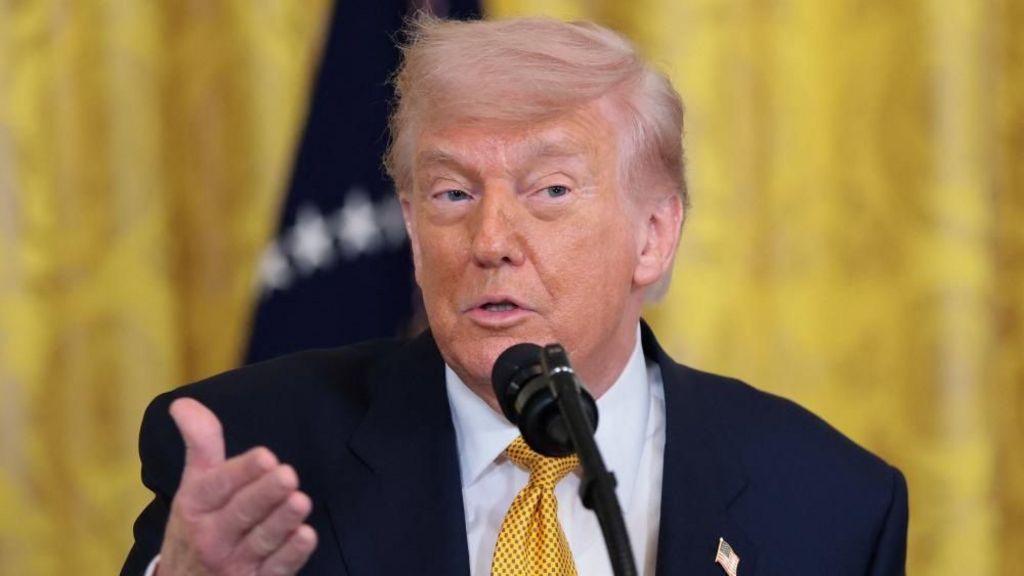
    In a striking declaration at Miami’s FII Priority investment conference, former U.S. President Donald Trump asserted that Iran must guarantee access to the Strait of Hormuz—which he momentarily rebranded as the “Strait of Trump”—as a prerequisite for any peace agreement. The Friday remarks, made during a Saudi-backed forum, included both an immediate retraction and a characteristically unapologetic follow-up, with Trump stating, “there’s no accidents with me.”

    The 79-year-old leader maintained that negotiations were actively underway to resolve the ongoing month-long conflict, despite Tehran’s consistent denials. He claimed Iran was “on the run” and that its military capabilities and nuclear program had sustained substantial damage. These comments align with his administration’s pattern of applying economic pressure, including previous suggestions about seizing Iran’s oil reserves similar to U.S. actions in Venezuela.

    Trump’s propensity for attaching his name to landmarks resurfaced throughout his address. He referenced prior rebrandings of Washington institutions—including the Kennedy Center and a peace institute—and even mentioned briefly renaming the Gulf of Mexico as the “Gulf of America.” The Strait of Hormuz, a critical chokepoint for global oil transit, has been largely closed since hostilities began, contributing to rising worldwide energy prices.

    Earlier on Friday, U.S. Secretary of State Marco Rubio expressed concerns that Iran might attempt to institute a permanent toll system for vessels passing through the strait, which typically handles one-fifth of the world’s oil shipments. The combination of military rhetoric and economic posturing continues to define the tense U.S.-Iran relationship, with Trump’s latest comments adding another layer of diplomatic complexity.

  • The German army protecting Western Europe’s eastern edge

    The German army protecting Western Europe’s eastern edge

    For decades after the end of World War II, Germany occupied a cautious, constrained position when it came to military leadership on the European continent, bound by historical guilt and a long-standing culture of strategic restraint. Today, however, a dramatic shift is underway: the once-reluctant European power is stepping into a critical role as the primary military anchor protecting NATO’s eastern border, the frontline dividing Western Europe from Russian influence. As the alliance grapples with heightened security threats following Russia’s full-scale invasion of Ukraine, the question that dominates defense corridors across Brussels and Berlin is whether Germany can actually live up to its newfound ambition of becoming Europe’s foremost military power.

    Germany’s evolving role comes against a backdrop of shifting transatlantic security priorities. For years, the United States bore the bulk of NATO’s defense burden, while many Western European nations, including Germany, consistently failed to meet the alliance’s target of spending 2% of GDP on defense. The 2014 Russian annexation of Crimea, and more dramatically the 2022 invasion of Ukraine, upended that long-standing status quo. Berlin responded with a historic policy shift: it unveiled a €100 billion special defense fund to modernize its aging military hardware, committed to hitting the 2% GDP spending target permanently, and positioned itself as a key coordinator of military aid to Kyiv. At the same time, German troops have become a core component of NATO’s forward deployments in the Baltic states and Eastern Europe, taking on a lead role that would have been unthinkable for generations of German policymakers.

    But significant challenges remain that threaten to derail Germany’s ambitions. Decades of underinvestment have left the Bundeswehr plagued by equipment shortages, slow procurement processes, and bureaucratic gridlock. Industrial bottlenecks in Germany’s defense sector also mean that expanding arms production to meet both domestic needs and the demands of supporting Ukraine is a slow, costly process. Political divides within Germany’s ruling coalition also create uncertainty: while the current government has committed to increased defense spending, skepticism of military escalation remains widespread among portions of the German public. Even so, NATO allies across Eastern Europe, who have long called for a more assertive German role in regional security, are watching the transition closely. For Europe’s security architecture, the outcome of Germany’s military buildup will shape the stability of the continent for decades to come, determining whether the eastern edge of Western Europe can be reliably defended against evolving security threats.

  • Nato to set up new corps in Turkey as Ankara eyes regional deterrence

    Nato to set up new corps in Turkey as Ankara eyes regional deterrence

    Turkey’s Defense Ministry has confirmed ongoing preparations for establishing a NATO multinational corps headquarters on its soil, marking a significant enhancement of the alliance’s southern defensive capabilities. Designated as MNC-TUR, this initiative forms part of NATO’s comprehensive southern regional strategy, with developmental work commencing in 2023 and formal notification delivered to alliance members in 2024.

    The strategic location selected for this headquarters is the 6th Corps Command in Adana, a southern province housing the strategically vital Incirlik airbase currently utilized by U.S. and Spanish military personnel. A Turkish general will assume command of the corps, with national core staff appointments already finalized. According to sources familiar with the timeline, Turkey anticipates completing establishment procedures by 2028.

    Defense officials emphasize that this military enhancement predates recent Middle Eastern tensions and remains unrelated to current regional conflicts. “Coordination with NATO authorities continues regarding the headquarters transformation into a multinational structure,” the ministry stated, noting that “approval processes remain ongoing as NATO procedures have not yet been fully completed.”

    This development represents Turkey’s third major NATO command facility, complementing existing Land Command headquarters in Izmir and the Rapid Deployable Corps in Istanbul. Retired Brigadier General Huseyin Fazla, with extensive NATO experience, clarifies the strategic rationale: “While the Istanbul corps provides rapid deployment capabilities, MNC-TUR will deliver permanent protection for Turkish territory against regional threats, including those emanating from Russia and the Mediterranean.”

    Karol Wasilewski of Poland’s OSW think tank contextualizes the move within NATO’s broader strategic evolution: “This initiative aligns with the alliance’s modular approach adopted at the Vilnius summit, emphasizing land force development while implementing 360-degree threat response capabilities particularly beneficial to Turkish security interests.”

    The Adana location offers practical advantages, leveraging existing infrastructure capable of accommodating international officers and their families. Fazla notes this minimizes financial investment while maximizing operational readiness: “The 6th Corps possesses established experience coordinating with allied forces, and necessary facilities from housing to educational institutions are already operational.”

    Regional analysts suggest the corps will demonstrate NATO’s commitment to collective defense while enhancing Turkey’s strategic positioning, potentially altering regional power dynamics through demonstrated alliance solidarity and enhanced military interoperability.

  • ‘Policing thought’: French bill to fight antisemitism accused of silencing Israel critics

    ‘Policing thought’: French bill to fight antisemitism accused of silencing Israel critics

    A legislative proposal intended to combat modern forms of antisemitism has ignited intense political and social controversy in France, with critics warning it could criminalize legitimate criticism of the Israeli government. The bill, scheduled for parliamentary debate next month, has drawn opposition from human rights organizations, left-wing parties, and even segments of the French Jewish community.

    Introduced in November 2024 by MP Caroline Yadan, a former member of President Emmanuel Macron’s Renaissance party, the legislation specifically addresses what it terms ‘renewed forms of antisemitism’ that have emerged since the October 7, 2023 attacks. Yadan, who represents French citizens abroad in a constituency including Israel and Palestine, left Macron’s parliamentary group in protest of his recognition of Palestinian statehood.

    The proposed law adopts the International Holocaust Remembrance Alliance’s (IHRA) controversial definition of antisemitism, which includes ‘targeting the state of Israel, conceived as a Jewish collectivity.’ While the French National Assembly adopted this definition as a non-binding resolution in 2019, the new bill seeks to incorporate it into criminal law.

    Legal experts and human rights advocates have raised significant concerns about several provisions. Article 1 expands the scope of ‘incitement to terrorism’ offenses, which have been increasingly used against pro-Palestinian voices. Article 2 creates a new offense punishing ‘incitement to the destruction or denial of a state’ with penalties of up to five years imprisonment and €75,000 fines—potentially criminalizing slogans like ‘Free Palestine.’ Article 4 broadens the definition of Holocaust denial to include comparisons between Israeli policies and historical crimes committed by regimes such as Nazi Germany or apartheid South Africa.

    The French Human Rights League (LDH) president Nathalie Tehio stated, ‘The aim is to criminalize the expression of certain opinions and prosecute anything critical of Israel.’ The National Consultative Commission on Human Rights, an independent governmental body, warned the bill would discourage ‘legitimate and healthy debates in a democratic regime.’

    Notably, the legislation has divided French political circles, receiving support from right-wing and far-right parties while facing opposition from across the left spectrum. Even the Council of State, France’s highest administrative court, recommended amendments to address vague terminology that could lead to arbitrary applications.

    Perhaps most significantly, French Jewish organizations including the French Jewish Union for Peace have condemned the bill, arguing it creates a ‘false equation between Jews, Israel and Zionism’ and could actually increase antisemitism by associating French Jews with Israeli policies. Pierre Stambul, co-president of the organization, warned the bill ‘imposes an assigned identity to French Jews that equates them with supporting the state of Israel and its policies.’

    The government has initiated an expedited procedure for the bill’s adoption, with Prime Minister Sebastien Lecornu recently stating that ‘to call oneself anti-Zionist is to contest Israel’s very right to exist.’ If passed, opponents plan to challenge the legislation before the Constitutional Council, though its political composition—with members appointed by the president—raises questions about its impartiality.

  • Rubio denies Zelenskyy’s claim that the US asked Ukraine to cede land to Russia for security deal

    Rubio denies Zelenskyy’s claim that the US asked Ukraine to cede land to Russia for security deal

    PARIS — U.S. Secretary of State Marco Rubio has forcefully rejected Ukrainian President Volodymyr Zelenskyy’s allegations that the Trump administration requires Kyiv to surrender the eastern Donbas region to Russia in exchange for American security guarantees. The diplomatic confrontation emerged during a Group of Seven meeting in France, where Rubio characterized Zelenskyy’s claims as fundamentally inaccurate.

    In a press briefing, Rubio explicitly stated, “That’s a lie. And I saw him say that. It’s unfortunate he would make such assertions when he knows perfectly well that’s not what was communicated to Ukrainian officials.” The Secretary of State clarified that the U.S. has merely conveyed Moscow’s demands to Kyiv without endorsing them, emphasizing that ultimate decisions remain Ukraine’s sovereign prerogative.

    The controversy stems from Zelenskyy’s recent Reuters interview where he suggested Washington had made security guarantees conditional upon Ukraine’s withdrawal from Donbas, the industrial heartland that has been partially occupied by Russian forces since 2014. Despite significant territorial control, Russian forces haven’t captured the entire region, leaving heavily fortified front lines intact.

    Rubio elaborated on America’s mediating role: “We’ve explained Russian positions to the Ukrainian side without advocacy. It’s their choice to make—not ours. Our diplomatic efforts focus on identifying common ground between both parties.”

    The Ukrainian presidential office maintained silence regarding the contradictory statements. Meanwhile, analysts note that complete control over Donbas would provide Moscow with a permanent strategic advantage to threaten other Ukrainian territories.

    Amid growing concerns about resource allocation, Rubio acknowledged that while no weapons destined for Ukraine have been redirected to the Middle East yet, such reassignments could occur if deemed necessary for American security priorities. This statement follows reports of Patriot air-defense systems being relocated from Europe to the Middle East as Washington intensifies its military engagement with Iran.

  • Sanctioned oil tanker enters UK waters day after government crackdown threat

    Sanctioned oil tanker enters UK waters day after government crackdown threat

    A Cameroon-flagged oil tanker under UK sanctions for transporting Russian crude has navigated through the English Channel without intervention, despite recent government authorization for military boarding operations. The VAYU 1, carrying a full cargo from Murmansk, Russia, entered UK territorial waters on March 26th, passing within six nautical miles of Dover according to maritime tracking data.

    This transit occurred just one day after British ministers publicly declared that armed forces had received permission to board sanctioned vessels in UK waters. The government had added VAYU 1 to its sanctions list in May 2025 for allegedly carrying Russian oil and “destabilizing Ukraine.”

    When questioned by BBC Verify about the non-intervention, the Ministry of Defence stated that “any enforcement action is considered on a case‑by‑case basis” in accordance with international law, declining to provide specific operational details that might compromise future enforcement actions.

    Maritime analysis reveals the tanker spent approximately 5.5 hours within UK territorial waters (extending 12 nautical miles from shore) and 29 hours within the UK’s Exclusive Economic Zone (extending 200 nautical miles). Its final destination remains unlisted on tracking platforms.

    The vessel represents part of Russia’s alleged “shadow fleet” of tankers with opaque ownership structures designed to circumvent international sanctions. Prime Minister Keir Starmer recently emphasized intensified efforts to target this fleet, stating: “Putin is rubbing his hands at the war in the Middle East because he thinks higher oil prices will let him line his pockets.”

    Naval enforcement expert Professor Kevin Rowlands, a former Royal Navy captain, detailed potential detention procedures involving helicopter deployments and specialized boarding teams comprising sailors and Royal Marines trained to safely search vessels and divert them to UK ports when necessary.

  • Le Monde: ‘Majority’ of ICC bureau members support Karim Khan exoneration report

    Le Monde: ‘Majority’ of ICC bureau members support Karim Khan exoneration report

    A significant majority within the International Criminal Court’s executive leadership has moved to endorse judicial findings exonerating Chief Prosecutor Karim Khan of misconduct allegations, according to diplomatic sources cited by French publication Le Monde. This development follows an extensive UN investigation into alleged sexual misconduct that failed to establish any breach of duty by the prosecutor.

    The three-judge panel, commissioned by the Assembly of States Parties (ASP) bureau, concluded that evidence presented by the UN’s Office for Internal Oversight Services (OIOS) was insufficient to support misconduct claims under the rigorous ‘beyond reasonable doubt’ standard. The judicial review criticized the OIOS investigation for lacking conclusive factual determinations and failing to assess evidence reliability adequately.

    Despite this judicial clearance, a minority faction within the 21-member ASP bureau continues advocating for disregarding the panel’s findings and conducting independent assessments. This internal division emerges against the backdrop of Khan’s controversial pursuit of arrest warrants against Israeli officials, including Prime Minister Benjamin Netanyahu and former Defense Minister Yoav Gallant, for alleged war crimes in Gaza.

    The timing of these proceedings has drawn scrutiny from international observers, with some diplomatic sources questioning whether Khan has received fair treatment throughout the process. One source anonymously noted that the entire affair appeared ‘designed to put the prosecutor under the guillotine.’

    Legal experts have warned that dismissing the judicial panel’s conclusions risks undermining the ICC’s institutional credibility and the rule of law principle. Sergey Vasiliev, an international criminal law specialist, emphasized that disregarding unanimous judicial findings simply because they contradict certain states’ expectations would create dangerous precedents.

    The controversy has intensified amid external pressures on the court, including financial sanctions and visa restrictions imposed by the Trump administration against Khan, his deputies, and several judges involved in the Israel-Palestine investigation. The ASP bureau faces an April 8 deadline to reach a final decision regarding the misconduct allegations.