分类: politics

  • Damascus races to reassure Beirut as Trump pushes Syria to take on Hezbollah

    Damascus races to reassure Beirut as Trump pushes Syria to take on Hezbollah

    In recent months, successive public statements from U.S. President Donald Trump suggesting Syria take charge of addressing the Hezbollah issue have rekindled deep-seated anxiety in Lebanon over a potential return of Syrian military involvement to the country, even as Syrian President Ahmed al-Sharaa and his administration have repeatedly rejected any plans for armed intervention. Trump’s increasingly explicit framing of a Syrian role has also exposed apparent inconsistencies in the Biden administration’s earlier messaging, directly contradicting a previous categorical denial from U.S. Ambassador to Syria Tom Barrack, who dismissed claims Washington had pressured Damascus to deploy troops into Lebanon as “false and inaccurate.”

    The most recent comments from Trump came during a June 21 interview with Fox News, where the U.S. leader expressed open disappointment with Israel’s ongoing campaign against Hezbollah, criticizing the operation for its widespread collateral damage. “They can’t do anything without knocking buildings down,” Trump told the outlet, adding “I’m close to giving it over to Syria.” Notably, Trump offered no additional context to clarify his use of the phrase “giving it over,” leaving observers uncertain whether he was referencing a full-scale Syrian military operation, regional political mediation, targeted pressure on Hezbollah, enhanced cross-border security coordination, or expanded cooperation with Lebanon’s central government. Even so, his remarks mark the latest in a string of public signals that the White House has actively explored assigning Damascus a formal role in managing the Lebanese armed group.

    The discourse around a potential Syrian involvement first emerged in public view on March 17, when Reuters published a report claiming U.S. officials had encouraged Damascus to consider deploying military forces into eastern Lebanon to support efforts to disarm Hezbollah. Citing five anonymous sources with direct knowledge of the behind-the-scenes talks, the outlet noted that Syrian officials had already expressed reluctance to move forward with the proposal, warning that intervention could drag Syria into a wider regional conflict and reignite volatile sectarian tensions in both Syria and Lebanon. According to the report, the proposal was first raised during bilateral talks between U.S. and Syrian officials in 2025, before being revisited in late February, shortly after the outbreak of the U.S.-Israeli war on Iran. Within hours of the report’s publication, Barrack issued a forceful public rejection of the claims, writing on the social platform X that “Reporting regarding the United States encouraging Syria to send forces into Lebanon is false and inaccurate.”

    Despite these denials, regional outlet Middle East Eye (MEE) subsequently reported that Sharaa held a meeting with leaders of Syrian armed factions shortly after the Reuters report to discuss the circulating claims. A Syrian source briefed on the gathering told MEE that “Those present agreed that Syria had neither the intention nor the desire to intervene militarily in Lebanon.” A separate senior Lebanese source also confirmed to MEE that Lebanese authorities in Beirut had received multiple formal reassurances that Damascus had no plans to deploy troops across the shared border. The outlet further reported that Syrian officials have begun coordinating with regional allies including Saudi Arabia, Qatar, and Turkey to push back against U.S. pressure for intervention. A second senior Syrian source told MEE that to avoid directly complying with Washington’s demands, Sharaa has laid out a series of preconditions for any Syrian involvement that would be nearly impossible for the U.S. to meet.

    Trump first floated the idea of a Syrian role in Lebanon publicly during a June 5 appearance on NBC’s *Meet the Press*, where he called for a more “surgical” campaign against Hezbollah and suggested Washington could either directly assist the effort or “recommend Syria” take the lead. “We can help them with that, or we can recommend Syria,” Trump said at the time, praising Sharaa and claiming the Syrian leader “would love to help.” While that initial stop stopped short of an explicit call for Syrian troops to enter Lebanon, Trump adopted a far more direct tone during a press availability at the G7 summit in Evian-les-Bains, France, on June 16. “I suggested to Israel to let Syria take care of Hezbollah, because, to be honest with you, I think they do a better job of doing it,” he told reporters. He doubled down on his criticism of Israel’s campaign, arguing it has progressed too slowly, caused unnecessary civilian casualties, and destroyed large swathes of residential infrastructure. He also reiterated his praise for Sharaa, claiming the Syrian leader has done an “amazing job” consolidating state control across Syria and “does not like” Hezbollah.

    The following day, when pressed by reporters to confirm whether he had directly discussed the Hezbollah issue with Sharaa, Trump confirmed the conversation had occurred but declined to share whether the Syrian leader had agreed to take on a role, saying only that he would address the matter at a later date. The exchange confirmed that Trump’s proposal was not merely an abstract suggestion for Israeli policymakers, but that the prospect of a Syrian role had already been raised directly with the Damascus government.

    In recent weeks, Sharaa has moved aggressively to quell growing speculation over potential intervention. During a June 11 meeting with dignitaries from the Damascus countryside, he dismissed reports of an imminent Syrian military entry into Lebanon as baseless rumors. Later, in an interview with Al Arabiya, Syrian presidential adviser Ahmed Muwaffaq Zaidan confirmed that Washington had proposed Syrian involvement amid the ongoing regional escalation, but said Damascus had rejected any military or security role in Lebanon. He added that Syria supports extending the authority of Lebanon’s central government across all of its territory, but that this goal should be achieved by strengthening Lebanese state institutions rather than deploying Syrian troops.

    Sharaa expanded on this position in a June 21 interview with Al Mashhad TV, pushing back against claims that Trump’s comments were a signal Syrian forces would enter Lebanon imminently. He argued Trump’s remarks had been misinterpreted, explaining that the U.S. president had raised concerns over the ongoing war and discussed potential Syrian contributions to a peaceful, secure resolution, rather than calling for an invasion. Sharaa emphasized that Syria’s top priority is ending the war and halting Israeli bombardment, noting that Damascus has discussed political, economic, and social pathways forward with U.S. officials. “Our vision is based on supporting the Lebanese state once again, strengthening its institutions, and seeking a solution that everyone believes in,” he said. “We are looking for economic channels between Lebanon and Syria, not military ones.” Sharaa also noted that Damascus is open to dialogue with all Lebanese political factions, including Hezbollah, acknowledging that the group’s role in Syria’s civil war left a “deep Syrian wound” but adding he would meet with Hezbollah representatives if it advanced the shared interests of both Lebanon and Syria.

    Lebanese President Joseph Aoun welcomed Sharaa’s public clarification, saying the reassurances had been well received in Beirut and helped put an end to rampant speculation over a Syrian military role. While Syrian statements have eased immediate public anxiety in Lebanon’s capital, Trump’s repeated calls for a Syrian role, paired with conflicting accounts of earlier U.S.-Syrian talks, have left lingering, unresolved questions about what role Washington ultimately expects Damascus to play in the future of Hezbollah and Lebanese stability.

  • Trump’s face is added to select US passports for America’s 250th birthday

    Trump’s face is added to select US passports for America’s 250th birthday

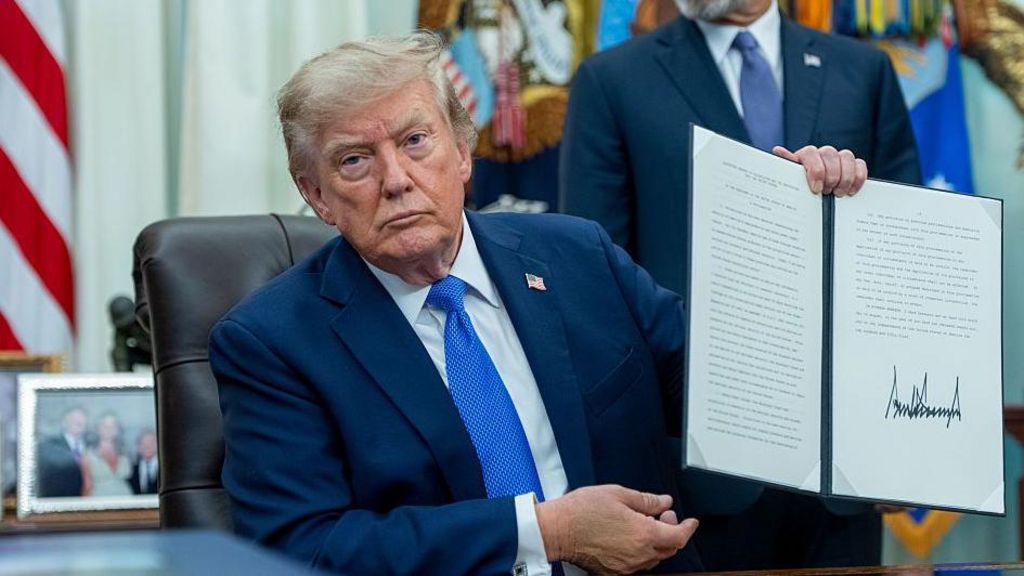
    Ahead of the United States’ 250th anniversary of independence, the Trump administration has unveiled a highly unusual limited-edition U.S. passport design that features an official likeness of incumbent President Donald Trump, drawing immediate attention across the nation. Former President and current officeholder Trump first shared images of the redesigned internal passport pages via his Truth Social platform on Friday. One prominent spread shows Trump standing with his fists resting on the Resolute Desk in the Oval Office, with the Declaration of Independence displayed in the background and Trump’s personal signature added below the portrait.

    The U.S. State Department confirmed this week that the special commemorative passports will officially go on sale starting July 6, and will only be issued while limited supplies last. This launch marks the latest in a string of high-profile moves by the Trump administration to place the president’s name or likeness on core federal American institutions, ranging from official government websites to federal building markers and now critical national identity documents.

    In his Truth Social post, Trump captioned the reveal, “The U.S.A.’s New Passport, which says, ‘Welcome, but be good!’” Notably, the phrase does not actually appear on the passport page images Trump shared publicly. The White House subsequently reposted the photos to its official X (formerly Twitter) account, framing the new document as a “patriot passport” celebrating national heritage.

    Access to the special edition passport is heavily restricted from the start, with eligibility limited exclusively to U.S. citizens. Per State Department guidelines, applicants cannot submit requests via online portals or traditional mail. To obtain the commemorative document, individuals must schedule an in-person appointment at the Washington D.C. passport agency, or attend one of a small number of invitation-only special acceptance events hosted specifically for the launch. As of the latest update, only two such events are listed on the State Department’s official website, both held at the Washington D.C. facility, with additional events to be added at a later date once details are finalized.

    Standard-issue U.S. passports currently feature historically significant American scenes, such as the 1969 Apollo 11 Moon landing, paired with iconic national symbols including the Statue of Liberty. It remains unclear as of publication whether applicants requesting an in-person passport at the Washington D.C. agency will be able to decline the special edition and receive a standard document instead.

    The commemorative passport was first announced to the public in April, with an earlier iteration that differed slightly from the final design: the initial draft only featured a close-up portrait of Trump, carried his signature in gold ink rather than the final black ink, and did not include the “250” anniversary marking on the spread. This launch makes history as the first time a sitting, living U.S. president has been featured on an official American passport.

    The addition of Trump’s likeness to national commemorative items extends beyond passports. The U.S. Mint recently confirmed plans to release a commemorative gold coin featuring Trump as part of this summer’s 250th anniversary celebrations, and the president is also set to become the first sitting U.S. president to have his official signature added to American banknotes.

    Beyond official documents and currency, the Trump administration has long sought to leave a lasting physical imprint on Washington D.C.’s institutional landscape. In a previous high-profile move, the administration added Trump’s name to a wing of the Kennedy Center for the Performing Arts, a decision that was later reversed. The administration has also announced long-term plans to construct the “Arc de Trump,” a massive triumphal arch modeled after Paris’ iconic Arc de Triomphe, to be built in the U.S. capital.

  • Hezbollah supporters protest in Beirut against Israel deal

    Hezbollah supporters protest in Beirut against Israel deal

    Fresh turmoil has erupted in Lebanon’s capital Beirut after hundreds of Hezbollah supporters launched mass street demonstrations opposing a landmark framework agreement brokered by the United States between Beirut and Jerusalem to end months of cross-border fighting. The protests, which stretched from late Friday into Saturday, saw demonstrators cruise through central Beirut, near the national parliament building, and along the key airport highway on motorbikes and mopeds, just hours after the deal was formally announced in Washington.

    Local media and social media footage captured crowds of protesters gathering in Dahieh, Hezbollah’s stronghold in southern Beirut — a neighborhood that was heavily damaged by Israeli airstrikes during the recent escalation of hostilities. Lebanon’s state-run National News Agency (NNA) confirmed that some demonstrators blocked a major arterial road near the prime minister’s office, while other groups used burning tires to shut down the airport road. Lebanese military forces intervened to disperse the blockading protesters, reopened the route, and deployed temporary security checkpoints across multiple districts of Beirut to contain unrest.

    The framework deal, hammered out over five rounds of direct negotiations between Israeli and Lebanese delegations in the U.S. capital, outlines a pilot plan that would see Lebanese armed forces take control of two small parcels of territory currently held by Israeli troops, alongside a formal process aimed at disarming Hezbollah, the Iran-aligned militant group that has long operated as a de facto military force independent of the Lebanese state. Critically, the agreement leaves the timeline and conditions for a full Israeli withdrawal from all occupied areas of southern Lebanon undefined, tying any pullout to improved security conditions and the elimination of what Israel defines as threats to its territory — effectively making full withdrawal dependent on the completion of Hezbollah’s disarmament.

    Hezbollah has repeatedly rejected any demand to surrender its weapons as long as Israeli occupation of Lebanese territory remains in place and the country faces security threats from Israel. Hassan Fadlallah, a senior Hezbollah member of Lebanon’s parliament, issued a stark warning Friday, arguing that Lebanese national authorities would only be able to enforce the Washington-brokered deal if they launched a civil war against the group with backing from the U.S. He added that the agreement was an intentional effort to undermine a prior U.S.-Iran understanding designed to prevent a full-scale regional war that would engulf Lebanon, and that no provision of the deal would be implemented without Hezbollah’s acquiescence.

    Even as protests unfolded in Beirut, cross-border activity continued Saturday: the NNA reported that an Israeli military drone carried out a strike in the Nabatieh region of southern Lebanon, and a second drone dropped an explosive sound device near a Lebanese army checkpoint in the town of Nabatieh al-Fawqa.

    Fadlallah reaffirmed that Hezbollah would actively resist all attempts to enforce the deal, and that the group would only strengthen its hold on its weapons stockpiles. He emphasized that Hezbollah’s opposition is uncompromising and would block the Lebanese government from meeting any of its commitments under the framework, but stressed that the group has no intention of clashing with the Lebanese national army. “The army will remain, the resistance will remain and the people will remain,” Fadlallah said.

    Israeli Prime Minister Benjamin Netanyahu welcomed the deal, framing it as a diplomatic victory that allows Israeli forces to maintain their occupation of southern Lebanon until Hezbollah is fully disarmed. He positioned the agreement as a significant setback to Iran, which has long backed Hezbollah as a proxy force. “Iran is trying to force us into a withdrawal from southern Lebanon by force. In effect, Israel, Lebanon, and the United States are telling them: this is none of your business,” Netanyahu said.

    A senior anchor on Israel’s Channel 12 echoed a common strategic reading of the deal, noting that sowing internal division in Lebanon has long been a core Israeli policy goal. “It seems we’re leading Lebanon to a civil war. Maybe it’s not so bad for us, let the Lebanese government fight Hezbollah… That’s been the goal from the start,” the anchor said.

    The emerging standoff over the framework agreement has already raised fears of renewed domestic unrest in Lebanon, a country already grappling with a years-long economic collapse and the lingering fallout of months of cross-border conflict between Israel and Hezbollah.

  • Burkina Faso severs diplomatic ties with France

    Burkina Faso severs diplomatic ties with France

    In a sharp escalation of tensions that have been simmering for more than two years, Burkina Faso’s military-led government has formally severed all diplomatic relations with France, marking one of the most significant breaks between the West African nation and its former colonial ruler in modern history. The split comes after years of escalating friction that began when Captain Ibrahim Traore seized control of the country in a 2022 coup, after which the new junta quickly pivoted away from longstanding Western alliances and toward alternative partners including Russia and China. The announcement was delivered in a nationally televised address Friday by Communications Minister Pingdwendé Gilbert Ouédraogo, who laid out the junta’s full slate of grievances against Paris. Ouédraogo accused France of engaging in “ceaseless activism” that directly undermines Burkina Faso’s national interests, leveling fresh claims that France continues to harbor overt neo-colonial ambitions for the Sahel region nation. The statement further alleged that France provides covert support to subversive networks operating within Burkina Faso and actively works to marginalize the country in global diplomatic forums. After more than two years of escalating disagreements, Ouédraogo emphasized that the fundamental conditions for mutually respectful bilateral relations no longer exist between the two governments. In a carefully worded clarification, the minister added that the severance of ties applies only to official institutional diplomatic relations, and does not challenge the deep historical, cultural, social and people-to-people ties that connect the populations of both countries. The French Ministry of Foreign Affairs quickly pushed back against the decision, dismissing the junta’s claims as “hostile and unfounded.” In a formal response, the French foreign ministry argued that the move underscores what it called a “troubling drift” by Traore’s administration, and issued an urgent advisory urging all French citizens currently residing in Burkina Faso to exercise extreme vigilance amid the rising diplomatic uncertainty. This formal break in relations is the culmination of a steady deterioration of ties that began immediately after Traore’s 2022 coup. Within months of taking power, Traore expelled all French combat troops that had been deployed to the country to support counter-insurgency operations, marking an end to a partnership that had stood for years. France has not had a sitting ambassador in Ouagadougou since January 2023, and in 2024, Burkina Faso expelled three senior French diplomats over unsubstantiated claims of subversive activity—claims that Paris immediately and categorically denied. Like its neighboring military-ruled states Mali and Niger, Burkina Faso has been locked in a brutal decade-long battle against Islamist insurgent groups across its territory, a conflict that once saw French forces fighting alongside Burkinabe troops to counter extremist expansion. Since taking power, Traore’s government has repeatedly accused France of pursuing a hidden “secret agenda” in the Sahel, justifying its decision to reorient the country’s foreign policy toward Moscow and Beijing. Beyond its split with France, the Traore administration has overseen a series of major shifts in Burkina Faso’s regional and political standing. The junta initially pledged to restore civilian democratic rule by 2024, but later backed out of that commitment and formally dissolved all national political parties in January 2025. Just weeks after that move, Burkina Faso joined Mali and Niger in officially withdrawing from the Economic Community of West African States (ECOWAS), the region’s leading political and economic bloc, to launch a new alternative regional alliance called the Alliance of the Sahel States.

  • Rome and Persia history lessons for US-Iran peace deal

    Rome and Persia history lessons for US-Iran peace deal

    Against the backdrop of fragile ongoing ceasefire talks between the United States and Iran, a striking historical parallel drawn by an ancient history scholar offers a stark warning: reaching a lasting peace may prove just as destabilizing and painful as enduring open conflict. As the future of any potential US-Iran agreement remains uncertain, with no clear consensus on its terms or longevity, Peter Edwell, an associate professor of ancient history at Australia’s Macquarie University and a specialist on ancient Persia (the historical predecessor to modern Iran), argues that the current diplomatic gridlock facing the Trump administration should come as no surprise.

    For centuries, the two great competing powers of the ancient world — the Roman Empire and the Persian Empire, ruled first by the Parthian dynasty from 247 BCE to 224 CE, then by the Sasanian dynasty until 651 CE — cycled endlessly between open war and fragile peace deals that rarely resolved core disputes, and often left underlying tensions worse than before. For these ancient rivals, peace treaties were rarely tools of lasting reconciliation; instead, they were most often just strategic pauses to buy time for military rearmament and preparation for the next conflict.

    The first major military clash between Rome and Parthia came in 53 BCE, when Roman general Marcus Crassus launched a disastrous invasion of Parthian territory. The campaign ended in catastrophic defeat on the plains of Carrhae, in modern-day southern Turkey, where Crassus himself was killed and thousands of Roman troops lost their lives. The defeat emboldened Parthia, and by 20 BCE, Rome was forced to accept a peace agreement that formalized the Euphrates River as the official border between the two empires — a major concession for a power that had previously known unbroken territorial expansion.

    Conflict reignited in the mid-first century CE, this time over control of strategically located Armenia, a buffer state nestled between the two empires in what is now modern Armenia and eastern Turkey. After the conclusion of hostilities, Roman Emperor Nero and Parthian King Vologases I agreed to the Treaty of Rhandeia in 63 CE, which allowed Parthia to nominate Armenia’s king, on the condition that the coronation be performed by the Roman emperor in Rome. While the treaty resolved the immediate crisis, its awkward power-sharing structure proved unworkable over time. When Parthia ultimately disregarded the agreement’s terms, Roman Emperor Trajan launched a full-scale invasion of Parthia in 114 CE. Though Trajan’s forces won early victories, including capturing the Parthian capital, the invasion ultimately collapsed, and all Roman territorial gains were lost within just three years, by the time of Trajan’s death in 117 CE.

    After the Sasanian dynasty replaced the Parthians as rulers of Persia in 224 CE, tensions with Rome escalated dramatically, with control of Armenia once again at the center of most disputes and peace agreements. When Roman Emperor Gordian III died during an invasion of the Sasanian Empire in 244 CE, the two powers struck a new treaty that imposed heavy financial reparations on Rome and included a clause banning any Roman interference in Armenian affairs. Within just a few years, however, Rome violated the agreement, triggering a wave of devastating Sasanian invasions of Roman territory that culminated in the capture of Roman Emperor Valerian by Sasanian forces in 260 CE. A famous rock relief from the period, which depicts Valerian kneeling in submission to Sasanian King Shapur I, remains a lasting symbol of this humiliating Roman defeat.

    Rome won a major victory over Sasanian King Narseh in the late 290s CE, and the resulting 299 CE Treaty of Nisibis extended Roman influence deep into the east and gave Rome full control of Armenia. But the lopsided agreement planted deep seeds of resentment among the Sasanians. By the 350s CE, Sasanian King Shapur II launched a major invasion of Roman territory explicitly to overturn the 60-year-old treaty. The conflict escalated when Roman Emperor Julian launched a counter-invasion of the Sasanian Empire in 363 CE, a campaign that ended in devastating Roman defeat and Julian’s death on the battlefield.

    While conflict between the two empires cooled slightly in the fifth century CE, it intensified dramatically again in the sixth and seventh centuries CE, when Rome and Persia were almost continuously at war. Dozens of peace treaties were negotiated during this period, but none endured. The most infamous example was the so-called Eternal Peace of 532 CE, which collapsed completely in less than eight years.

    Edwell notes that history repeatedly demonstrates that even highly celebrated peace agreements, celebrated as breakthroughs at the time of signing, often lay the groundwork for future discord and renewed conflict. It took more than 400 years of intermittent war and dozens of failed negotiations before Rome and Persia finally reached a lasting agreement to partition Armenia between the two powers in the 380s CE.

    Centuries of cyclical conflict, broken treaties, and stalemate preceded even that partial resolution. Today, as the US pursues a peace deal with Iran against the backdrop of a shaky ceasefire, the question lingers: will the current negotiations follow the same fraught path as the ancient clashes between Rome and Persia? Only time will reveal the answer — but the scholar’s hope is that a lasting resolution will not take centuries this time around.

  • Ukraine strikes industrial facility in Russia’s Volgograd as Russian drone attack kills 1

    Ukraine strikes industrial facility in Russia’s Volgograd as Russian drone attack kills 1

    In a significant escalation of Kyiv’s cross-border military campaign, Ukrainian President Volodymyr Zelenskyy confirmed Saturday that Ukrainian forces have struck a critical military-industrial complex in the southwestern Russian city of Volgograd. The assault comes as part of Kyiv’s expanded strategy to disrupt Russia’s war production machine, just one day after one of the largest single drone offensives against Russian territory since the full-scale invasion began more than four years ago.

    According to Zelenskyy’s statement posted on social platform X, the attack was carried out using FP-5 Flamingo missiles, targeting the Titan-Barrikady facility—a major industrial site that produces core military hardware for the Russian military. Ukraine’s General Staff elaborated on the strike, noting that the complex manufactures key components for Russian missile systems, including self-propelled launchers and transport-loading vehicles for the Iskander-M short-range ballistic missile system—the same platform Russia has repeatedly deployed to strike civilian and military targets across Ukrainian cities.

    Local Russian governor Andrei Bocharov confirmed the attack on an industrial site in Volgograd’s Krasnooktyabrsky district, reporting that 10 people were wounded in the strike and transported to local medical facilities. Bocharov acknowledged that production infrastructure at the site sustained damage, but declined to publicly confirm the identity of the targeted facility, matching the pattern of limited official disclosure following recent Ukrainian strikes on Russian military sites.

    The Volgograd strike was not the only cross-border attack carried out by Ukrainian forces Saturday. Ukraine’s state security service announced that Ukrainian troops also hit an oil pumping station in Russia’s Vladimir Region, a facility that supplies fuel to the Moscow area. This marks the second time this month the same type of infrastructure in the region has been targeted, a sign of Kyiv’s consistent focus on disrupting Russian energy supply chains that support the Kremlin’s military operations.

    Saturday’s strikes follow a massive one-day drone assault that targeted more than a dozen Russian regions, Russian-occupied Crimea, and adjacent maritime areas on Friday. Russia’s Ministry of Defense claimed that its air defense systems intercepted 660 incoming Ukrainian drones during the attack, marking one of the largest single interception operations Moscow has reported since the start of the full-scale invasion.

    The stepped-up campaign of long-range strikes is part of a deliberate 40-day escalation ordered by Zelenskyy last Thursday. The Ukrainian leader stated that the operation is intended to increase pressure on the Kremlin to force it into meaningful peace negotiations, after 12 months of U.S.-led diplomatic efforts to end the conflict failed to produce any tangible breakthrough. Western defense officials and independent analysts say the campaign has already produced measurable impacts: it has constrained Russian fuel distribution networks, slowed military equipment deliveries to frontline units, hampered Moscow’s offensive operations on Ukrainian battlefields, and piled unprecedented domestic political pressure on Russian President Vladimir Putin. Kyiv’s broader strategic goal with these strikes is to erode Russia’s war revenue streams and bring the tangible costs of the invasion home to Russian populations, who have largely been shielded from direct impacts of the conflict for most of its course.

    While Ukraine pressed its cross-border offensive, Russia continued its own air attacks on Ukrainian territory overnight. In Ukraine’s northeastern Sumy Region, a 66-year-old civilian man was killed when a Russian drone struck a private residential property, regional governor Oleh Hryborov confirmed Saturday. The death marks the latest civilian casualty in the relentless cross-border exchange of strikes that has characterized the fifth year of the ongoing conflict.

    This development comes alongside parallel European Union moves related to the war, with Brussels advancing plans to extend temporary protection status for displaced Ukrainians, while excluding new arrivals eligible for military service from the coverage. The EU also recently disbursed a 3 billion euro loan package earmarked for Ukraine’s post-invasion reconstruction, part of a broader two-year commitment to support Kyiv’s economic and infrastructure recovery efforts.

  • US-Iran MoU ‘conditional surrender’ signed by America, analyst says on Tucker Carlson’s show

    US-Iran MoU ‘conditional surrender’ signed by America, analyst says on Tucker Carlson’s show

    In a recent appearance on Tucker Carlson’s political talk show, prominent American author and geopolitical analyst Brandon Weichert has delivered a scathing assessment of the US-Iran ceasefire memorandum of understanding, reached after months of joint US-Israeli military action against Iran, calling the document nothing less than a formal conditional surrender by the United States.

    Weichert’s core argument centers on the massive drawdown of American missile stockpiles over the course of the conflict, which he says left the Trump administration with no viable option but to enter negotiations and accept a deal that ultimately handed Iran a strategic victory.

    “Ultimately, this is a conditional surrender document,” Weichert stated during the interview. “The United States started a war and it promptly lost. The Iranians have, unfortunately, at a strategic level, achieved victory.” He added that while the Trump administration had no other choice given the pressing timeline of looming resource shortages that left it backed into a corner, the end result remains a surrender regardless of the administration’s reasoning.

    Weichert’s controversial remarks land amid intense ongoing partisan and policy debate over the text of the memorandum, which establishes a foundational framework for sustained diplomatic negotiations between Washington and Tehran and codifies the ceasefire that halted months of open military confrontation between the two sides. Citing only unclassified, publicly available data on American weapons usage throughout the conflict, Weichert laid out staggering figures for depleted US munitions inventories.

    According to his analysis, roughly half of the United States’ total stockpile of Patriot ballistic missile interceptors were fired during the war, alongside between 50% and 80% of the nation’s Terminal High Altitude Area Defence (THAAD) interceptors. Weichert also claimed that more than 1,000 Tomahawk cruise missiles — approximately one-third of the entire US stockpile — were expended in the conflict. He added that large numbers of JASSM air-to-surface standoff missiles were used, and that nearly the entire pre-war inventory of newly produced Precision Strike Missiles was completely consumed in military operations.

    Beyond ground and air-launched munitions, Weichert argued that US naval forces faced far greater and more underreported threats during the kinetic phase of the war than the White House has publicly acknowledged. “The Navy reports that they expended large quantities of their SM-3 and SM-6 naval interceptors,” he said. “That indicates to me, if I may conjecture here, that there must have been one hell of a fight over the security of our ships when the war was in its kinetic phase.” From these figures, he concluded that the White House deliberately misled the public when it claimed US naval vessels operating in the region remained completely safe throughout the conflict, arguing the high interceptor expenditure proves American ships faced severe, unacknowledged risks.

    One of the most alarming parts of Weichert’s assessment is his projection of multi-year delays to replenish these drained arsenals. According to his timeline, Precision Strike Missiles can be fully restocked by the end of this year, while JASSM inventories will not be fully replaced until the middle of 2026. Naval SM-3 and SM-6 interceptors, he estimates, will not be back to pre-war levels until 2028. Patriot and THAAD interceptor stockpiles could take until roughly 2030 to fully replenish, and Tomahawk cruise missile inventories may require another five years to restore.

    “So, we’d better hope that the Chinese or some other area of interest is no longer requiring our assistance because we have depleted ourselves,” Weichert warned.

    Weichert’s analysis aligns with a recent bombshell report from *The New York Times*, which revealed that former President Trump and senior Pentagon leaders have been pressuring major defense contractors to speed up weapons production, while simultaneously pushing Congress to approve an extra $70 billion in funding to cover war costs and restock depleted arsenals. The *Times* reporting confirms that defense companies have told the Trump administration that expanding production capacity will require massive new capital investment, and the administration’s funding request is already projected to face fierce bipartisan opposition on Capitol Hill. The *Times* also independently verified the broad scope of US munitions depletion, confirming that the military used roughly 1,100 long-range stealth cruise missiles, more than 1,000 Tomahawk missiles, over 1,200 Patriot interceptors, and more than 1,000 Precision Strike and ATACMS missiles throughout the conflict.

    Beyond the immediate military implications of drawn-down stockpiles, Weichert argued that the conflict has accelerated an irreversible long-term geopolitical shift across the Middle East, moving the region rapidly toward what he calls a “post-American” order that diminishes the central role Israel has played for decades as the anchor of Washington’s regional security architecture.

    “There is now going to be a new Middle East,” he said, outlining his prediction that five regional powers will shape the future balance of power in the area: Saudi Arabia, Iran, Pakistan, Egypt, and Turkey. Weichert argued that Turkey’s rapidly expanding domestic defense industry, Pakistan’s established nuclear capabilities, and the competing regional influence of Saudi Arabia, Iran, and Egypt will combine to form a new regional order that is far less dependent on Washington for security and governance. “Those greater Middle East powers are gonna form a new post-American order,” he said. “Where it goes from here really is up to Mr Netanyahu and his government.”

    To date, the White House and senior US military officials have publicly defended the memorandum, framing it as a favorable deal that advances US national interests. Even so, the Trump administration has faced widespread criticism from across the US political spectrum for failing to achieve the core stated objectives it laid out at the start of the conflict, including removing the Iranian government, permanently weakening Iran’s regional influence, and decimating its military capabilities.

  • Burkina Faso cuts diplomatic relations with France, once a key ally

    Burkina Faso cuts diplomatic relations with France, once a key ally

    In a sharp escalation of strained bilateral relations, Burkina Faso’s ruling military junta announced Friday it has severed all diplomatic ties with France, the West African nation’s former colonial ruler and once-key Western security partner, with the decision taking effect immediately. The junta leveled serious unsubstantiated allegations against Paris in an official statement, accusing France of harboring “blatant neo-colonial ambitions” and providing active support to subversive networks and terrorist groups operating within Burkina Faso’s borders.

    France’s Foreign Ministry swiftly pushed back against the claims, with spokesman Pascal Confavreux noting the government deeply regrets what it calls the “hostile and unfounded decision,” which it says highlights a concerning shift in the Burkinabè authorities’ approach to international relations. Confavreux added that Paris is currently reviewing necessary reciprocal measures in response to the split, and that it is closely monitoring the safety and security of French government personnel and private citizens currently residing in Burkina Faso, urging all French nationals in the country to maintain heightened vigilance amid the uncertainty.

    Burkina Faso, a landlocked West African nation home to roughly 23 million people, has been grappling with a yearslong wave of extremist violence linked to affiliated groups of al-Qaida and the Islamic State. The broader Sahel region, where Burkina Faso is located, is now recognized as the deadliest region in the world for extremist-related conflict. In addition to insurgent attacks, government forces in the country have faced repeated accusations of widespread extrajudicial killings of civilians.

    Communications Minister Pingdwende Gilbert Ouedraogo explained in the junta’s statement that the breakdown in relations came after the conditions necessary for cooperative ties built on mutual respect, reciprocal trust, and respect for national sovereignty and non-interference in internal affairs were no longer satisfied. It remains unclear what immediate operational changes will follow the severance of ties, including what will happen to France’s embassy in Ouagadougou, the Burkinabè capital, and its diplomatic staff.

    Rifts between the two countries have been building for years, with the Burkinabè military government repeatedly targeting foreign diplomatic missions, including French representatives, and regularly accusing Paris of working against the junta’s national interests. Tensions have mounted steadily in recent years: in 2023, the junta forced France to recall its ambassador to Ouagadougou and declared the United Nations’ resident humanitarian coordinator persona non grata; in 2024, it expelled three additional French diplomats over allegations of subversive activity. Before the 2022 military coup that brought the current junta to power, France had served as Burkina Faso’s primary security partner, deploying hundreds of counterterrorism troops to the region. Following the coup, the junta ordered all French forces to withdraw from the country.

    Independent analysts note that extremist violence across Burkina Faso has actually worsened significantly since the junta took power, despite the military government’s core promise to curb insurgent activity. A recent report from Human Rights Watch found that over the two years following the 2022 coup, Burkinabè government forces were responsible for twice as many civilian deaths as extremist insurgents. Between January 2023 and August 2025, the group documented 1,837 total civilian fatalities across the country, with at least 1,200 of those deaths attributed to government security forces.

  • Billionaire Leon Black walks out of Epstein investigation hearing

    Billionaire Leon Black walks out of Epstein investigation hearing

    A high-stakes congressional investigation into the late convicted sex offender Jeffrey Epstein hit a dramatic standoff on Friday, as billionaire investor Leon Black exited a closed-door hearing after declining to respond to questions about non-disclosure agreements tied to his connections to Epstein, according to committee lawmakers.

    Black, whose ties to the disgraced financier have placed him under intense scrutiny in recently unsealed Epstein documents released by the U.S. Department of Justice, had agreed to appear voluntarily before the U.S. House of Representatives Oversight Committee. But he left the session abruptly when questioning turned to NDAs he may have executed in connection with his relationship with Epstein, committee chairman James Comer, a Republican, confirmed.

    The committee had already issued two formal subpoenas demanding Black turn over all NDA documents and participate in a sworn on-camera deposition. Black stepped down from Apollo Global Management, the private equity giant he co-founded, in 2021, when public scrutiny of his long-standing ties to Epstein first intensified. He has consistently denied any wrongdoing related to his association with the financier.

    Comer laid out the committee’s core line of inquiry Friday, saying: “We want to know, was Jeffrey Epstein involved in the NDAs? Was he involved in writing? Was he involved in awarding funds to the women for the NDAs? What was the reason for the NDA? We want to know everything about the NDAs.”

    Black’s legal team confirmed to the BBC that the billionaire left the hearing after the team completed its opening remarks. Per CBS News, the BBC’s media partner, Black hired Epstein as a personal wealth management advisor years ago, and the pair allegedly discussed sensitive personal matters, including extramarital affairs that resulted in non-disclosure agreements.

    During his short appearance Friday, Black told the committee that over the course of his decades-long professional relationship with Epstein, he paid the financier a total of $158 million (£120 million) for legitimate professional services. That large sum has already been the subject of a separate Senate probe, which examined claims that Black intentionally overpaid Epstein, masking undisclosed personal payments under the cover of financial consulting fees.

    Black’s attorneys have repeatedly pointed to an independent internal investigation conducted by international law firm Dechert on behalf of Apollo, which concluded all fees paid from Black to Epstein were tied to legitimate tax advisory work. Following the narrative shared by dozens of other wealthy and powerful figures tied to the Epstein investigation, Black told the committee he was deceived by the late financier.

    In his opening statement, a copy of which was shared with the BBC by his legal team, Black said: “I knew Jekyll. I didn’t know Hyde.” He added: “With the benefit of hindsight, I now know, as does the world, that Epstein was engaged in horrific, sordid activities. I feel terrible for Epstein’s victims. I want to state clearly that I did not know about this nefarious activity until Epstein was charged with trafficking in July 2019.”

    Black issued a sweeping denial of all allegations of misconduct, saying he never abused any woman, was never with an underage person, never participated in sex trafficking, never paid Epstein for access to women, and was never blackmailed by the financier.

    Black’s lead attorney, Susan Estrich, has denounced the congressional subpoenas as “a planned political stunt.” She emphasized that “Mr Epstein had no involvement with any NDAs, whether they exist or not,” and accused the committee of avoiding questions about the legitimate payments Black made to Epstein for tax and estate planning services.

    Court records show Black carried on a six-year extramarital affair with former Russian model Guzel Ganieva, which ended with Ganieva filing a lawsuit accusing Black of abuse. In that 2015 suit, which was ultimately dismissed, Ganieva alleged Black drafted an NDA to force her to stay silent about the affair. Unsealed Department of Justice documents show Epstein advised Black on the matter, including an email to Black’s assistant where Epstein suggested Black hire former law enforcement officials to approach Ganieva and deliver the NDA terms, writing: “Choose method of message delivery, my choice. – two highly respected former —- fill in the blank, immigration, scotland yard. sfo. . who may knock on her door and present the terms.”

    Estrich has dismissed Ganieva’s allegations as “demonstrably false”, and Black has previously said he was the victim of extortion over the affair. A judge ultimately dismissed Ganieva’s lawsuit, noting the NDA she had signed and the roughly $9 million she received in the years after entering the agreement.

    The House Oversight Committee’s top Democratic member, Robert Garcia, said in a post-hearing statement that Black “stormed out” of the transcribed interview when pressed about the NDAs. “Leon Black had a chance to do the right thing and help us bring justice to the survivors,” Garcia said. “Instead, he ran out of the room when he was pressed for information about his non-disclosure agreements with women and his relationship with survivors of Jeffrey Epstein. Black will be held accountable if he doesn’t comply with our investigation.”

  • Pro-Israel rabbis demand Mamdani apologise for likening Aipac to ‘monsters’

    Pro-Israel rabbis demand Mamdani apologise for likening Aipac to ‘monsters’

    A new firestorm has erupted in New York City’s charged political landscape after more than 700 pro-Israel rabbis and cantors signed an open letter released Friday calling on Mayor Zohran Mamdani to walk back inflammatory remarks that compared the powerful pro-Israel lobbying group the American Israel Public Affairs Committee (Aipac) to monsters.

    Widely recognized as one of the most influential foreign policy advocacy organizations in the United States, Aipac has built its reputation by spending millions of dollars to defeat electoral candidates who take public critical stances toward Israel. The open letter was organized by The Jewish Majority, a relatively new advocacy group launched by Jonathan Schulman, a former Aipac staffer with nearly 20 years of experience working with the organization.

    The letter opens by acknowledging the diverse ideological backgrounds of its signatories: “We are rabbis and cantors from across the United States. We serve different communities, hold different political views, and do not speak with one voice on every question concerning Israel, American politics or the war in Gaza.” But it quickly establishes unified condemnation of Mamdani’s rhetoric, adding: “But we are united in our belief that Mayor Zohran Mamdani’s recent speech about pro-Israel civic participation is dangerous, unacceptable and beneath the office he holds.”

    Mamdani first made the controversial comments during a June 18 campaign rally alongside independent US Senator Bernie Sanders. At the event, he framed Aipac as a group of “monsters” that leverages millions in unreported dark money to advance a singular goal: holding onto political power by sowing division among the American public.

    In the open letter, the rabbis argue that Mamdani’s language constitutes an act of dehumanization that amplifies rising antisemitism across the United States. “History demonstrates that campaigns against Jews often begin with rhetoric portraying them as uniquely sinister, uniquely powerful and somehow less deserving of equal treatment,” the letter reads. “Mr. Mamdani’s words invoke a familiar story about Jewish power, Jewish money and Jewish manipulation of public life.”

    For his part, Mamdani has long pushed back against claims that criticism of Israel or anti-Zionist views equate to antisemitism, and he has refused to apologize for his remarks. When pressed by reporters to clarify his comments earlier this week, the mayor doubled down on his criticism, tying his remarks directly to the ongoing humanitarian crisis in Gaza.

    “I want to be very clear. We’re talking about a status quo where children are being killed on a daily basis. More than 1,000 Palestinians have been killed by the Israeli military since the so-called ceasefire, [including] Al Jazeera journalist Ahmed Wishah, who was killed this past Saturday by an Israeli strike,” Mamdani told reporters.

    “When I am speaking about Aipac, I’m speaking about an organisation that has been supportive of the status quo, that has fought any attempt to actually deliver safety to people, not just in Palestine, but frankly, through much of the region – and it is a status quo for immorality,” he added. “It is one that I will not accept.”

    When asked specifically if he regretted using the term “monsters”, Mamdani claimed he was quoting a widely cited line from Italian Marxist philosopher Antonio Gramsci, though scholarly analysis has repeatedly found the specific phrasing he used is often misattributed or misquoted. “The old world is dying and the new world struggles to be born. Now is the time of monsters,” Mamdani explained, arguing he used the term to describe all actors blocking systemic change, not just Aipac.

    Mamdani’s refusal to apologize drew fierce condemnation from right-wing media outlets across the US, which lambasted the mayor for his stance. The open letter from rabbis comes just one week after Mamdani’s progressive political movement passed a critical early electoral milestone: all three of the congressional candidates he endorsed won hotly contested Democratic primary races.

    All three of the winning candidates have maintained open, consistent criticism of Israeli policy toward Gaza. In the most high-profile upset, public defender and first-time candidate Darializa Avila Chevalier defeated five-term incumbent Congressman Adriano Espaillat, chair of the Congressional Hispanic Caucus. Former city comptroller Brad Lander unseated incumbent Representative Dan Goldman, while state assembly member and former union organizer Claire Valdez defeated Brooklyn Borough President Antonio Reynoso in the race to fill the open seat left by retiring Representative Nydia Velazquez.

    Supporters of the progressive movement quickly celebrated the three victories as evidence that Mamdani’s political project is not a passing fad, but rather the start of a lasting ideological shift within New York’s Democratic Party. Not all reactions were positive, however: the Anti-Defamation League (ADL), a prominent national pro-Israel organization, labeled the primary wins antisemitic, claiming they sent a “chilling” message to Jewish New Yorkers. On Friday, the ADL publicly endorsed the rabbis’ open letter on its social media platform X.

    Alongside backing the letter, the ADL also issued condemnations of two unrelated political developments this week: a recent United Nations report that documents allegations of Israeli forces intentionally targeting Palestinian children, and a nuclear deal signed by former President Donald Trump’s administration to end escalating hostilities with Iran.