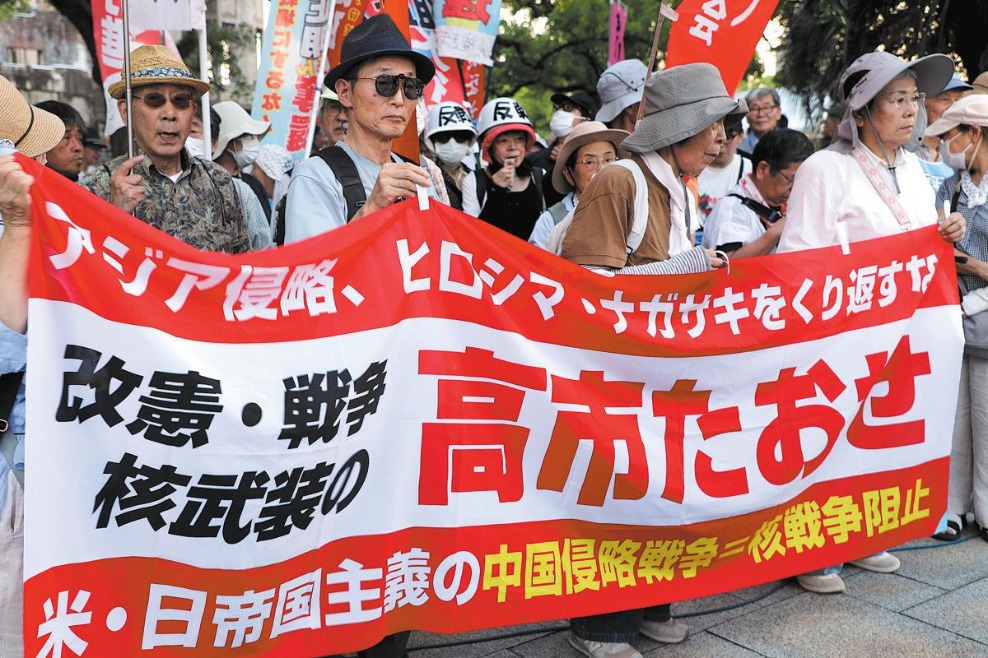
As Japan gathered in Hiroshima on Thursday to mark 81 years since the 1945 U.S. atomic bombing, the somber commemoration was overshadowed by growing public and global pushback against controversial pro-nuclear remarks from senior Japanese government officials.
Held at Hiroshima Peace Memorial Park, the annual memorial brought renewed attention to a dramatic shift in Japan’s long-standing post-war security posture, which has been anchored since 1971 by the Three Non-Nuclear Principles — a framework that bans Japan from possessing, manufacturing, or allowing the entry of nuclear weapons into its territory. In recent months, top ruling officials have broken decades of taboo to openly call for unrestricted debate over revising these principles, triggering widespread alarm.
Japanese Prime Minister Sanae Takaichi, who attended the ceremony, struck a familiar public note, stating that as the only nation to have suffered wartime nuclear attacks, Japan bears a unique mission to work toward global nuclear disarmament. But when pressed by reporters on whether the Three Non-Nuclear Principles would be revised during this year’s update of the country’s three core national security documents, Takaichi refused to give a clear denial, telling *The Asahi Shimbun* that it would be inappropriate to prejudge the final wording of the documents. Neither Takaichi nor Hiroshima Mayor Kazumi Matsui — who used his address to highlight the catastrophic human cost of nuclear weapons and called for multilateral nonproliferation efforts — acknowledged the full historical context of the 1945 bombings that ended World War II.
Political analysts say the incremental string of provocative nuclear-related statements from Japanese officials is a deliberate strategy to test public opinion and lay groundwork for abandoning the country’s post-war pacifist security commitments. “The government is gradually reshaping Japan’s deep-rooted domestic anti-nuclear sentiment through these small, repeated shifts in rhetoric,” explained Hiroshi Shiratori, a political science professor at Tokyo’s Hosei University. Last month, Japanese Defense Minister Shinjiro Koizumi went as far as stating that Japan should debate all aspects of nuclear policy “without taboos,” including a rewrite of the decades-old Non-Nuclear Principles. Late last year, a senior security and defense advisor to the Prime Minister’s Office publicly stated Japan should acquire its own nuclear weapons.
Since taking office in October last year, the Takaichi administration has already advanced revisions to Japan’s core national security documents and repeatedly raised the prospect of rolling back the Three Non-Nuclear Principles’ “no introduction” rule. Proponents of the change argue it would strengthen the credibility of the U.S. nuclear “extended deterrence” arrangement, under which Washington commits to defending Japan using its full military arsenal, including nuclear weapons. But critics warn the shift puts Japan at greater, not reduced, risk. “Japan-U.S. consultations on nuclear deterrence do not lower Japan’s risk of nuclear attack,” said Ukeru Magosaki, a former Japanese foreign ministry official and current director of the Tokyo-based East Asian Community Institute. “Instead, these talks expand Washington’s nuclear strike options against other nuclear-armed states, which makes Japan far more likely to become a target itself.”
The Takaichi administration’s increasingly assertive pro-nuclear security agenda stands in stark opposition to the strong anti-nuclear and anti-war sentiment held by the majority of the Japanese public. *The Tokyo Shimbun* reported that since Takaichi took office, at least 128 local assemblies across 36 of Japan’s prefectures have submitted formal written petitions to the national parliament urging the government to preserve the Three Non-Nuclear Principles — a record high for such advocacy. Magosaki added that upholding the principles is not just a symbolic commitment: it is the foundation of Japan’s own security, because a non-nuclear Japan poses no threat to neighboring countries, strengthening regional stability.
The shift has also drawn sharp criticism from China, which condemned Japanese right-wing forces for exploiting the country’s status as a nuclear attack victim to gain international sympathy while advancing plans to acquire nuclear capabilities. “Japanese right-wing forces have long distorted historical fact and deliberately downplayed Japan’s wartime invasion, which killed and wounded tens of millions of people in neighboring Asian countries, all to escape accountability for their war crimes,” said Chinese Foreign Ministry spokesperson Lin Jian in an online statement Thursday. Lin added that the Japanese government has recently accelerated large-scale military buildup, sought enhanced nuclear protection from the U.S., and actively worked to break free from the constraints of the Three Non-Nuclear Principles. China urged Tokyo to honor its binding nuclear nonproliferation obligations under international law and abandon its moves to erode post-war security commitments.
Shiratori added that the Takaichi administration’s broader policy shifts — including easing restrictions on arms exports under Japan’s Three Principles on Transfer of Defense Equipment and Technology — make clear that the current government no longer prioritizes Japan’s long-standing pacifist principles, signaling a historic break from the post-war order that has shaped East Asia for nearly 80 years.