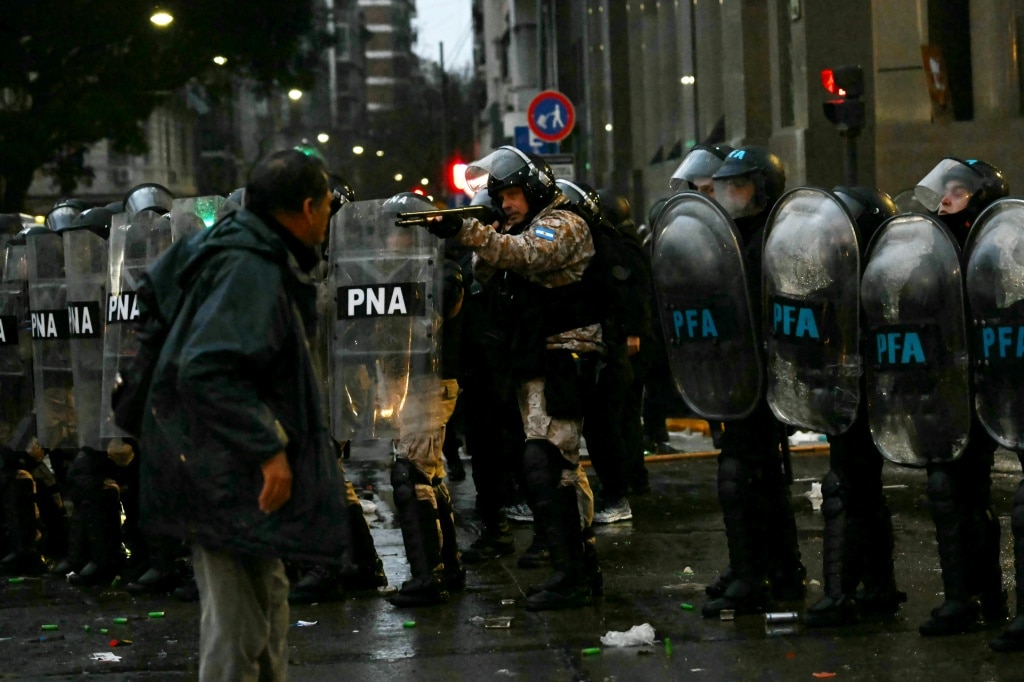
Thousands of Argentine demonstrators gathered outside the National Congress in Buenos Aires on Thursday, defying severe stormy weather to voice their fierce opposition to a divisive private property law pushed by libertarian President Javier Milei, in a demonstration that ended in violent scuffles between protesters and security forces. What began as a large-scale peaceful protest organized by left-wing political movements and national trade unions eventually erupted into clashes on Congress Square. Protesters threw stones and other projectiles at police officers, who responded by deploying tear gas, rubber bullets, and a high-pressure water cannon to disperse the crowd.
The legislation in question, officially titled the Inviolability of Private Property Bill, is currently going through debate in Argentina’s Senate. The proposal includes a series of sweeping changes to the country’s existing property regulations: it would streamline lengthy eviction processes, revise rules governing rural land use, and impose new restrictions on the state’s ability to expropriate private property. Milei’s administration has framed the bill as a critical legal framework designed to unlock much-needed foreign direct investment and stimulate Argentina’s struggling economy.
Even after Milei’s ruling party made a major concession last week — removing the most controversial provision that would have raised the cap on foreign-owned land from 15% of the country’s total territory to 25% — protesters refused to end their demonstration. Opponents of the legislation, including opposition political blocs and leading environmental advocacy groups, argue that the bill still poses a severe threat to national sovereignty. Many demonstrators carried Argentine national flags and held signs reading “The homeland is not for sale,” echoing widespread concerns that the legislation would open the door to what opponents call the “colonization, fragmentation, fracture and balkanization” of Argentine territory.
Milei’s party currently holds just 20 out of 72 seats in the Argentine Senate, leaving it with little choice but to make concessions to win broader support for the legislation. A 2025 joint study from the University of Buenos Aires and independent research groups found that foreign entities already own roughly 5% of Argentina’s total territory — an area roughly the same size as the entire country of England. The report also noted that in multiple strategic regions, foreign ownership already exceeds the current 15% cap. This is particularly true in resource-rich territories with abundant water reserves, rich mineral deposits, and key logistical advantages such as major port districts.
The protest highlights the deep political divides facing Milei’s administration just months into his term, as he pushes forward with a sweeping pro-market reform agenda that has faced widespread pushback from labor unions, left-wing groups, and environmental organizations across the country.