分类: environment

  • Spanish PM urges better prevention after deadly wildfire

    Spanish PM urges better prevention after deadly wildfire

    A catastrophic wildfire that tore through southern Spain’s Almeria province has claimed at least 13 lives, left dozens missing, and turned idyllic Mediterranean rural communities into smoldering ghost towns, prompting Spanish Prime Minister Pedro Sanchez to call for urgent systemic reforms to strengthen wildfire prevention amid accelerating climate change-driven extreme weather.

    The inferno, which ignited last Thursday, has scorched roughly 7,000 hectares of forest and dry scrubland, ravaging an area popular with international retirees and second-home owners along Spain’s sun-soaked Mediterranean coast. On Monday, Sanchez traveled to the affected municipality of Turre to meet with first responders still working to fully extinguish the blaze and assess the scope of the destruction.

    In remarks following his site visit, Sanchez stressed that Spain’s current response-focused approach to wildfires is no longer sufficient as rising global temperatures amplify disaster risk. “We must not only react when these fires happen, we must prevent,” he said, noting that climate change has made civil protection emergencies far more frequent than historical averages. The prime minister outlined key steps for improvement, including bolstering protected buffer zones around residential communities and expanding fire safety training for young people to build a culture of preparedness across the country.

    Juanma Moreno, president of the Andalusia regional government that oversees Almeria, echoed Sanchez’s call, adding that broad public engagement is also critical to reducing wildfire risk and fatalities. “We also need the public as a whole to adopt that awareness and self-protection, which is fundamental,” Moreno said. He noted that engaged members of the public can cut response times dramatically by reporting early smoke sightings, potential arson activity, and complying quickly with official evacuation warnings.

    At the peak of its spread last week, the blaze advanced at a staggering rate of 100 meters per minute, trapping many residents who attempted to flee by car or on foot. Local authorities have suggested some victims delayed their evacuation and did not heed official evacuation orders in time, contributing to the death toll. As of Monday, the exact number of missing people remained unconfirmed, as forensic teams continue work to identify recovered remains. Ten formal missing person reports have been filed so far, and authorities from the United Kingdom, Belgium, and France are supporting the identification effort by providing genetic profiles from relatives of missing foreign residents.

    Milder weather conditions, including calmer winds and cooler temperatures over the weekend, allowed more than 400 firefighters to make significant progress containing the blaze. Investigators currently suspect the fire started after an overloaded power line broke, igniting vegetation that had been completely parched by a weeks-long heatwave that pushed regional temperatures above 40 degrees Celsius.

    Climate scientists have long warned that human-caused greenhouse gas emissions from fossil fuel combustion are increasing the frequency and severity of extreme weather events, including prolonged heatwaves that create the tinder-dry conditions that enable destructive wildfires. Moreno framed the Almeria disaster as a clear sign of the accelerating climate crisis. “Here climate change is having a very big impact, and we are in a state of climate chaos with situations that are practically unheard of, exceptional and increasingly explosive,” he said.

    Sanchez echoed that warning, urging nationwide preparedness for the months ahead. “We are looking at a complex, complicated summer that will require us to be vigilant and alert in order to respond as quickly as possible,” he said.

    The Almeria fire comes on the heels of a record-breaking 2023 wildfire season in Spain, when blazes burned nearly 400,000 hectares of land — the highest annual total recorded by the European Forest Fire Information System in the country’s history. Experts warn that without major cuts to greenhouse gas emissions and significant investments in wildfire prevention and community preparedness, such deadly events will become the new normal across southern Europe.

  • Fire in Fontainebleau forest near Paris triggers evacuations, disrupts trains and highway

    Fire in Fontainebleau forest near Paris triggers evacuations, disrupts trains and highway

    As extreme heat blankets Western Europe in the region’s third red-alert heat wave of 2024, a series of destructive wildfires have spread across France and Spain, forcing evacuations, disrupting critical infrastructure, and leaving a trail of deadly destruction.

    On Monday, a rapidly expanding wildfire broke out in Fontainebleau forest, a beloved historic natural area located just 44 miles south of Paris. The forest, which surrounds the iconic Fontainebleau Chateau once favored by French leader Napoleon Bonaparte, draws millions of local and international visitors every year. The proximity of the blaze to the French capital marks an unusual and alarming development, as the region rarely faces large-scale wildfire threats this close to major population centers.

    In response to the spreading fire, local officials ordered immediate evacuations of nearby residential neighborhoods. The blaze also caused widespread disruption to regional transport: train services traveling to and from Paris’ busy Gare de Lyon station were suspended late Sunday, though limited services resumed by Monday morning, and a key stretch of the A6 highway— one of Paris’ major southeast-bound routes— was closed over ongoing fire risk concerns. More than 300 firefighters have been deployed to contain the fire, supported by two water-bombing aircraft assigned to drop fire retardant and water on burning areas, regional fire service spokesperson Paul Laurain confirmed to public broadcaster France-Info.

    The Fontainebleau fire is just one of dozens of wildfires burning across France. Large blazes in the country’s southern region have already scorched thousands of hectares of forest and brush land since last week, forcing organizers of the annual Tour de France cycling race to reroute stages and stretching national firefighting resources thin. France is currently at the peak of its third heat wave of the summer, with temperatures soaring above 104 degrees Fahrenheit (40 degrees Celsius) across western and central parts of the country, while Paris recorded highs of around 98 F (37 C).

    To the south, Spain is reeling from one of the deadliest wildfires in its recent history. A blaze that tore through a remote remote expat community in southern Spain last week has now killed 13 people, including a 93-year-old British national who succumbed to burn injuries in a hospital Sunday. Ten additional people remain unaccounted for as of Monday. The wildfire burned through roughly 27 square miles of forest and agricultural land— an area larger than the entire island of Manhattan— before regional authorities announced it had been contained on Sunday. Spanish Prime Minister Pedro Sánchez was scheduled to visit the disaster site Monday to meet with first responders and affected families.

    Officials warn that the extreme heat, combined with persistent high winds and near-zero rainfall across the Iberian Peninsula, has created perfect tinder conditions that allow small ignitions to explode into large, uncontrollable blazes almost instantly. Climate data from the European Union’s Copernicus Climate Change Service underscores the severity of the crisis: Europe is warming faster than any other continent on Earth, with average temperatures rising twice as quickly as the global average since the 1980s, a trend scientists directly link to increasing frequency and severity of extreme wildfire and heat wave events across the region.

  • Heavy rains and flash floods in Bangladesh leave 51 dead

    Heavy rains and flash floods in Bangladesh leave 51 dead

    Devastating seasonal monsoon flooding triggered by days of intense heavy rainfall has left at least 51 people dead and displaced more than one million residents across Bangladesh, with widespread damage to homes and infrastructure stretching from the capital Dhaka to the southeastern refugee hub of Cox’s Bazar. Flash floods and concurrent landslides have swept through large swathes of the low-lying South Asian nation, leaving thousands of families without permanent shelter and overwhelming emergency response systems. More than half of the confirmed fatalities have been recorded in Cox’s Bazar, the site of the world’s largest Rohingya refugee settlement that hosts over one million displaced people from Myanmar. Last week alone, the district recorded the tragic deaths of multiple students and a schoolteacher when rushing floodwaters inundated their campus.

    Bangladesh’s geographic profile, which features extensive river networks and most of its landmass lying just meters above sea level, makes it inherently prone to heavy monsoon rains and annual flooding. But climate experts have repeatedly warned that human-caused climate change is amplifying the severity and frequency of extreme rainfall events across the region, worsening the annual flood risk for vulnerable populations.

    The current bout of rain began more than a week ago, and as downpours intensified in recent days, national authorities moved quickly to issue widespread flood and landslide warnings, evacuate thousands of households from high-risk zones, and postpone scheduled student examinations to protect public safety. Today, thousands of displaced residents are taking shelter in temporary government-run emergency facilities across the country.

    In Dhaka, the densely populated capital, urban flooding has brought daily life to a near halt. Local reports from BBC Bangla confirm that floodwaters have reached knee depth on many residential and arterial streets, slowing vehicular traffic to a crawl and leaving many neighborhoods inaccessible. On Monday, local media outlets raised questions about the effectiveness of past government investments to upgrade Dhaka’s outdated stormwater drainage systems, which have repeatedly failed to cope with extreme monsoon downpours.

    Officials from Bangladesh’s Flood Forecasting and Warning Center have noted that conditions in the country’s southeast, including Cox’s Bazar, are expected to improve in the coming days as rainfall eases. However, Sarder Udoy Raihan, a representative from the center, told AFP that the threat of new flooding remains high for the nation’s northeastern and northern regions, where monsoon activity is projected to continue. “There is a possibility of further inundation,” Raihan cautioned, urging continued vigilance from residents and emergency teams in at-risk areas.

  • Planes sent to tackle wildfires of ‘exceptional scale’ near Paris

    Planes sent to tackle wildfires of ‘exceptional scale’ near Paris

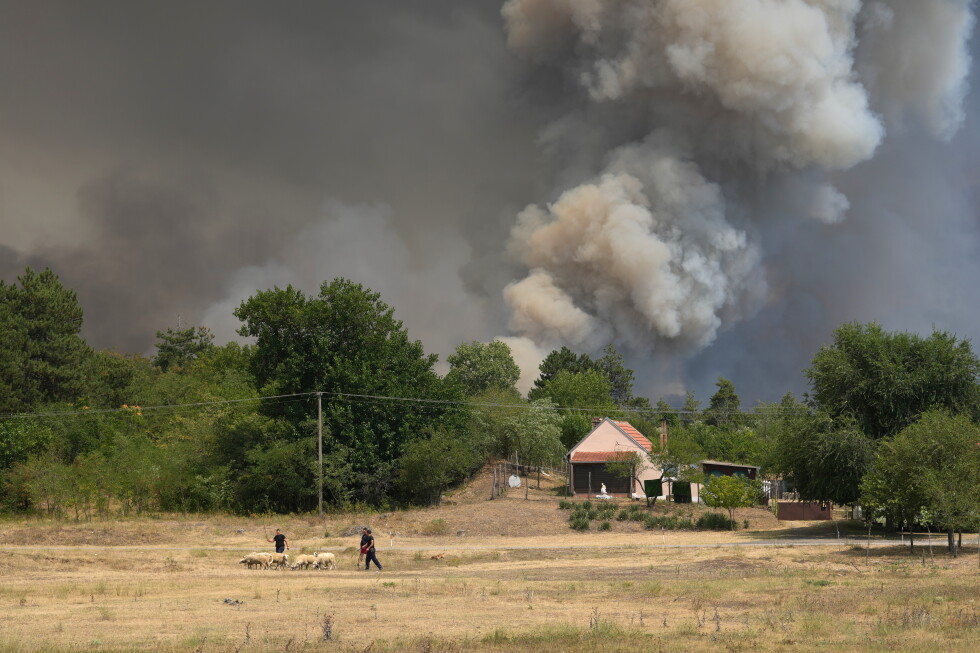
    A large, fast-spreading wildfire has ignited near Noisy-sur-Ecole, close to the iconic Fontainebleau forest just 60 kilometers southeast of Paris, triggering an extraordinary emergency response amid the third record-breaking heatwave to hit the French capital region this summer. Local officials have labeled the blaze as “virulent” and of “exceptional scale”, with flames tearing through more than 800 hectares of forest as of early Monday, with the fire line still expanding across the wooded landscape.

    In response to the crisis, French authorities took an unprecedented step: two dedicated firefighting aircraft were deployed from the warmer, drier southern region of the country, where large wildfires are more common, to combat the blaze near Paris. This marks the first time such aerial assets have been reassigned north to the Paris region for wildfire response, according to Eric Brocardi, a spokesperson for France’s national federation of firefighters. Joining the two water-bombing planes were two additional firefighting helicopters and a dedicated observation aircraft, all mobilized to prioritize the core mission of protecting civilian lives and nearby infrastructure, Brocardi confirmed in comments to Agence-France-Presse.

    The spreading fire has already caused major travel disruption across France, hitting the first major summer holiday weekend when millions of Parisians travel out of the capital for seasonal getaways. The blaze forced partial closure of France’s key north-south highway, snarling traffic for thousands of travelers. Earlier in the emergency, a separate fire linked to the hot, dry conditions blocked an eastbound highway out of Paris and interrupted service on the high-speed rail line connecting Paris to southern France. By Sunday evening, French national rail operator SNCF announced that travelers faced delays of up to six hours for all services arriving at or departing from Paris Gare de Lyon.

    This wildfire is not an isolated event, but part of a broader pattern of extreme heat and fire risk sweeping Europe this summer, where multiple countries across the continent have already broken all-time temperature records. In France alone, the prolonged heat has forced additional cascading disruptions beyond the wildfire: three nuclear power plants have been temporarily taken offline, as operators avoid releasing warm cooling water into already overheated rivers and waterways that would further threaten aquatic ecosystems. Even the Tour de France, one of the world’s most high-profile annual cycling events, was forced to adjust its schedule, cutting 30 kilometers from Sunday’s race stage as temperatures climbed close to 40 degrees Celsius to protect rider safety.

    Across the continent, the record heat has sparked a series of devastating wildfires with severe human costs. In southern Spain, a wildfire near Almeria that broke out Thursday has already killed at least 13 people, making it one of the deadliest wildfire events in the country’s modern history. In the United Kingdom, emergency services declared a major incident Sunday after a large wildfire broke out in north Wales, with fire crews battling multiple blazes across both Wales and England as the region also swelters under record high temperatures.

  • China’s ‘Green Great Wall’ tames desert growth, but scientists warn the fight is not over

    China’s ‘Green Great Wall’ tames desert growth, but scientists warn the fight is not over

    In the arid sandscapes of northern China’s Kubuqi Desert, a quiet, decades-long revolution against one of the world’s most persistent ecological threats has unfolded. For half a century, millions of workers have carved order into shifting dunes one grid at a time: driving forearm-length straw sticks into loose sand in intersecting lines to create a widespread checkerboard pattern, then planting native saplings at the center of each small square. This low-tech but highly effective technique, called straw checkerboarding, stabilizes dunes against strong desert winds, traps moisture, and gives young seedlings the stable environment they need to put down roots.

    This vast greening effort is the backbone of the Three-North Protective Forest Program, more widely known globally as China’s Green Great Wall. Launched in 1978, the ambitious initiative is designed to roll back the steady expansion of desertification, a process driven by centuries of drought, overgrazing, and unsustainable farming that stripped northern China of vegetation, degraded soil, and left communities vulnerable to devastating wind and sandstorms.

    Generations of steady work have delivered striking, measurable results. Official state data shows that desertified land across northern China peaked in 2000, and has shrunk by more than 1,000 square kilometers every year since that turning point. As of 2024, the cumulative forest area established through the program covers more than 500,000 square kilometers — an area roughly the size of Spain. Long-term monitoring from a team of researchers at the Chinese Academy of Sciences’ Institute of Applied Ecology found that overall desertified land in China has fallen by roughly 10% since 2000, while areas of severe and extreme desertification have dropped by more than 40%. Forest coverage across the program’s working area has jumped from just 5% in 1978 to 14% in 2022.

    For frontline workers like 60-year-old Yin Yuzhen, who has spent four decades fighting sand near the Mu Us Desert adjacent to Kubuqi, that transformation is personal. Yin recalled her early years on the sand line as a time of profound isolation: when even a single bird passing overhead was enough to lift her spirits, and blowing sand often blocked visibility just a few feet ahead. Today, she says the horizon is clear, greenery stretches for miles, and permanent roads cut through landscapes that were once unnavigable shifting dunes. Even after 40 years, she still works from dawn to midday every day tending saplings and repairing worn checkerboards, a task now joined by her children and occasional local volunteers. Researchers estimate more than 300 million rural laborers have contributed to the program over its history, mostly as paid part-time participants.

    Scientists and environmental experts across the globe have hailed the program as a landmark model for landscape restoration. Barron Joseph Orr, chief scientist for the United Nations Convention to Combat Desertification, noted that the Three-North Program’s greatest contribution goes beyond the sheer scale of land restored. What sets it apart, he says, is the sustained political and financial commitment that has kept the initiative running for five decades. “Reversing desertification is possible when it becomes part of long-term development strategies,” Orr explained in comments to the Associated Press. The Green Great Wall has inspired similar large-scale efforts worldwide, including the Great Green Wall initiative launched across 11 African nations in 2007 to hold back the expanding Sahara Desert.

    Yet despite the remarkable progress, experts stress that the work is far from finished. Preserving the hard-won gains of the past 50 years will require decades more consistent investment and management, researchers say. Restored dryland ecosystems can become increasingly self-sustaining over time, but they remain dependent on long-term monitoring, careful management, and favorable conditions including adequate water access and healthy soil.

    Many Chinese environmental advocates and researchers also point to a key ongoing challenge: aligning ecological restoration with local community livelihoods, to avoid framing conservation and economic development as opposing goals. Zhao Zhong, founder of Gansu-based environmental advocacy group Green Camel Bell, which works with local farmers and herders to plant native vegetation and educate communities on desertification risks, notes that projects that deliver tangible economic benefits to local populations have far higher long-term success rates. Orr echoed this assessment, noting that community buy-in through shared economic benefit is a critical predictor of restoration success.

    For Dr. Zhu Jiaojun, the Chinese Academy of Sciences ecologist who has spent decades studying the program, the biggest open question remains how to sustain conservation gains if future levels of state investment and human intervention decrease. “This is what we are very concerned with and this is also the biggest challenge,” he said. For frontline workers like Yin, the solution lies in passing the work on to coming generations, and cultivating a shared sense of stewardship for the land. “We need to teach young people to love this Earth,” Yin said. “If we love it with all our hearts, nature will love us in return.”

  • British couple return to village at heart of deadly Spanish wildfire

    British couple return to village at heart of deadly Spanish wildfire

    When our vehicle wound up the steep, curved mountain road leading to Bédar, a small Andalusian town in Spain’s southeastern Almeria province, we stepped out into a scene of utter devastation. Twisted, molten fragments of burned cars littered the roadside, and every hillside stretching toward the horizon was blanketed in a thick, ashy black coating of charred vegetation. This is the aftermath of Thursday’s catastrophic wildfire, already ranked as one of the deadliest wildfire events in modern Spanish history.

    As of Sunday, the official death toll has climbed to 13, with five of the victims believed to be British citizens. The latest fatality was a 93-year-old British woman who succumbed to her burn injuries in a hospital over the weekend. Official confirmation of all victims’ identities is still pending, while emergency teams have now fully contained the blaze after it consumed roughly 7,000 hectares (17,300 acres) of forest and residential land. Fanned by gusty winds reaching 50 km/h, the flames spread with a speed and ferocity that caught many local residents off guard.

    Yet amid the widespread destruction, pockets of survival offered small, bittersweet moments of relief. Driving deeper into Bédar’s residential neighborhoods, it became clear that dozens of the region’s distinctive bright white stucco homes escaped the blaze unscathed. For British expats Emma and Simon Mitchell, who moved to the town three years ago, that escape felt nothing short of a miracle. “This is our house and it survived,” Emma told reporters, breathing a heavy sigh of relief. When the couple returned to their property Sunday as part of the first wave of evacuees allowed back into the zone, they found all 15 of their chickens alive, and power and water still running, despite the inferno that burned right up to their property line.

    That relief quickly gave way to grief and anger, however, as Emma looked across the valley to the homes of friends that were reduced to ash. The Mitchells are among 600 of the nearly 1,500 evacuated residents permitted to return to their properties to assess damage, and their experience has laid bare critical gaps in the region’s emergency alert system. The couple told reporters they received no formal advance notice of the spreading fire, despite living just a quarter kilometer from the blaze’s path. “We get an alert for earthquakes that are 50 miles away but we don’t get an alert for a fire that is a quarter of a kilometre away,” Simon Mitchell explained. “Next time it would be good to get an alert on our phones.”

    Emma Mitchell has also pushed back against claims from some local officials that victims, including the British citizens killed, failed to follow official evacuation instructions. She lashed out at authorities for engaging in victim-blaming, noting that many victims never received any instructions at all. “You need to get your act sorted and please don’t try and victim-blame afterwards,” she said. “These people that died, they had no instructions to follow, they did the best they could in the circumstances they could and they paid the price.”

    Local officials have defended their response, explaining they chose not to issue a broad phone alert Thursday night out of concern that it would reach residents outside the danger zone and create unnecessary congestion that would complicate evacuation efforts. They added that police instead relied on door-to-door notifications and phone calls to warn at-risk residents. As of Sunday night, neither the Andalusian regional government nor Spain’s national Civil Guard had responded to requests for additional comment on the response criticism.

    The disaster has had a disproportionate impact on the region’s large community of foreign expats, who have settled in the Los Gallardos area surrounding Bédar for its warm climate and scenic landscapes. Among the injured are a British couple who were out hiking when the fire spread rapidly Thursday. Local media reports say the pair was found badly burned and semi-conscious in a ravine, and they remain in intensive care after being evacuated to a major hospital.

    Spanish Prime Minister Pedro Sánchez has scheduled a visit to the devastated fire zone on Monday to meet with first responders and affected residents. This wildfire already ranks among the deadliest in recorded Spanish history: only two other major wildfires have recorded higher death tolls, a 1979 blaze near Lloret de Mar that killed 21 people, including nine children, and a 1984 fire on the Canary Island of La Gomera that killed 20.

    Climate scientists have repeatedly warned that rising global temperatures driven by anthropogenic climate change are increasing the frequency and intensity of summer heatwaves across Southern Europe, creating ideal dry, warm conditions for extreme, fast-spreading wildfires like the Almeria blaze. First responders and local leaders across the Mediterranean have called for updated emergency infrastructure and more robust alert systems to adapt to the growing risk of catastrophic wildfire events.

  • ‘This landscape is completely charred’: Inside the village at epicentre of Spain’s wildfires

    ‘This landscape is completely charred’: Inside the village at epicentre of Spain’s wildfires

    When BBC correspondent Nick Beake stepped into the small Andalusian village of Bédar this week, the first thing that hit him was the overwhelming silence — and the uniform layer of black that stretched as far as the eye could see. Once a picturesque rural settlement dotted with terracotta-roofed homes and rolling Mediterranean scrubland, Bédar now stands as the epicenter of one of Spain’s most destructive recent wildfire outbreaks, leaving little trace of the lush landscape that defined the community for generations.

    Beake’s on-the-ground reporting reveals a scene of total destruction: dozens of residential properties have been reduced to nothing more than smoldering ash and twisted metal, with entire neighborhoods leveled by the fast-moving blaze. “This landscape is completely charred,” Beake described from the ground, surveying a vista that has been transformed from a thriving rural village into what he calls an endless “sea of black.” What were once green hillsides dotted with olive groves and native oak trees are now barren, blackened stretches of earth, with even deep-rooted vegetation consumed by the extreme heat of the fire.

    The wildfire, which was fanned by record-breaking early summer heat waves and strong gusty winds that have gripped southern Spain in recent weeks, spread rapidly across the Almería region, forcing hundreds of local residents to evacuate their homes with little more than the clothes on their backs. Firefighting crews have been working around the clock to contain the blaze, but dry conditions and unseasonably high temperatures have hampered containment efforts, allowing the fire to expand across thousands of hectares of land.

    As crews continue to battle the blaze, Bédar’s destruction offers a stark reminder of the growing wildfire risk facing Mediterranean nations amid accelerating climate change. Regional officials have already warned that this fire season could be one of the worst on record, as higher average temperatures and prolonged drought create tinder-like conditions across much of southern Spain.

  • Heat dome spreads across US, bringing dangerous days, little relief at night

    Heat dome spreads across US, bringing dangerous days, little relief at night

    A brutal, high-pressure heat dome has settled across wide swathes of the western and central United States, unleashing a prolonged period of life-threatening extreme temperatures that show little sign of abating through the first half of next week, federal forecasters confirmed Saturday.

    The National Weather Service’s Weather Prediction Center stated that a strong upper-level atmospheric ridge stretching from the West Coast deep into the Midwest will trap hot air across multiple regions, keeping temperatures far above the average mid-July baseline for days on end. The affected areas, ranging from the Intermountain West to the Northern Plains and Upper Midwest, face major to extreme heat risks, with forecasts calling for both record-breaking daytime highs and unusually warm overnight lows that offer almost no reprieve from sweltering conditions.

    Across much of the north-central U.S., Sunday will bring even hotter conditions than Saturday. In central and eastern Montana and North Dakota, forecast highs sit between 100 and 110 degrees Fahrenheit (38 to 43 degrees Celsius) — 8 to 14 degrees Celsius above the seasonal average — and local communities could see even higher readings. Forecasters warn that long-standing all-time temperature records are at risk of being broken in multiple cities, including Salt Lake City’s current record of 41.6 C and Billings, Montana’s 42.2 C.

    While a cold front is projected to push slightly cooler air into Montana starting late Sunday and continuing through Monday, the heat dome will simply shift east, intensifying across the Northern Plains and Upper Midwest after Monday. In Southern California, the National Weather Service’s Los Angeles office warned that most of the region will see temperatures climb to 35 to 41 C or higher through the coming week, with cooler conditions limited to coastal communities. In the San Diego region, temperatures will begin climbing again Tuesday and peak Wednesday, bringing minor to moderate heat risk to inland valleys and mountains and moderate to major risk for desert areas.

    The combination of extreme heat, bone-dry conditions and gusty winds has already complicated wildfire response efforts in Los Angeles County. The Summit Fire, which ignited Friday afternoon near Llano, had charred 2,690 acres of land and was only 8 percent contained by Saturday evening, according to the California Department of Forestry and Fire Protection. Mandatory evacuation orders and warnings remain in effect for affected communities. Cal Fire reported that near-38 C temperatures, single-digit humidity, and gusty winds along mountain ridges are creating ideal conditions for rapid fire spread and aggressive fire behavior. The cause of the blaze remains under active investigation.

    Even Arizona, a state accustomed to extreme summer heat, remains blanketed by widespread heat alerts. On Saturday, an extreme heat warning covered the Phoenix metropolitan area and surrounding desert regions, with warnings extending through Sunday for the Grand Canyon below 4,000 feet (1,219 meters) and covering Marble Canyon, Glen Canyon, and Page through the weekend. These conditions pose disproportionate risk to hikers and other outdoor visitors, who often find themselves in exposed terrain with limited access to shade, clean drinking water, and emergency medical care. The National Weather Service has urged all residents and visitors in heat-affected zones to stay consistently hydrated, take frequent cool-down breaks, and limit non-essential outdoor activity whenever possible.

    One of the most pressing public health concerns surrounding this heat event is the lack of overnight cooling. Unusually warm overnight temperatures leave homes and indoor spaces dangerously hot for extended periods, a particular hazard for households that lack access to affordable, functional air conditioning.

    The U.S. Centers for Disease Control and Prevention notes that three groups face the highest risk of heat-related illness and death: older adults, young children, and people living with chronic health conditions. People who work outdoors or in uncooled indoor spaces are also disproportionately vulnerable, as elevated surrounding temperatures cause body heat to build up rapidly, leading to life-threatening conditions if left untreated.

    This latest heat wave comes on the heels of a deadly extreme temperature event over the July Fourth holiday weekend. Between July 2 and July 6, New Jersey health officials reported 29 suspected heat-related deaths across the state.

    The current heat surge also represents a major test for Arizona, which has made incremental progress in reducing its historically high annual heat death toll in recent years. Maricopa County, home to Phoenix, recorded roughly 430 heat-related deaths in 2025, down from 608 in 2024 and an all-time record of 645 in 2023. Despite that progress, the Maricopa County Department of Public Health reports that the county has already confirmed 18 heat-related deaths so far in 2026, with another 215 cases still under investigation. That puts the county on pace to exceed last year’s premature death toll from heat by this point in the summer.

  • Evacuees allowed to return home after deadly wildfire in Spain stabilises

    Evacuees allowed to return home after deadly wildfire in Spain stabilises

    One of the deadliest wildfires in recent Spanish history, which claimed at least 12 lives as residents and visitors fled its rapid advance in southern Spain’s Andalusia region, has been fully contained, officials announced Sunday. The containment order clears the way for roughly 1,500 displaced people to return to their properties over a phased timeline.

    Juan Manuel Moreno, president of the regional Andalusian government, confirmed to reporters that the blaze has been locked within its burned perimeter with no remaining risk of spread. “This marks, in a sense, the beginning of the end of a terrifying wildfire that set records for the speed of its advance,” Moreno said.

    The first wave of returning residents, made up of around 600 people evacuated from Almeria province’s high-risk fire zone, were allowed to go back to their homes Saturday evening. The remaining 1,000 evacuees will follow in staged groups to ensure safety, Moreno added.

    Scorched, abandoned vehicles still sit along rural roads where many victims became trapped as the fire raced through the landscape at speeds of up to 100 meters per minute. All 12 confirmed fatalities were people who became trapped in their vehicles or while attempting to escape on foot, according to official accounts.

    Jerome Navarro, a French tourist who arrived at his Spanish holiday home just as the fire advanced, described the chaotic speed of the blaze to French media Saturday. “I said to my wife ‘Get out quick, leave everything. Get out.’ And the time it took to say that I was engulfed in a ball of fire,” a tearful Navarro recalled. Navarro survived by throwing himself into a ditch and crawling to safety, but his wife remains missing.

    Officials have kept the official death toll at 12, noting that the full number of missing people cannot be confirmed until autopsies and DNA identification of recovered remains are complete. Many of the victims are believed to be foreign nationals, a detail that has slowed identification work as officials wait for DNA samples from relatives traveling from overseas.

    Spain’s Civil Guard is conducting a final, comprehensive search of the fire-ravaged area Sunday to account for all missing residents and visitors. Civil Protection Secretary-General Virginia Barcones told Spain’s public broadcaster that officers have already cleared more than 250 homes to confirm no one was trapped inside, and the final sweep will confirm no unaccounted victims remain. “I sincerely hope they don’t find anyone else, but we need to carry out one final thorough search to make sure that’s the case,” Barcones said.

    A shift to calmer winds and higher atmospheric humidity allowed firefighters to launch direct assaults on the blaze for the first time Saturday, bringing the fast-moving fire under control after days of difficult conditions. Around 500 firefighters, supported by water-dropping helicopters and aircraft, have worked around the clock to contain the blaze that broke out Thursday in the Gallardos area, a region popular with foreign retirees and holiday homeowners.

    Authorities suspect the fire started when a power line snapped amid an prolonged extreme heatwave that has pushed regional temperatures above 40°C for weeks. Unusually wet winter and spring conditions spurred dense vegetation growth across the region, which then fully dried out in successive heatwaves, creating ample fuel for a catastrophic blaze. So far, the fire has destroyed roughly 7,000 hectares of land.

    Manoli Ramos, a 72-year-old city councilor in the small village of Bedar where multiple victims were found, described the scene as apocalyptic. “We were absolutely terrified. We could see the flames. It was horrific, it was like hell,” Ramos told AFP.

    Spanish Prime Minister Pedro Sanchez is scheduled to visit the fire-stricken area Monday to meet with first responders and displaced residents. Scientists have widely documented that human-caused climate change from fossil fuel emissions is increasing the frequency and intensity of extreme heat events that drive major wildfires across Southern Europe. Last year, wildfires burned nearly 400,000 hectares of land across Spain — the highest annual total recorded by the European Forest Fire Information System in the country’s history.

  • Badly-burned British couple rescued from ravine during Spain wildfires

    Badly-burned British couple rescued from ravine during Spain wildfires

    A destructive wildfire sweeping through Spain’s southern Almeria province has become one of the deadliest wildfire events in the nation’s modern history, leaving at least 12 people dead — including four British citizens — and destroying more than 6,600 hectares of land. The rapid spread of the blaze, which was amplified by a record-breaking regional heatwave that pushed temperatures to 40 degrees Celsius, trapped a pair of British hikers who were exploring local trails last Thursday. What followed was a dramatic, overnight search and rescue that pulled the critically injured pair from a remote ravine, offering a small glimmer of hope amid widespread devastation.

    Civil Guard search teams combing the area near Bedar, the village hardest hit by the fire, discovered the couple in the early hours of Friday morning. The pair, who had been missing for more than a day, were found semi-conscious, with severe burns covering 40 percent of their bodies. Rescuers said the pair’s faint calls for help cut through the smoky air, leading searchers to their remote location off hiking trails. “As you gain more experience, something inside you tells you, ‘Look again, try one more time,’” Sergeant Pedro Barre, one of the first rescuers on scene, told Spanish public broadcaster TVE. After following the sound down a steep hillside, the team reached the injured hikers. Rafael Zea, another officer involved in the operation, noted that even calling out for help required extraordinary effort given the couple’s condition. “We’ll never forget that look of surprise and emotion on their faces,” Barre added.

    Following the rescue, the pair was evacuated to a local hospital, where they remain in intensive care in critical condition. As of Saturday, firefighting teams reported major progress in containing the spread of the blaze, with calmer winds and increased humidity creating favorable conditions for containment operations. Roughly 600 of the 1,500 evacuated residents from high-risk areas have been allowed to return to their homes, according to regional emergency director Antonio Sanz. Many residents of the Los Gallardos district, which has a large population of foreign expats, described the scale of destruction as unprecedented. Local mayor Francisco Miguel Reyes told Cadena SER radio that the landscape “feels like a bomb has fallen” on the area, adding “this is the first time we’ve faced a fire as devastating as this.”

    Identification efforts for the 12 deceased victims are still ongoing, with forensic teams in Madrid relying on DNA cross-referencing with samples provided by the families of missing people. The process has been slowed by the need to collect samples from relatives traveling from other countries, and no official identities have been released to the public as of Saturday. With 12 confirmed fatalities, the Almeria wildfire already ranks among the deadliest in Spanish history. It falls just behind two major 20th century fire events: a 1979 blaze near Lloret de Mar that killed 21 people, including nine children, and an 1984 fire on the Canary Island of La Gomera that claimed 20 lives.

    The Almeria fire is not an isolated event this summer. A sustained heatwave across Southern Europe has triggered dozens of large wildfires across France, Portugal, and Spain, forcing mass evacuations and straining emergency response resources. In France, more than 10,000 people were evacuated from areas near the Pyrenees foothills earlier this week, and French authorities announced Saturday that 32 people have been arrested on suspicion of starting blazes across the country.

    Climate scientists warn these extreme events are directly linked to human-caused climate change. Data from the Copernicus Climate Change Service confirms that Europe is warming twice as fast as the global average, creating conditions that amplify summer heatwaves, strain regional water supplies, and increase the frequency and intensity of destructive wildfires across the continent.