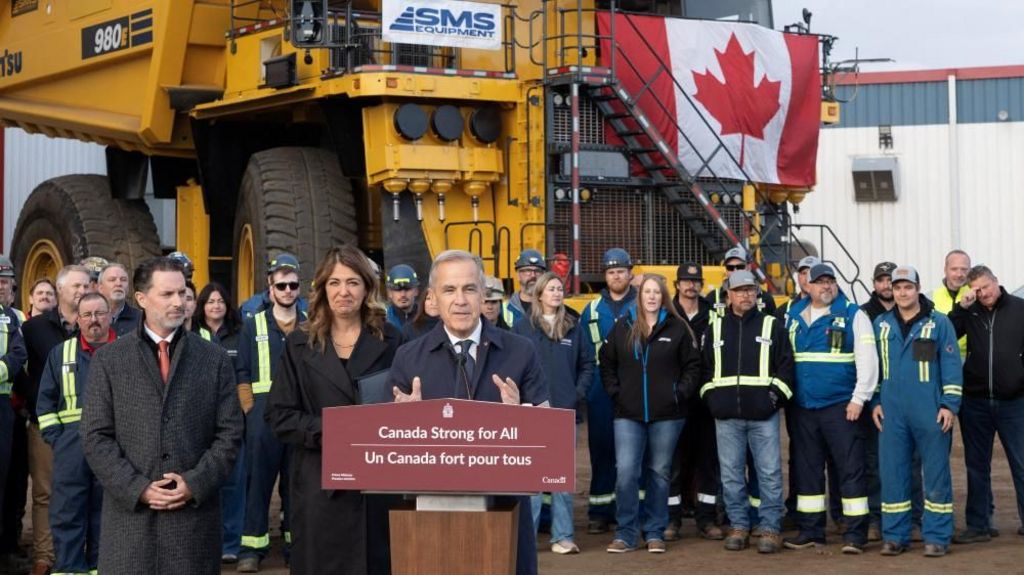
Canadian Prime Minister Mark Carney has launched an ambitious push to reshape the nation’s energy economy, announcing Thursday that the 1,250-kilometer Pacific Link oil pipeline project will receive expedited federal approval and regulatory review under new government rules designed to cut through historic project delays.
Carney framed the infrastructure initiative, which will run from Alberta’s oil-producing heartland to a new deep-water port on British Columbia’s Pacific coast, as a core national priority to break Canada’s overreliance on the United States as its sole major crude export market, a dynamic he called an avoidable economic vulnerability amid rising U.S. protectionism under the second Trump administration. Last year alone, 90% of Canada’s crude oil exports crossed the southern border to the U.S., a concentration the government aims to reduce to between 65% and 70% once Pacific Link is operational.
“A pipeline to the west coast is part of our mission to transform our economy, to double our non-U.S. exports over the next decade,” Carney told reporters during a visit to Fort McMurray, Alberta. Beyond expanding market access, Carney said the project is a critical test of Ottawa’s commitment to delivering large-scale infrastructure for global investors, a promise he has made as part of a broader goal to establish Canada as a leading global energy superpower.
When completed, the pipeline will transport roughly one million barrels of Alberta crude daily to the new Pacific coast terminal, which will include purpose-built marine berths capable of accommodating supertankers carrying up to two million barrels of oil. From the British Columbia port, cargoes will be shipped directly to fast-growing Asia-Pacific markets, including China, Japan, and South Korea, opening new revenue streams for Canadian energy producers that have long been cut off from these markets by limited export infrastructure.
Economic projections from the federal government estimate the project will add up to C$30 billion ($21 billion) annually to Canada’s gross domestic product and create 140,000 jobs across construction and operations. The total capital cost of the project is currently estimated between C$35.2 billion and C$43.7 billion, and government officials told reporters on Thursday that successful execution of the fast-track process is expected to draw additional private sector interest from global investors.
Pacific Link is the first major project to benefit from a 2025 law passed by Carney’s Liberal government that mandates federal regulators deliver a final approval or rejection decision within 12 months, a major reform designed to address Canada’s history of costly, multi-year regulatory delays that have sunk multiple major pipeline projects over the past two decades.
Beyond economic strategy, the project is also a direct effort to address longstanding grievances in Alberta, where voters will head to the polls later this month for a contentious independence referendum. Carney called the pipeline “a demonstration of the power of Canada” when asked about his message to Albertans, who have long argued that federal policies have blocked their ability to develop and profit from their natural resource wealth.
As with all major Canadian pipeline projects, Pacific Link is expected to face significant pushback from two key groups: environmental organizations, which have raised alarms about the project’s impact on coastal marine ecosystems and contribution to global greenhouse gas emissions, and Indigenous communities whose traditional territories lie along the pipeline route. Carney countered that Ottawa has already held preliminary discussions with affected Indigenous groups and will launch intensive additional consultations in the coming months, while also noting structural concessions designed to win buy-in: a minimum 10% ownership stake in the project will be offered exclusively to Indigenous communities for purchase.
To address environmental concerns, the governments of Canada and Alberta have paired the pipeline approval with major climate commitments. Alberta has agreed to develop what will be the world’s largest carbon capture and storage program to cut emissions from oil production, while Ottawa has increased funding for ocean protection and implemented new strict rules to safeguard marine life affected by increased tanker traffic, particularly the endangered Southern Resident killer whale population that inhabits British Columbia’s coastal waters.
Currently, both the federal government and the government of Alberta back the project, with Calgary-based Pembina Pipeline Corporation already signed on as a private partner. Pembina holds a non-binding agreement for a 10% stake during construction and retains an option to acquire an additional 10% stake once the pipeline enters operation. If the project receives final approval, construction is on track to begin by 2032.