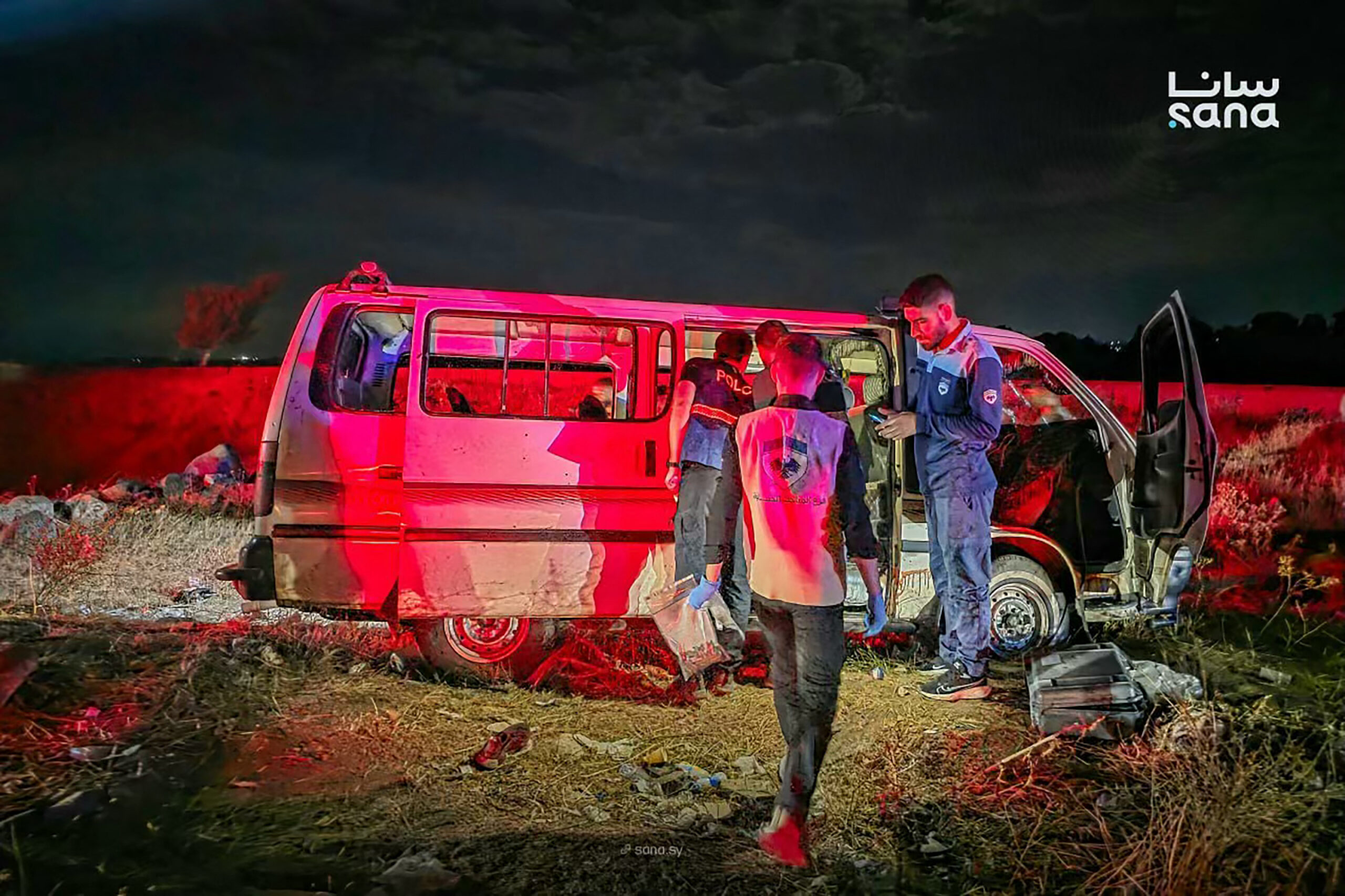
On a Wednesday evening, Syria faced a trio of interconnected security crises that have reignited fears of widespread instability across the country, just months after the collapse of Bashar al-Assad’s government in December 2024. The first and deadliest incident was a targeted ambush on a civilian bus traveling through the western countryside of Homs province, which left at least seven private sector employees dead and four more with severe injuries.
According to local health authorities, the bus was carrying workers back to their homes after the end of their work shift when gunmen opened fire on the vehicle as it crossed the Masyaf Bridge. Maan Mahmoud Fahd, the director of Homs Grand Hospital, confirmed to Syria’s official state news agency Sana that four of the seven fatalities were pronounced dead immediately upon their arrival at the medical facility, having suffered catastrophic gunshot wounds to the head and torso. The remaining casualties were transferred to other medical centers across the Homs governorate for urgent treatment.
Moments after reports of the shooting emerged, Syrian security units were deployed to the attack site to cordon off the area and launch a full criminal investigation. Brigadier General Bassem Mohammad Shaaban, commander of Homs Internal Security Forces, told reporters that forensic investigators have begun collecting physical evidence to track down the perpetrators and uncover their motive for the attack. As of the latest updates, no militant or opposition group has claimed responsibility for the shooting, and no suspects have been publicly named by authorities.
Shaaban issued a firm promise that the attackers would face justice, stressing that the brutal act would not go unpunished. “We view this cowardly attack as an attempt to undermine security in Homs and destabilise the stability we have worked to consolidate,” he said. “We will not allow criminals to threaten the security of our people or undermine the stability the city is experiencing.”
Brigadier General Munir al-Hariri, a veteran Syrian military analyst, told local broadcaster Syria TV that the attack most likely bears the hallmarks of operations carried out by former Assad regime loyalists, who have carried out a string of small-scale attacks across the country to undermine the new government’s efforts to restore order. Wednesday’s bus shooting is part of a growing wave of security incidents that have raised alarm across Syria since the transition of power last December. In August alone, two separate attacks targeting buses near the capital Damascus left 14 people injured: one targeted a convoy of internal security personnel, while the second was a hidden explosive device detonated on a public passenger bus in Jaramana, a town southeast of the capital.
Simultaneously to the Homs shooting, a major explosion hit a key gas pressure-reduction station at the entrance of the Tishreen thermal power plant, located roughly 36 kilometers outside Damascus in the Damascus countryside. The blast sparked a massive blaze that injured two plant workers and severely damaged the two main gas pipelines supplying the facility, according to the Syrian Petroleum Company.
The loss of gas input forced three major power plants – Tishreen, Deir Ali, and Nasiriyah – to shut down all operations immediately. The Syrian Electricity Company issued a public warning that the shutdown would lead to extended scheduled rolling blackouts across affected regions. Abdul Hamid Salat, head of the media department at Syria’s energy ministry, added that the cut in gas supplies also disrupted operations at critical water pumping and treatment facilities, leaving hundreds of thousands of residents across Damascus, its surrounding countryside, Daraa, Sweida, and Quneitra without consistent access to clean running water.
Energy Minister Mohammad al-Bashir confirmed that civil defence teams managed to bring the large fire under control overnight Wednesday. Speaking to reporters from the blast site, al-Bashir said technical specialists would conduct a full inspection of the facility once cooling operations are complete to “precisely determine the causes and circumstances” of the explosion. Authorities have not yet ruled out any potential causes, including accidental technical failure, deliberate sabotage, or a targeted attack.
The third incident unfolded on Thursday morning in southern Syria’s Quneitra governorate, when approximately 12 Israeli military vehicles entered the village of Saida al-Golan as local students were traveling to their schools. After a short presence in the area, Israeli forces withdrew back to positions in the Yarmouk Basin, and no reports have emerged of arrests, home searches, or additional casualties from the incursion. This incursion follows a pattern of increased Israeli military activity in southern Syria in recent weeks: on Tuesday, Syrian state media reported that Israeli troops carried out incursions into Quneitra, where they questioned and physically assaulted local shepherds.
Local news outlet Al-Araby News also reported Thursday that an assassination attempt was carried out against a Syrian Ministry of Defence officer in Sanamen, a city located north of Daraa, though no further details on the officer’s condition or the perpetrators have been released.
These concurrent crises come just days after Syrian President Ahmed al-Sharaa revealed that ongoing negotiations with Israel over a new cross-border security framework had reached roughly 90 percent completion before Israel pulled back from the deal and introduced new, unagreed-upon conditions. Speaking at an Atlantic Council policy panel in New York last week, al-Sharaa noted that multiple rounds of negotiations had been held over the past year with diplomatic mediation from the United States, and that talks would continue moving forward.
The string of back-to-back security incidents highlights the significant challenges the new Syrian government faces as it attempts to consolidate control, rein in armed factions, and restore basic public services across the country after decades of civil conflict and the recent collapse of the previous regime.