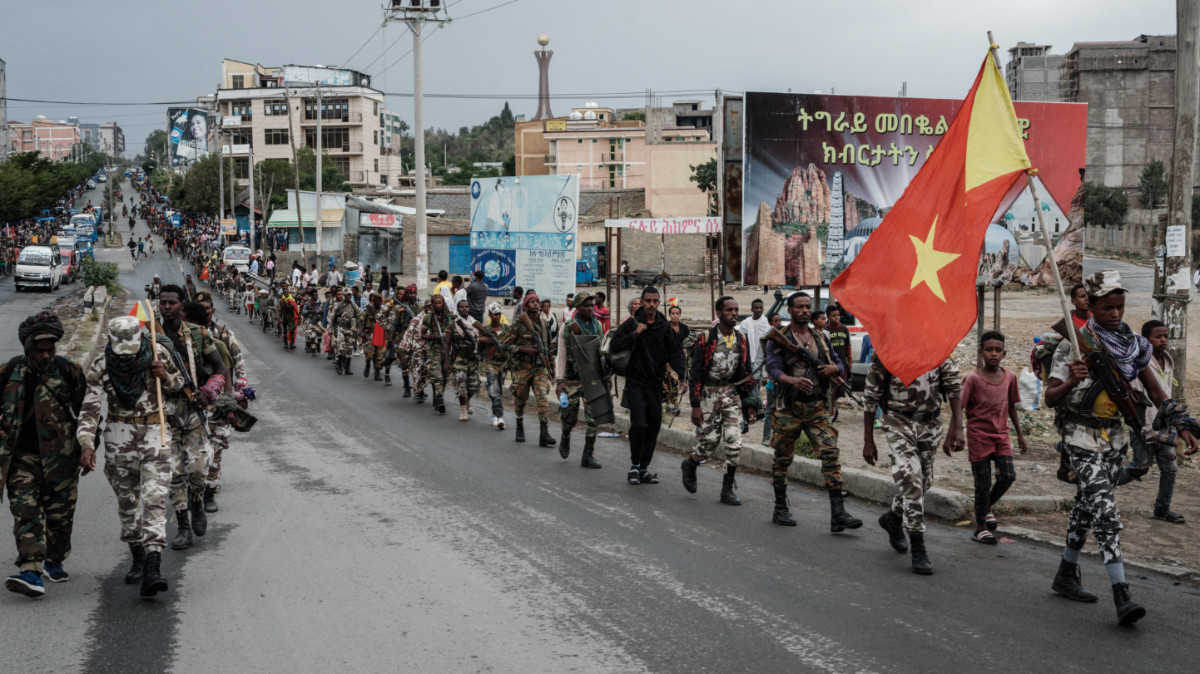
A decades-long rivalry between Eritrea and Ethiopia has boiled over into a full breakdown of diplomatic relations, triggering grave concerns that a new conflict could ignite across the already volatile Red Sea region, drawing in multiple global and regional powers. The crisis erupted after an alleged drone strike targeted Ethiopian military headquarters in the capital Addis Ababa earlier this week, ending a period of relative calm in the city amid Prime Minister Abiy Ahmed’s ongoing fight against a coalition of rebel movements across the country’s Tigray, Amhara, and Afar regions.
Following the explosion at the Ethiopian National Defence Force headquarters in Addis Ababa’s Tor Hayloch neighborhood, Western and regional officials confirmed to Middle East Eye that the strike was carried out by a drone. Ethiopian authorities quickly pinned blame on Asmara, accusing Eritrea of carrying out “direct and indirect acts of hostility and belligerence” in a formal government statement. In response, Addis Ababa announced the expulsion of 10 Eritrean diplomats and the permanent closure of its embassy in Asmara, Eritrea’s capital.
Eritrean officials rejected Ethiopia’s accusations and reciprocated by cutting all diplomatic ties with Addis Ababa. In a statement from Eritrea’s Ministry of Foreign Affairs, officials accused Ethiopia of fueling internal unrest in Eritrea by arming, training, and hosting anti-government armed opposition groups with the explicit goal of forcing regime change in Asmara. “Ethiopia has pursued an agenda of incessant hostility” against Eritrea, the statement read.
This diplomatic rupture caps months of steadily deteriorating relations between the two neighboring countries, a turnabout that surprised many observers after their unexpected alignment during Ethiopia’s 2020–2022 civil war against the Tigray People’s Liberation Front (TPLF), the former ruling party of Ethiopia’s Tigray region. In the years since that conflict concluded, the old rivalry between the two states reemerged with renewed intensity. Ethiopia has laid claim to parts of Eritrea’s Red Sea coastline, and has repeatedly accused Asmara of covertly supporting the TPLF – a charge Eritrean officials have consistently denied.
In an exclusive interview with Middle East Eye last month from Asmara, Eritrean Foreign Minister Osman Saleh framed Ethiopia’s territorial ambitions in stark terms, comparing Abiy Ahmed’s expansionist vision to Israel’s regional strategy. “[Abiy Ahmed] has a two-waters strategy like Israel. Only for him it is from the Nile River to the Red Sea,” Saleh said, drawing a parallel to Israel’s longstanding territorial vision stretching from the Gaza Strip to the Jordan River along the occupied West Bank frontier.
The breakdown of diplomatic ties comes at an already precarious moment for the Horn of Africa and Red Sea region, with active conflicts already underway in Yemen and Sudan. Analysts and regional diplomats warn that the standoff between Eritrea and Ethiopia could easily widen into a larger conflict that draws in multiple outside powers, which are already aligned with different actors in the region’s existing disputes.
The complex web of alliances raises the risk of escalation. The TPLF, which remains in open rebellion against Abiy Ahmed’s federal government, is already aligned with the Sudanese Armed Forces (SAF), which is currently fighting Sudan’s Rapid Support Forces (RSF) militia. The RSF, which has been accused of genocide in Sudan, is backed by the United Arab Emirates and maintains training facilities inside Ethiopia. Eritrea, for its part, is aligned with Egypt and Saudi Arabia in their support for the SAF.
Ethiopia’s Prime Minister Abiy Ahmed counts the UAE as one of his strongest international backers; the Gulf state has supplied Abiy’s forces with drones and other critical military equipment. Saleh also noted in his interview that Eritrea believes the UAE is cooperating with Israel against Asmara. This aligns with a long history of Israeli support for Ethiopia: dating back to the late 1970s and 1980s, Israel supplied arms to Ethiopia’s Marxist Derg government, which were used to wage war against Eritrean independence fighters.