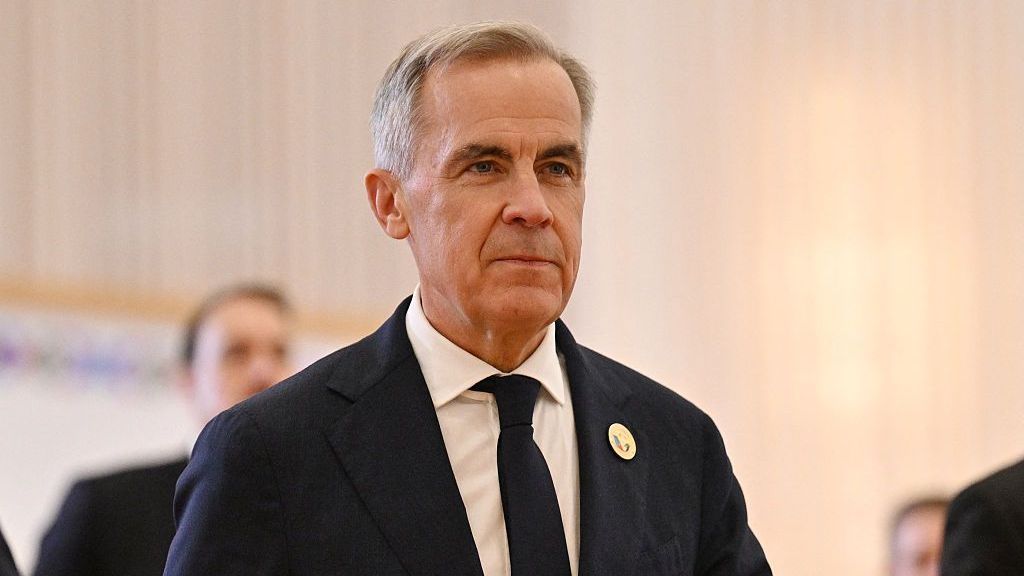
Canada’s long-stable automotive manufacturing ecosystem, a cornerstone of the country’s industrial identity forged over decades of integrated North American free trade, now faces an existential crisis in the wake of the 25% import tariffs on non-U.S. vehicles imposed by U.S. President Donald Trump 18 months ago. With 90% of all vehicles assembled in Canada historically bound for U.S. consumers, the punitive trade measures have triggered cascading factory shutdowns, mass layoffs, and widespread uncertainty about the sector’s long-term viability, forcing Prime Minister Mark Carney’s administration to pursue unorthodox, high-stakes diplomatic and trade solutions as he travels to China for the 2024 Asia-Pacific Economic Cooperation (APEC) summit.
During a stopover in Cambodia earlier this week ahead of his arrival in Beijing, Carney addressed traveling reporters, framing Canada’s robust automotive workforce, existing industrial infrastructure, and large domestic consumer market as underutilized assets that could form the foundation of new partnerships beyond traditional North American supply chains if ongoing trade negotiations with the U.S. fail to deliver relief. “Canada’s going to move forward either way,” he emphasized, noting that European and Asian automakers represent viable alternative pathways to preserve high-value manufacturing jobs for Canadian workers.
His Tuesday bilateral meeting with Chinese President Xi Jinping — the second face-to-face encounter between the two leaders in less than 12 months — yielded a public commitment to deepen bilateral trade ties and pursue additional mutual tariff reductions, even as neither leader explicitly referenced automotive sector cooperation in official post-meeting statements. Independent trade analysts widely agree that expanding access for Chinese electric vehicle (EV) manufacturers to Canadian markets was a core priority of closed-door discussions, building on policy signals Carney first laid out in January, when he floated that targeted openings for Chinese EV firms could drive new investment in Canadian domestic automotive companies and create thousands of new green manufacturing roles.
Recent policy moves have already signaled a clear break from U.S. trade posture toward Chinese EVs, which the Biden administration first subjected to steep punitive tariffs to shield its domestic industry. Ottawa recently introduced a quota framework that will allow 49,000 Chinese EVs to enter the Canadian market at preferential low tariff rates, with planned gradual annual increases to 70,000 units by 2030. Leading Chinese EV manufacturers including BYD and Chery have already launched formal advocacy campaigns to secure expanded market access, and Canada’s Minister of International Trade Maninder Sidhu toured Chery’s domestic production facilities earlier this month, confirming to reporters that affordable Chinese EV models will be available for Canadian consumers as early as 2027.
The urgency of these efforts has been amplified by recent high-profile industry setbacks, most notably U.S. automaker Stellantis’ decision to permanently shutter its Brampton, Ontario assembly plant, a facility that had been idled for a planned 2023 retooling before Trump’s tariffs made the planned upgrade economically unviable. The company, which previously assembled iconic models including the Dodge Challenger and Chrysler 300 at the site, is shifting a portion of that production to Illinois in the U.S. and selling a majority stake in the Brampton facility to Canadian armored vehicle manufacturer Roshel. Carney publicly condemned the move as a “betrayal” of the plant’s 2,200 unionized workers, while Canada’s national auto workers union decried the deal as “underhanded” and warned it could precipitate the loss of tens of thousands of high-paying industrial jobs across the province. Unconfirmed reporting from Canadian outlet CTV News, citing anonymous industry sources, has fueled widespread speculation that Stellantis may lease back 25% of the Brampton facility’s floor space to a Chinese EV maker for low-cost affordable vehicle assembly.
The proposed pivot to Chinese automotive partnerships has ignited fierce domestic and cross-border pushback. Ontario Premier Doug Ford sent a formal letter to Carney voicing staunch opposition to any plan that would allow Chinese firms to import semi-knocked-down vehicle kits for assembly at the Brampton site, a common global manufacturing practice for Chinese automakers that operate most full production lines domestically. University of Toronto China Governance Lab director Lynette Ong noted the proposal carries significant inherent risks, from potential erosion of domestic automotive job quality to gaps in industrial technology security and foreign interference vulnerabilities, emphasizing that any approved venture must enforce strict local hiring, worker training, and Canadian-made parts content requirements.
The policy shift has also drawn sharp rebukes from close allies of the Trump administration. Peter Navarro, Trump’s senior trade and manufacturing policy counsel, published a public post on the X social media platform excoriating Carney for attempting to “play China off the U.S.,” describing the move as “offensive in the extreme” and warning that unregulated Chinese automotive investment would allow Chinese firms to “eat Canada alive.” U.S. Ambassador to Canada Pete Hoekstra subsequently shared Navarro’s critical statement to amplify the U.S. administration’s disapproval.
Despite these headwinds, recent public opinion polling from Angus Reid, released the same day as Carney’s meeting with Xi, shows Canadian public sentiment toward China has grown measurably more favorable since Trump returned to the White House, with a majority of respondents expressing openness to Chinese EV sector investment provided it is paired with clear national security safeguards and regulatory guardrails. The Carney government has already outlined strict preconditions for any Chinese automotive joint venture, including mandatory shared Canadian ownership, full compliance with national labour standards, and minimum thresholds for locally sourced Canadian auto parts. Carney has also emphasized that existing national security restrictions remain fully in place for sensitive sectors including artificial intelligence and critical minerals development, which are entirely off-limits for expanded Chinese partnership.
Parallel to its China outreach, Ottawa is also pursuing diversified trade alliances to de-risk its automotive sector, including a bid to secure associate membership status with the European Union’s single market and a recently signed comprehensive free trade agreement with the Philippines. While Carney has confirmed incremental progress in ongoing U.S.-Canada trade negotiations, significant unresolved structural differences remain, and it is still unconfirmed whether Carney and Trump will hold a bilateral meeting on the sidelines of the upcoming APEC summit.