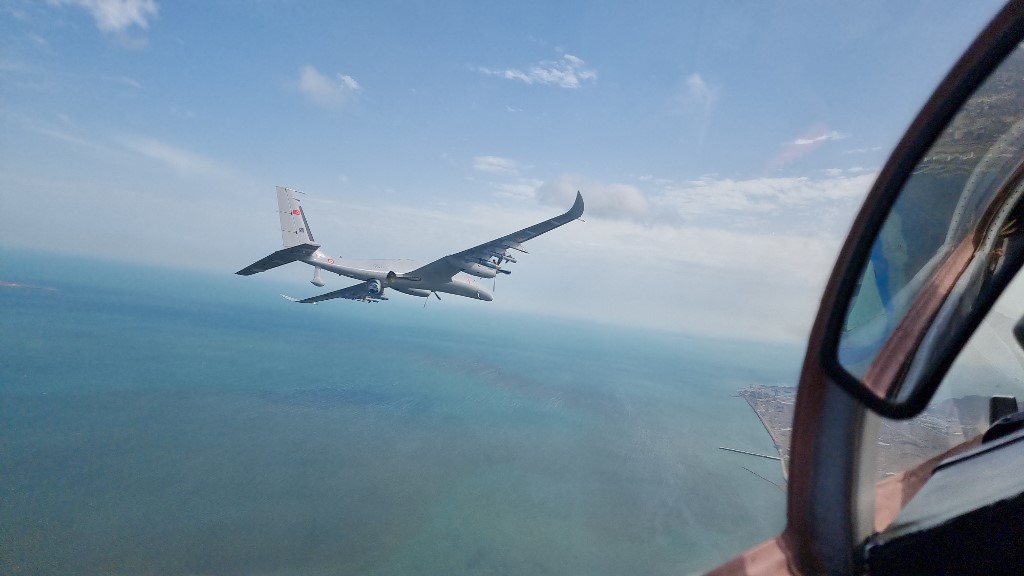
Seven years ago, Canada triggered a major shakeup in Turkey’s defense manufacturing sector when it imposed a full arms sales ban on the country, a response to Ankara’s cross-border military incursion into northern Syria. Two of Turkey’s most prominent drone developers, industry leaders Baykar and Turkish Aerospace Industries (TAI), bore the brunt of the trade restriction, as both firms relied entirely on specialized electro-optical (EO) and infrared (IR) surveillance cameras built by Canadian defense manufacturer Wescam for their unmanned aerial vehicles.
Cut off from their primary supply source, Turkish defense contractors were forced to rapidly pivot, launching aggressive campaigns to source alternative components from both global and domestic producers. Today, that forced self-sufficiency has paid off: Turkey now boasts a robust cohort of local manufacturers capable of producing the same high-end EO/IR cameras once imported exclusively from Canada.
Now, in a striking reversal of policy, the same Western nation that cut off Turkey’s drone component supply is now in preliminary discussions to purchase Turkish-made military drones, multiple insiders have confirmed to Middle East Eye. An anonymous official familiar with the negotiations noted that Canada is specifically seeking medium-altitude, long-endurance (MALE) drones to boost its national surveillance capabilities.
While the source emphasized that talks remain in their earliest stages and may never result in a finalized deal, the shift in diplomatic and policy tone under Canadian Prime Minister Mark Carney is impossible to miss. Middle East Eye has reached out to the Canadian embassy in Ankara for official comment on the negotiations, with no response issued as of publication.
The policy shift was echoed publicly by senior Canadian officials in recent weeks. During a panel discussion held in Istanbul last week, Canadian Secretary of State for Defence Procurement Stephen Fuhr announced that Ottawa was eager to expand bilateral defense collaboration with Turkey in sectors where Ankara has built globally recognized competitive advantages. In a subsequent interview with Defense News, Fuhr specifically named drone technology, counter-drone systems, and ammunition production as priority areas for new partnership.
Fuhr added that Canada is open to structured co-development projects rather than simple off-the-shelf purchases, a model that would allow Canada to accelerate its defense capability growth without investing years of time and billions of dollars in building a domestic drone program from the ground up.
Ankara has a long track record of embracing this collaborative framework: Turkish defense firms have already established similar localized co-production drone partnerships with the United Arab Emirates, Saudi Arabia, and Ukraine in recent years.
One official familiar with Canada’s strategic calculations told Middle East Eye that the shift can be traced back to shifting reliance on U.S. defense cooperation, with the change in posture indirectly tied to former U.S. President Donald Trump’s reshaping of transatlantic security arrangements. The official noted that Carney’s government no longer has full confidence in the long-term security guarantee provided by Washington, pushing Ottawa to diversify its defense supply chains. “Canadians don’t want to rely on American weapons anymore; they would like to diversify,” the source explained.
Fuhr echoed this sentiment during his Istanbul appearance, noting that the United States, Canada’s southern neighbor, has moved away from the long-standing defense trade norms that Ottawa relied on for decades. That shift has forced Canada to speed up efforts to strengthen its own independent defense capabilities, he added. Currently, Ottawa is already rolling out billions in new defense spending to meet NATO’s requirement that member states allocate 2% of annual GDP to defense. It also recently announced plans to launch a national drone innovation hub at the country’s National Research Council, backed by a $105 million investment over three years.
Diplomatic momentum for deeper bilateral defense ties is building quickly. Carney is already scheduled to travel to Turkey for the NATO summit set to take place in Ankara this July, but multiple officials confirmed that the prime minister is also planning a standalone formal bilateral visit to the country in October. During that October visit, multiple defense cooperation initiatives are expected to be officially launched, including the drone development and procurement projects currently under discussion.
“You will see our prime minister coming here a couple of times in the near future to demonstrate how interested we are and how committed we are to working more bilaterally with Turkey moving forward,” Fuhr told the Istanbul panel.
Fuhr also outlined the core urgency driving Canada’s push for rapid collaboration: the growing mismatch between shrinking defense technology cycles and the slow pace of traditional domestic procurement. “One of the military’s biggest frustrations with the defence industry was how long it takes to develop new capabilities, especially as technology cycles continue to shrink while procurement cycles grow longer,” he said. “You end up with something that is slow and irrelevant. So we are very motivated to move quickly, and I see signs that our partners are working quickly as well, and I’m seeing tangible results from that.”