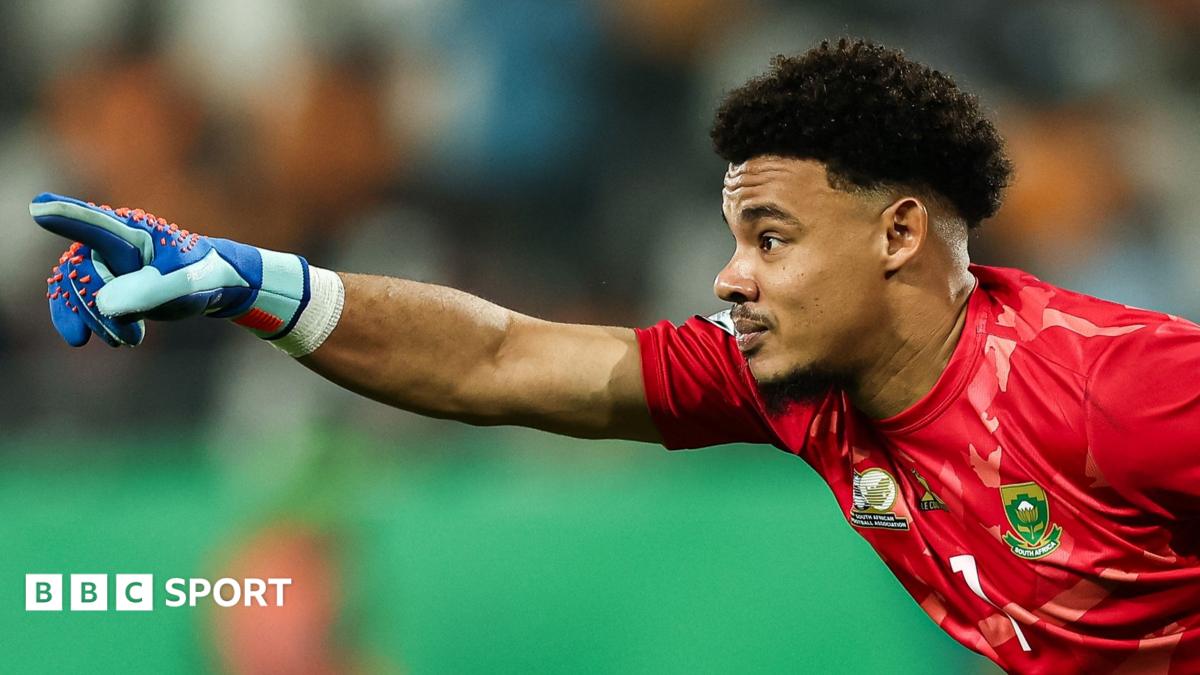
Football has long served up moments of poetic, unexpected coincidence, and for South Africa national team captain Ronwen Williams, the 2026 FIFA World Cup will deliver one of the most remarkable such occasions. When Bafana Bafana steps onto the pitch for the tournament’s opening match against co-hosts Mexico in Mexico City’s iconic Estadio Azteca, it will mirror the opening fixture of the 2010 World Cup – the tournament that marked South Africa’s historic first time hosting football’s biggest global event.
For Williams, this opening match carries far more personal weight than just a poetic callback to 2010. Just two months before the 2010 World Cup kicked off on home soil, the 18-year-old emerging goalkeeper lost his older brother Marvin in a devastating car crash. Grief-stricken, Williams briefly considered walking away from the sport he loved entirely. Now, 16 years later, that choice to stay in the game has led him to this unprecedented moment: leading his country out as captain in the opening match of the world’s most-watched sporting tournament.
In an interview with BBC World Service’s Newsday, Williams opened up about the overwhelming emotion of the opportunity. “He had so much high hopes for me,” Williams said of his brother. “To know I’ll be leading out my team in the opening game, I can’t put it into words. It gives me chills. Sometimes I find myself just laying at night thinking about it. I always say the two most important games at the World Cup are the opening and the final, and Bafana Bafana is going to be part of one.”
While the loss of his brother left a permanent gap, Williams has been surrounded by unwavering family support throughout his rise. He recalled the intimate family celebration after Belgian head coach Hugo Broos named him captain shortly after taking the role in 2021, saying the joy and pride his family felt then has only multiplied exponentially ahead of the 2026 tournament. Broos, a 74-year-old veteran manager who won the 2017 Africa Cup of Nations with Cameroon, inherited a South African side in the doldrums when he took over. His first major decision was naming Williams skipper, and the pair have since orchestrated a remarkable turnaround for Bafana Bafana: a third-place finish at the 2023 Africa Cup of Nations, and a top spot in their 2026 World Cup qualifying group that booked South Africa’s fourth ever appearance at the tournament.
Williams credits Broos with rebuilding not just the team, but the nation’s belief in Bafana Bafana. “Broos has united the country after bringing belief and love back to the team and South Africa itself,” Williams explained. “Two, three years ago we were crying for supporters to come out and support us. And he mentioned that it goes hand in hand with performance, with results. When we started picking up the results, that’s when the belief came back. Now people can’t wait for Bafana Bafana to play. Buying our merch, sending us the well wishes. He’s been amazing, exceptional.”
Despite the momentum behind the team, Williams remains grounded as South Africa prepares for Group A play against Mexico, Czech Republic and South Korea. The team have never advanced past the group stage in their three previous World Cup appearances, even picking up four points in both the 2002 and 2010 tournaments. For the expanded 48-team 2026 tournament co-hosted by Canada, Mexico and the United States, just making it to the knockout round (the last 32) would mark a historic milestone for South African football. Williams says his team’s priority is clear: “I think we need to be realistic about our chances. The most important thing is to get out of the group. The mentality that we need to have is: can we compete? Can we show up? Can we perform?”
Williams, who also captains South African club side Mamelodi Sundowns to a recent CAF Champions League title, has built his reputation as a formidable penalty saving specialist – a skill that could prove critical if South Africa advances to a knockout round. At the 2023 Afcon, he delivered two legendary shootout performances: saving four out of five penalties against Cape Verde in the quarterfinals, then two more against DR Congo in the third-place playoff, cementing his team’s best continental finish since 2000. Those performances earned him the 2024 African Goalkeeper of the Year award and a surreal nomination for the prestigious Yashin Award at the Ballon d’Or ceremony.
Far from shying away from the pressure of penalty shootouts, Williams embraces the moment. “I enjoy it. There’s no pressure on the goalkeeper,” he said. “You analyse, you watch. When it comes to penalty shootouts, I try and pick up a lot of trends. Sometimes it goes with just the feeling that you have on the field. Penalties present a moment to shine.”
He cites 2022 World Cup champion Emiliano Martinez as a major influence, calling the Argentine goalkeeper a hero for his decisive shootout performance in the 2022 final. While Martinez’s gamesmanship drew criticism, Williams notes that goalkeepers have always had a different mindset than outfield players. “You have to be [a bit different],” he explained. “Diving at someone’s feet, saving a ball that’s coming, I don’t know at what speed, it’s not normal. You need to be a bit crazy. Most goalkeepers are the jokesters in the team.”
Williams also pushes back on the common football cliche that goalkeepers make poor captains, arguing that modern rules allow keepers to assign an on-field player to handle quick discussions with referees, eliminating the inefficiency critics point to. For Williams, captaincy is a role he was born for: he describes his leadership style as bringing “stability” to the squad, calling himself the “glue” that holds the team together – a role he has filled since he started playing in local leagues as a young boy. “I think that I was made for it. I cherish the captaincy, the responsibility that comes with it,” he said.
When Williams walks out onto the Estadio Azteca pitch in front of 73,000 fans for the 2026 World Cup opener, all eyes will be on the South African captain. It will be the culmination of 16 years of perseverance through grief, doubt, and hard work – and a chance to finally write the new chapter of South African football that Williams has spent his entire career working toward.