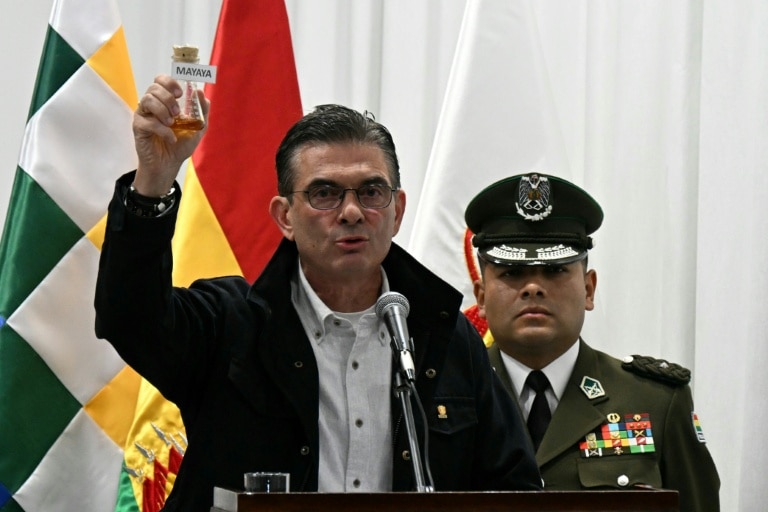
Weeks of mass anti-government demonstrations and widespread road blockades have pushed Bolivia to the brink of a total national standstill, leaving embattled conservative President Rodrigo Paz with dwindling patience and on the cusp of deploying military forces to crush the unrest. The ongoing disruption has sent food and fuel prices soaring, created acute shortages of essential goods across the country, and sparked violent clashes that have left multiple people injured on both sides. Riot police attempts to clear barricades with tear gas have been repelled by gunfire that wounded several officers, while Bolivia’s ombudsman’s office confirms at least 14 civilians have also been hurt in the unrest, during which protesters have thrown stones and burned tires to maintain their blockades. Demonstrators have two core demands: they want Paz’s newly formed administration to address the nation’s deep, ongoing economic crisis, and many are calling for the pro-business US-backed president to resign from office entirely. Speaking at a signing ceremony on Monday for a new emergency powers law, President Luis significantly ramped up his rhetoric against the movement, blaming so-called “narcoterrorists” for fomenting the chaos and warning that the dissidents’ “days are numbered.” The legislation, approved by Bolivia’s legislature on Sunday, clears the legal path for Paz to declare a national state of emergency that would formally authorize military deployment to clear blockades and suppress the protest movement. Paz has long implied that former left-wing president Evo Morales, the leader of Bolivia’s first Indigenous-led government and his political predecessor, alongside Morales’ base of coca-growing supporters, are behind the unrest in a plot to destabilize the country’s first conservative government in 20 years. “Our security is put at risk when narco‑terrorism, and the priorities of certain actors, are not aligned with our democracy, our constitution,” Paz stated during the ceremony. “They put their own interests above those of Bolivian society.” As the crisis drags on, a growing counter-movement has emerged among residents exhausted by the shortages and disruption. On Monday, hundreds of Bolivians marched through central La Paz waving white flags and chanting “Peace for La Paz,” calling for an immediate end to the paralyzing roadblocks. Ninoska Diaz, a market vendor who joined the counter-protest, told AFP that widespread deprivation has become unbearable for ordinary citizens: “We can no longer bear the hunger of the people, whose food baskets are empty.” In a post to social platform X on Sunday, Paz attempted to strike a more optimistic tone, acknowledging that the capital La Paz and the country’s second-largest city El Alto “are still facing difficult times, but concrete progress is also beginning to be made,” including improvements to disrupted fuel distribution networks. Paz, who took office in November on a promise to resolve Bolivia’s worst economic crisis in decades, has seen public anger surge over his unpopular austerity-focused economic reforms and his perceived failure to address urgent social needs. Morales, who has been in hiding to avoid prosecution on charges related to an alleged relationship with a minor that resulted in a child, has been directly accused by Paz’s administration of orchestrating the current unrest. International backing for Paz’s handling of the crisis arrived last Friday, when the new “Shield of the Americas” anti-cartel alliance, launched by former U.S. President Donald Trump and made up of pro-U.S. administrations across Latin America including Argentina, Chile and Bolivia, issued an unambiguous statement of support for the embattled Bolivian president.