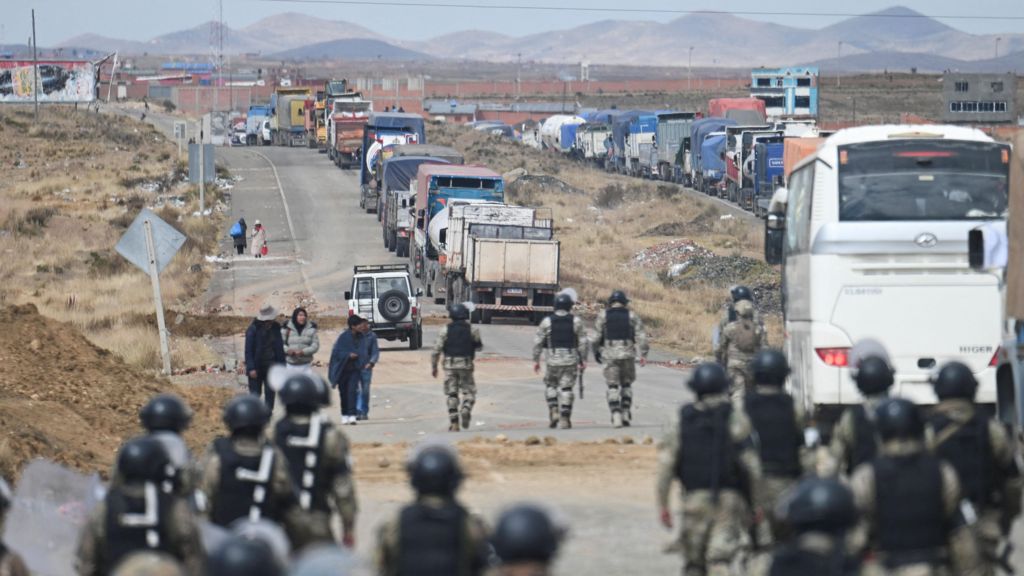
Bolivia has been plunged into escalating political unrest this week, as anti-government demonstrations led by allies of left-wing former president Evo Morales have targeted the six-month-old administration of center-right President Rodrigo Paz. Tensions boiled over on Saturday, when an official convoy led by Public Works Minister Mauricio Zamora was ambushed by protesters during a mission to clear blocked highways leading to the administrative capital La Paz and neighboring El Alto.
Local media reports confirm that Zamora’s vehicle was intercepted in the town of Copata, on a route south of La Paz, on Saturday afternoon, leaving the minister separated from his security detail and out of communication for a short period. According to Bolivia’s leading private news agency Agencia Noticias Fides, after the initial ambush the separated vehicle attempted to escape via an unpaved side road, only to face a second attack before ultimately rejoining the rest of the convoy. Zamora was later confirmed to be safe with no reported injuries.
Zamora was leading a state operation launched before dawn on Saturday to clear roadblocks erected by protesters and establish “humanitarian corridors” to restore the flow of essential food and medical supplies into the capital region. Security forces including police and military units were deployed from major urban centers, using heavy equipment like bulldozers to remove rocks and concrete barriers placed across key highways. However, the operation met fierce resistance from demonstrators, who responded with sustained violence across multiple flashpoints.
In addition to the attack on Zamora’s convoy, protesters launched coordinated attacks on state infrastructure across the country. On the main highway leading into El Alto, demonstrators looted and burned a customs checkpoint in Achicha Arriba, hours after police used tear gas to disperse crowds gathered there. Near Caracollo, located north of the department capital Oruro, a separate official convoy was hit with explosive devices. Local daily newspaper La Razon reported that protesters set fire to a military truck, burned a civilian minibus on the La Paz-Oruro highway, and ransacked a local police station. Multiple journalists covering the state clearance operation have also been targeted in attacks, according to several regional news outlets.
The current wave of unrest has been building all week, with mass marches, continuous road blockades, and repeated clashes between protesters and security forces across La Paz. The demonstrations are led by national trade unions and Morales supporters, who are demanding President Paz’s resignation. Two core grievances have driven the protests: widespread anger over Paz’s austerity economic policies, particularly his decision to eliminate long-standing national fuel subsidies that has pushed up living costs amid ongoing inflation and supply shortages, and opposition to the new administration’s pro-United States diplomatic alignment, which breaks with decades of left-wing foreign policy in Bolivia.
Paz, who was elected last year on a pledge to pull Bolivia out of its worst economic crisis in decades, has faced widespread public backlash since taking office six months ago. Former president Morales, who still commands broad support across much of rural and working-class Bolivia, has publicly backed the protests and amplified unconfirmed reports of protester deaths during the clearance operation. The government has denied Morales’ claim that one person was killed in the town of Vilaque on the La Paz-Oruro highway.
Morales is currently facing outstanding criminal charges relating to an alleged relationship with a minor during his time in office, and has been sheltering by his supporters amid attempts by the Paz administration to prosecute him. The current government accuses Morales of deliberately instigating the current unrest to undermine the new administration and regain political power.
In comments Saturday to Argentine news outlet Todo Noticias, President Paz said his government was open to pursuing all possible channels of dialogue to de-escalate the crisis, but added a firm warning: “Everything has a limit.” As of Saturday evening, roadblocks have been re-established in multiple locations where security forces had previously cleared routes, leaving the capital region still facing critical shortages of essential goods.