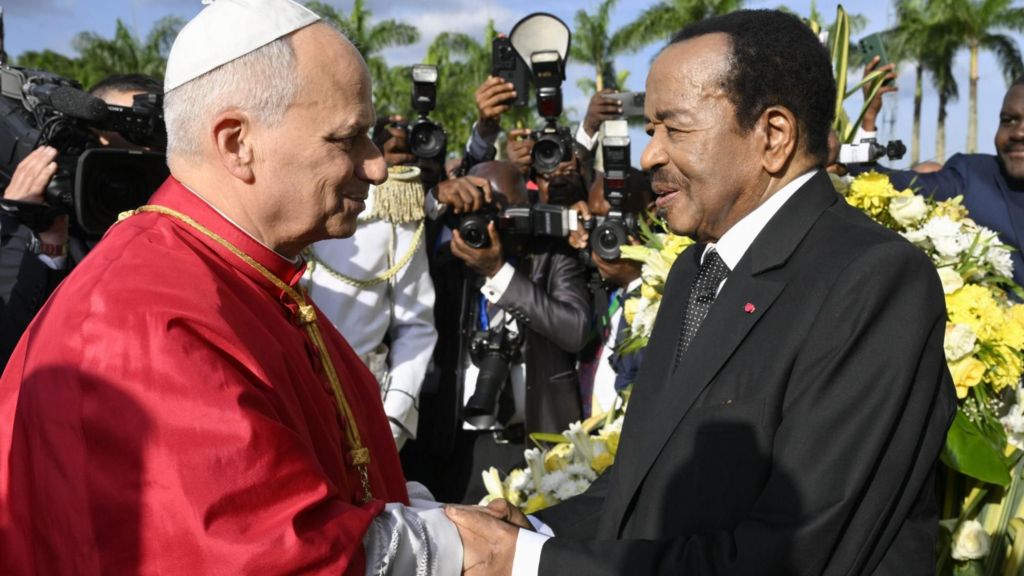
On the second stop of his landmark 11-day tour across Africa, Pope Leo XIV delivered a blunt, unflinching address to Cameroon’s leadership at Yaoundé’s presidential palace, calling on the government to dismantle systemic corruption as a foundational step toward lasting peace and justice. His remarks, delivered in the presence of 93-year-old President Paul Biya — the world’s oldest sitting head of state, who secured a contested eighth term in office last year — marked a rare public rebuke of an administration long dogged by allegations of graft, poor governance, and ineffective security management.
“In order for peace and justice to prevail, the chains of corruption – which disfigure authority and strip it of its credibility – must be broken,” the 70-year-old pontiff told the assembled crowd. He expanded on the theme, adding, “Hearts must be set free from an idolatrous thirst for profit.” According to reporting from the Associated Press, Cameroon’s state television cut its live broadcast of portions of the Pope’s speech, with no clarity on whether the interruption stemmed from technical issues or intentional editing. Biya sat through the entire address without visible reaction, multiple observers confirmed.
Following his meeting with Cameroon’s government, Pope Leo traveled north to Bamenda, the epicenter of a nearly decade-long separatist insurgency in Cameroon’s English-speaking North-West and South-West regions. The conflict, which erupted in 2017 when Anglophone separatists launched their push for an independent state, has killed at least 6,000 people and displaced hundreds of thousands more. Separatist leaders had pre-emptively declared a temporary “safe travel passage” to allow the papal visit to proceed, and throngs of excited local residents lined city streets to greet the pontiff upon his arrival.
During his remarks ahead of a planned peace Mass at Bamenda’s airport, Pope Leo waded into the long-running conflict, noting that while security must remain a priority for the state, it must always be exercised in full respect for fundamental human rights. The separatist movement grew out of decades of grievances over what the Anglophone minority describes as systemic marginalization by Cameroon’s French-speaking majority government.
Beyond his calls for anti-corruption action and peace, Pope Leo used his address to center marginalized groups in Cameroon’s future. He emphasized that young people represent the country’s greatest hope, arguing that investment in their education, professional training, and entrepreneurial ventures is critical to curbing brain drain and addressing deep-rooted social inequality. He also highlighted the underrecognized role of women, who are often disproportionately harmed by conflict and injustice but serve as persistent, unsung architects of peace, calling for their full inclusion in all national decision-making processes. Biya, who was re-elected in October, has made public promises to prioritize young people and women, and expectations remain high for a looming cabinet reshuffle to deliver on those pledges.
Local church leaders have framed the papal visit as a rare moment of hope for a region shattered by years of violence. “I can confidently say now is the time for peace,” Archbishop Andrew Nkea of Bamenda told worshippers ahead of the Mass, adding that the visit would bring comfort to thousands whose lives have been upended by the conflict.
This tour is the first papal visit to Africa under Pope Leo XIV, with peace as its overarching central theme. The pontiff launched his trip in Algeria, marking the first ever papal visit to the majority-Muslim North African nation — which is also the birthplace of St. Augustine, the theological figure whose teachings shape Pope Leo’s own spiritual background as the first pope from his religious order. During his two days in Algeria, the Pope visited Algiers’ Great Mosque, a moment he called a powerful demonstration that people of differing faiths and backgrounds can coexist peacefully. After wrapping up his time in Cameroon, Pope Leo will travel on to visit Angola and Equatorial Guinea to conclude the 11-day tour.